
CAS and Tsinghua Find 4-bit Quantization Works on Diffusion LLMs Like LLaDA
First systematic study of post-training quantization on diffusion LLMs shows 4-bit weights work, but W4A4 activation quantization still breaks math and code tasks.
 Pro
Takeaways
- First systematic study of post-training quantization on diffusion LLMs like LLaDA-8B and Dream-7B.
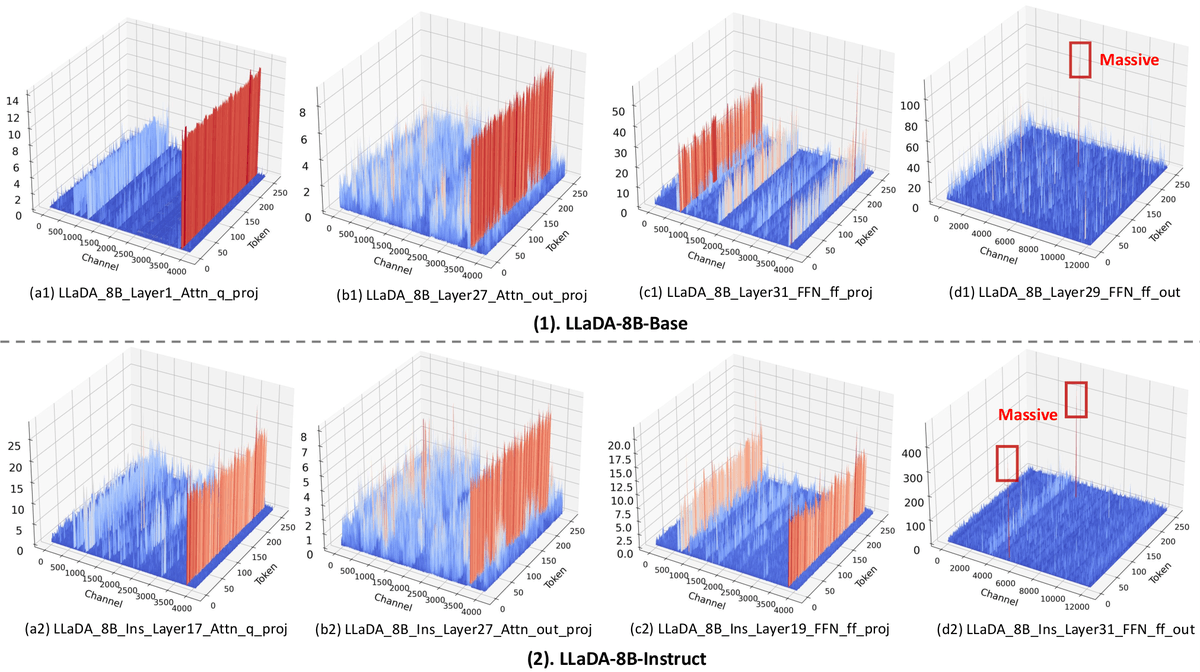
- Activation outliers exist in dLLMs, concentrated in the second FFN linear layer, and spread across more tokens than in autoregressive LLMs.
- 4-bit weight-only quantization with GPTQ is near-lossless; 3-bit causes significant drops on math and code.
- W8A8 works with almost any method; W4A4 collapses SmoothQuant but rotation-based DuQuant and QuaRot survive.
- Instruction-tuned models handle aggressive quantization far better than base models across every setting tested.
- Code released at github.com/FelixMessi/QDLM, though efficient low-bit kernels for dLLMs are still future work.
Diffusion-based language models like LLaDA and Dream have been picking up steam as an alternative to the autoregressive GPT-style paradigm, generating text through iterative denoising with bidirectional attention instead of left-to-right token prediction. But nobody had really checked whether the compression tricks that make Llama and Qwen deployable on consumer GPUs actually transfer to this new architecture. A new study from researchers at CAS, Tsinghua, CityU Hong Kong, CUHK and Zhejiang University fills that gap with the first systematic evaluation of post-training quantization on diffusion LLMs, and the results are a mixed bag.
Why compressing a diffusion LLM is not the same job
Diffusion LLMs use full attention and denoising-based decoding, but deploying them on edge devices is difficult because of their massive parameter scale and high resource demands. Post-training quantization, or PTQ, is the standard fix for that problem in the autoregressive world: shrink the weights (and optionally activations) from 16-bit floats down to 4 or 8-bit integers after training is done, no fine-tuning required. While PTQ has been widely adopted for autoregressive LLMs, its applicability to dLLMs has remained largely unexplored, and this work presents the first systematic study on quantizing them.
The first thing the authors looked for was activation outliers, the small number of unusually large values inside a network that make low-bit quantization painful because they blow up the dynamic range and force the majority of values into a handful of quantization bins. Their visualizations of LLaDA-8B-Base and LLaDA-8B-Instruct show two types: normal outliers with relatively large magnitudes across tokens, and massive outliers with extremely large values on a few tokens, with the massive outliers concentrated in the second linear layer of the feed-forward network module. The same pattern shows up in Dream-7B, which suggests this is architectural, not a quirk of one model.

One twist matters for practitioners: in dLLMs the massive outliers appear across more tokens than in a typical autoregressive model, rather than being concentrated in a few positions. That broader spread makes global scaling tricks less effective, which the results confirm.
What actually works
The team re-implemented five well-known PTQ methods on top of LLaDA-8B-Base, LLaDA-8B-Instruct, and Dream-7B: GPTQ and AWQ for weight-only quantization, plus SmoothQuant, QuaRot, and DuQuant for weight-plus-activation quantization. Evaluation covered general QA (MMLU, ARC, HellaSwag, PIQA, WinoGrande), math (GSM8K, MATH), and code (HumanEval, MBPP). The findings cluster into four practical takeaways:
- 4-bit weight-only is the sweet spot. GPTQ at W4A16 drops LLaDA-8B accuracy by only 0.3% on QA tasks, and actually nudges the instruct model up 0.3%. Pushing to 3-bit causes significant degradation, particularly on math and code.
- 8-bit weight-activation is nearly lossless, 4-bit is not. W8A8 loses under 1% for the instruct model regardless of method. W4A4 collapses SmoothQuant almost entirely, with a 97.4% drop on GSM8K for the base model.
- GPTQ beats AWQ on most tasks. The authors hypothesize AWQ's activation-driven salient-weight detection is weakened because outliers in LLaDA are less prominent than in traditional LLMs.
- Rotation-based methods rule W4A4. QuaRot and DuQuant hold up where SmoothQuant fails, with DuQuant edging out QuaRot across QA, math, and code.
Where quantization still breaks
Math and code are where the wheels come off. Under W4A4 on LLaDA-8B, even the best method (DuQuant) loses 13% on math averages and 18% on code averages. The authors attribute this to error accumulation across multi-step reasoning and the strict syntactic requirements of code generation, where one perturbed token can cascade. Instruction-tuned checkpoints hold up noticeably better than base models. For instance, under 3-bit GPTQ, LLaDA-8B-Instruct loses about 5% on math while the base model drops around 10%, suggesting instruction tuning produces representations that are inherently more quantization-friendly.
Grabbing the code
The implementation is on GitHub as QDLM. The repository, released alongside the arXiv paper, provides the first systematic study on quantizing dLLMs and implements state-of-the-art PTQ methods including GPTQ, AWQ, SmoothQuant, QuaRot, and DuQuant. Worth noting: the paper focuses on downstream accuracy rather than end-to-end inference speedups. The authors flag that adapting existing LLM-optimized kernels to the architectural quirks of diffusion decoding (block-wise denoising, remasking) is substantial engineering work they leave for later, so if you want real wall-clock gains you will still need to build the runtime yourself.