
Capital University Researcher Splits Giant AI Models Into Parallel Sub-Operators Without Retraining
A new theoretical framework shows that trained networks contain hidden block structures that let inference split into independent parallel sub-operators without touching model outputs.
 Pro
Takeaways
- New arXiv paper argues trained networks are already decomposable into independent parallel sub-operators without retraining.
- Uses the initialization distribution as a statistical null hypothesis to identify which weights actually learned anything.
- Two-stage test separates structural preference from random-walk noise, going beyond magnitude-based pruning.
- Permutes the annealed weight matrix into block-diagonal form, exposing sub-operators executable in parallel.
- Matrix-only decomposition algorithm has O(log n) critical path via Kleene-Valiant Boolean squaring on GPUs.
- Framework paper only, no code, no benchmarks, no validation on transformer-scale weight matrices yet.
A new arXiv paper argues that the way we run inference on large models, treating every parameter matrix as one giant dense operator, is throwing away a structural gift that training itself leaves behind. The work, from Jidong Jin at Capital University of Economics and Business, proposes that trained networks are already decomposable into independent sub-operators, and gives a matrix-only procedure to reveal them without retraining or changing model outputs.
The pitch is unusual because it does not propose a new architecture, a distillation method, or a pruning heuristic. Instead it treats the trained weight matrix as a statistical object and asks a simple question of every parameter: has learning actually done anything to you, or do you still look like your initialization?
The monolith problem
Current large-scale AI models typically perform inference by operating on the full parameter matrix as a single matrix operator, and as model size continues to grow, this paradigm leads to inference costs and system complexity that scale in an increasingly unsustainable manner. The author's framing is that this is not a capacity problem, it is a bookkeeping problem. The post-training inference system has long been treated as a structurally uniform operator, while the internal structural differences that emerge during learning have not been explicitly identified.
The empirical basis for that claim is well established in the pruning and interpretability literature. Under over-parameterized conditions, gradient updates exhibit strong locality and selectivity in parameter space, and as a result the parameter matrix obtained after training usually contains a large number of parameters that have not received sustained support from the training samples. Those parameters drift barely at all from their initial random values. The paper's move is to make that observation operational.

Initialization as a null hypothesis
The core trick is to reuse the initialization distribution as a statistical null. If a weight was drawn from, say, a zero-mean symmetric distribution at init, then after training you can ask whether its final value is a genuine sample from that same distribution or a significant departure. The paper wraps this in a Neyman-Pearson significance test with a chosen tail level x%. Weights that fall inside the tail region are treated as real structural edges. The rest are annealed to zero.
That alone is not enough, because a weight can drift from init without carrying any directional meaning. So a second test is layered on top: a random-walk hypothesis that normalizes each column and asks whether the outgoing influence of a node is statistically indistinguishable from a uniform 1/n allocation. This splits parameters into three buckets:
- Structural preference, meaning the learning process has actively strengthened this direction.
- Random-walk noise, meaning the parameter changed but carries no directional structure.
- Systematic suppression, meaning the learning process has actively pushed this direction down.
Only edges that pass both tests survive. Structural annealing is no longer equivalent to simple numerical pruning, but becomes a structural extraction process based on statistical decision criteria. This is the conceptual break from magnitude-based pruning, which cannot distinguish a small-but-directional weight from a small-random one.
From sparse matrix to parallel sub-operators
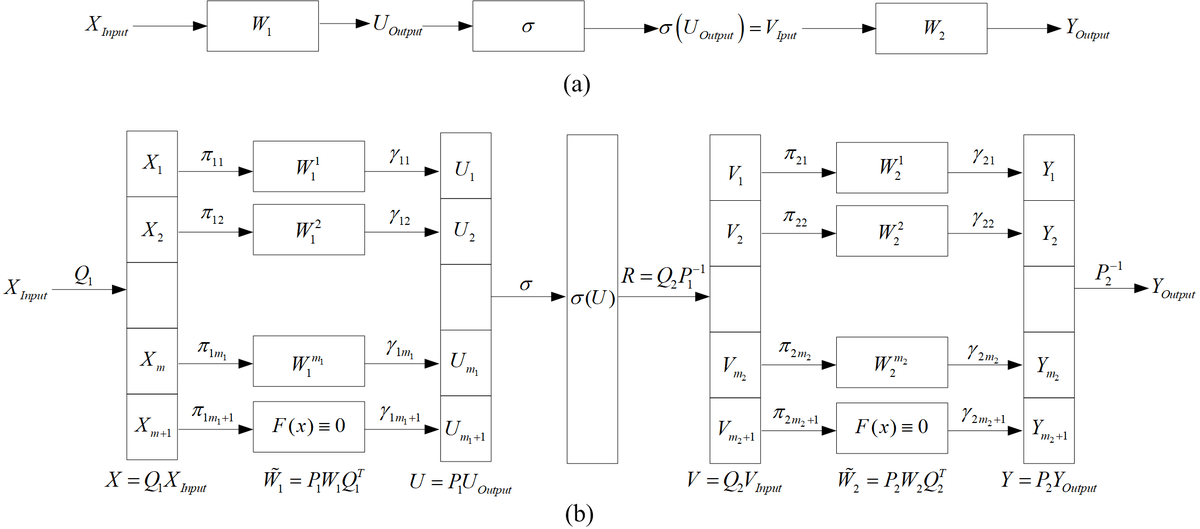
Once ineffective edges are removed, the weight matrix typically stops being irreducible. The paper then applies a permutation to expose a block-diagonal structure, where each diagonal block is an independent sub-operator, and within each block a further permutation yields a Frobenius (block-triangular) normal form that captures sequential dependencies among strongly connected components.
The reorganized inference pipeline is a five-stage pass with no numerical work outside the sub-operators themselves:
- Permute the input vector positions.
- Project the reordered vector into the input side of each sub-operator.
- Run each sub-operator
W^iin parallel. - Embed each sub-output back into the global output layout.
- Apply the inverse permutation to restore the original interface.
Permutations, projections, and embeddings are all bijections on finite index sets, so their cost is O(n) rather than the O(n^3) you would pay if you naively implemented them as permutation matrices. The result is that the wrapping logic is essentially free compared to the matrix multiplies it schedules.

The decomposition algorithm
Part II of the paper is a matrix-only algorithm to compute the block-diagonalizing permutations. It works on the Boolean adjacency matrix of the sparsified weight matrix and uses the Kleene-Valiant recursion to compute the transitive closure by repeated Boolean squaring. In the context of GPU-based matrix parallel computation its iteration dependency chain does not exceed O(log2 n). Traditional graph-search algorithms such as SCC decomposition based on DFS have a total workload of O(n+m) under the RAM model.
The point is not that the matrix approach has better total work, it does not, but that its critical path is logarithmic in n and it never needs to convert the weight tensor into an edge-list format, which is where GPU pipelines usually break down. For feed-forward layers the algorithm uses a co-source relation on the output nodes; for recurrent or feedback-carrying weights it identifies strongly connected components and layers them into a condensation DAG.
Where it fits, and where it does not
This is a framework paper, not a benchmark paper. There is no released code, no model checkpoint, no comparison against SparseGPT or lottery-ticket pruning, and no numbers on GPT-scale weights. What it offers is a principled way to think about post-training structural reorganization that is orthogonal to compression:
- Functional equivalence is preserved by construction, since permutations are exact.
- The input-output interface does not change, so the reorganized system is a drop-in replacement.
- If the resulting decomposition has k independent blocks, the paper argues compute and hardware requirements for that portion drop by roughly 1/k.
- The two-tier transform-and-inference service architecture it sketches allows each sub-operator to scale elastically according to its actual load.
The obvious limitations are the ones the paper does not address. There is no empirical validation on real transformers, no measurement of how much block structure actually emerges under realistic significance levels, and no accounting for what happens once you compose this with attention, layer norms, or residual streams that mix channels across layers. The random-walk test also assumes a symmetric zero-mean init, which is fine for classic MLPs but less obvious for the mixed initialization schemes used in modern foundation models.
Still, the conceptual contribution is worth chewing on. It reframes inference-time optimization as a question about which parts of the trained network are statistically real, and gives a clean algebraic apparatus for acting on the answer without ever perturbing model behavior. If it holds up on production-scale weight matrices, it would give a principled route to modular deployment and elastic scheduling that sits underneath, not on top of, the usual quantization and distillation stack.