
CANVAS Fixes AI Storyboards by Tracking Story Worlds Across Shots
A training-free multi-agent system that tracks characters, locations, and object states across shots lifts background continuity by 21.6 percent.
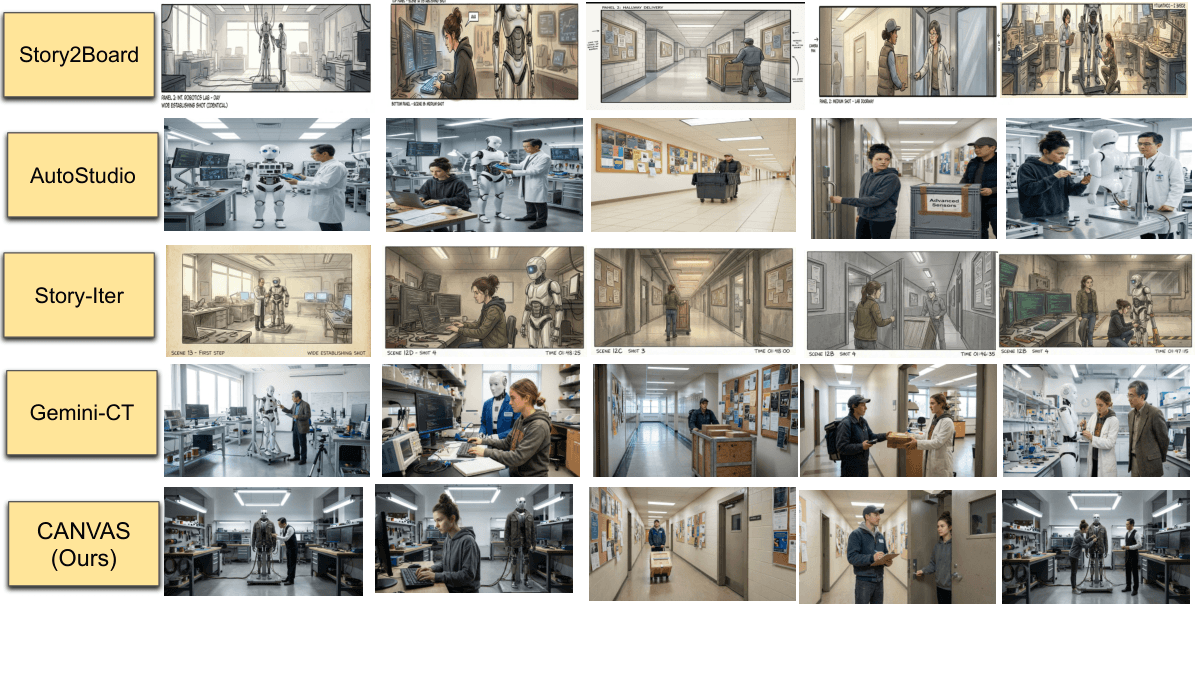
Takeaways
- CANVAS is a training-free multi-agent framework for continuity-aware multi-shot storyboard generation.
- Models storyboards as explicit world-state tracking of characters, locations, and object states over time.
- Three stages: global story planning, memory-guided retrieval, and VLM-based QA candidate selection.
- Beats baselines by 21.6% background, 9.6% character, and 7.6% props continuity on ContinuityEval.
- Introduces HardContinuityBench stress-testing long-range recurring locations, appearance changes, and occlusions.
- Evaluated on ViStoryBench-Lite and ST-Bench; no public code yet released.
Image generators can nail a single stunning frame, but string ten of them together into a story and things fall apart. The hero's jacket changes color, the coffee shop rearranges itself, and a stolen artifact reappears in its display case two shots later. A new framework called CANVAS tackles this by treating storyboard generation as an explicit world-state tracking problem rather than a sequence of isolated image generations.
The approach is training-free, wraps around existing image models, and improves background continuity by 21.6%, character consistency by 9.6%, and prop consistency by 7.6% over the strongest prior baseline.
Why storyboards break
Most story visualization systems generate each frame more or less independently, sometimes with short-range conditioning on the previous image. These methods enforce short-range consistency and do not explicitly model the evolving narrative world. Inconsistencies accumulate over time, producing familiar failure modes: character appearance drifts, environments shift when locations reappear, and objects end up in the wrong state after narrative events. The story world itself is never explicitly represented.
Think of the difference between an artist sketching each panel from scratch versus one who keeps a reference sheet pinned to the wall. In a coherent narrative, characters keep their identity unless the plot changes them, revisited rooms preserve their spatial layout, and objects follow causal state changes (a vase is intact, then broken, then swept away).

Storyboarding as world-state tracking
CANVAS reframes the problem by formulating storyboard generation as explicit world-state modeling, maintaining structured representations of characters, locations, and object states as the narrative evolves. The multi-agent framework enforces continuity through world-state transitions via iterative planning, generation, and memory updates.