
Campus Bio-Medico's Quantum-GRU Hybrid Beats Classical AI at ICU Vital Sign Forecasting
Researchers embed a quantum circuit inside a GRU to forecast ICU vitals, showing surprising noise robustness on a 53-patient dataset
 Pro
Takeaways
- What happened: Researchers proposed a hybrid GRU + Variational Quantum Circuit (VQC) model for forecasting ICU vital signs (HR, SpO2, pulse, RR) at 15, 30, and 60 seconds ahead.
- Key result: The model achieved 91.6% AvgWins across all task-horizon pairs, outperforming LSTM, PatchTST, TCN, and CNN-1D baselines on the BIDMC dataset.
- Standout finding: GRU+VQC showed significantly better robustness to input noise and missing sensor data compared to the classical GRU baseline.
- How it works: A GRU encodes the signal history; its output is projected into quantum rotation angles that parameterize the VQC, which mixes cross-variable features before a linear prediction head.
- Important caveat: The VQC runs on a classical noiseless simulator -- no real quantum hardware is used; this is an architectural inductive bias argument, not a quantum advantage claim.
- No code released alongside the paper; the BIDMC dataset is publicly available on PhysioNet for reproduction.
Predicting a patient's next vital sign reading before it changes is one of those problems that sounds deceptively simple but gets hard fast. Forecasting physiological signals can support proactive monitoring and timely clinical intervention by anticipating critical changes in patient status. The challenge is that clinical datasets are small, signals are noisy, sensors drop out, and the variables are tightly coupled -- heart rate, oxygen saturation, pulse rate, and respiratory rate all influence each other in ways a model needs to capture jointly. A new paper from researchers at Campus Bio-Medico University of Rome proposes an unusual fix: replace the mixing layer in a recurrent network with a quantum circuit.
A field searching for its first real win
Quantum machine learning (QML) is an emerging field combining quantum computing and artificial intelligence, with promising applications in medicine and healthcare, and research activity has seen a sharp increase in the last three years. But the track record is mixed at best. Of an initial 4,915 studies reviewed in one systematic survey, only 169 were eligible for inclusion -- and only 16 of those considered realistic operating conditions involving quantum hardware or noisy simulations. The honest summary from the field itself: quantum machine learning has attracted growing interest in healthcare applications, although the empirical evidence remains preliminary, with recurring limitations including weak benchmarking, limited evaluation under realistic operating conditions, and inconsistent superiority over classical approaches -- suggesting that QML components should be studied as structured inductive biases within hybrid pipelines and evaluated against strong classical baselines under realistic protocols.
That framing is exactly what this paper adopts. Rather than claiming quantum supremacy, the authors ask a narrower question: can a quantum layer act as a useful structural prior when data is scarce and inputs are unreliable?
The architecture: GRU meets quantum circuit
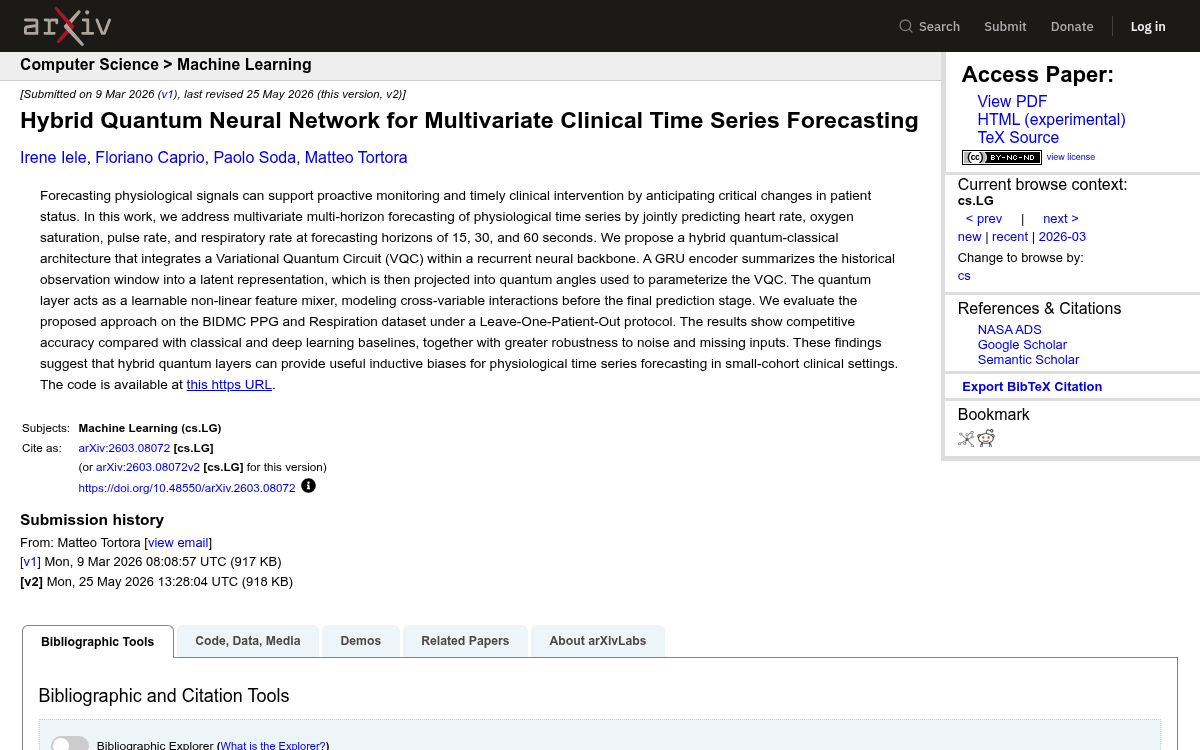
The proposed hybrid quantum-classical architecture integrates a Variational Quantum Circuit (VQC) within a recurrent neural backbone. A GRU encoder summarizes the historical observation window into a latent representation, which is then projected into quantum angles used to parameterize the VQC. The quantum layer then acts as a learnable non-linear feature mixer, modeling cross-variable interactions before the final prediction stage.
To unpack the terminology: a Variational Quantum Circuit (VQC) is a parameterized quantum circuit whose gate angles are tunable -- think of it as a differentiable function that lives in a high-dimensional quantum state space and can be trained via gradient descent just like a neural network layer. A GRU (Gated Recurrent Unit) is a compact recurrent architecture that processes sequences step by step, maintaining a hidden state that summarizes history. The pipeline works like this:
- A window of recent physiological readings is fed into the GRU encoder, which compresses the sequence into a fixed-size vector.
- That vector is linearly projected into rotation angles -- the parameters that control the quantum gates inside the VQC.
- The VQC applies a series of quantum rotations and entangling operations across its qubits, producing an output measurement that mixes features across all four physiological variables simultaneously.
- A classical linear head reads off the VQC output and produces predictions at 15, 30, and 60 seconds ahead.
The key intuition is that quantum circuits naturally implement highly non-linear, entangled transformations across their inputs. Studies have shown that quantum circuits can represent certain nonlinear relationships more efficiently than classical layers of equivalent parameter count -- making them potentially well-suited to the cross-variable interaction problem in multivariate physiological forecasting.
The dataset and evaluation
The BIDMC dataset contains ECG, pulse oximetry (PPG), and impedance pneumography respiratory signals acquired from intensive care patients, intended to evaluate the performance of respiratory rate algorithms and reflect their potential performance in a real-world critical care environment. It comprises 53 eight-minute recordings sampled at 125 Hz, acquired from adult patients aged 19 to over 90. The BIDMC dataset is derived exclusively from critically ill patients in ICU or sleep study settings, and its signals often exhibit significant noise, irregularities, and pathological patterns. That makes it a genuinely hard benchmark -- not a clean toy dataset.
The proposed approach is evaluated under a Leave-One-Patient-Out protocol -- meaning the model is trained on all patients except one, tested on the held-out patient, and this is repeated for every patient in the cohort. This is the right evaluation strategy for small clinical datasets because it tests true generalization to unseen individuals, not just held-out time windows from the same patient.
The baselines tested include ExtraTrees, CNN-1D, TCN (Temporal Convolutional Network), LSTM, and PatchTST -- a modern transformer architecture designed for time series.
Results: competitive accuracy, better resilience
The proposed GRU+VQC model achieves the strongest overall performance, attaining an AvgWins score of 91.6% -- the percentage of task-horizon pairs in which a method achieves the lowest error. This advantage is also reflected in the aggregated results, where GRU+VQC achieves the lowest MAE and RMSE at all forecasting horizons and in the overall average across tasks and horizons.
At the task level, the proposed model achieves the best average performance for SpO2, pulse, and respiratory rate, while remaining very close to the best competitor on heart rate. Among the baselines, ExtraTrees is clearly the weakest approach, while LSTM and PatchTST emerge as the strongest classical competitors.
The more interesting finding is what happens when inputs degrade. Whereas the GRU baseline degrades monotonically as perturbation level increases, GRU+VQC remains comparatively stable, with only limited variation across noise levels -- suggesting that the quantum mixer provides a regularizing effect under noisy inputs. The same pattern holds for missing data: GRU+VQC consistently achieves lower MAE than the GRU baseline across all missing rates. In a clinical setting where sensor dropout and motion artifacts are routine, this robustness gap matters more than marginal accuracy improvements on clean data.
The real story: inductive bias, not quantum advantage
It would be easy to read this paper as a claim that quantum computing is ready for the ICU. It is not that. The VQC here runs on a classical quantum simulator -- no actual quantum hardware is involved. The proposed hybrid architecture is assessed using noiseless quantum circuit simulations. The paper is better understood as an argument about architecture design: that the particular structure of a VQC -- its entangling operations, its high-dimensional state space, its constrained parameter geometry -- imposes a useful inductive bias when you have few patients and noisy signals.
These findings suggest that hybrid quantum layers can provide useful inductive biases for physiological time series forecasting in small-cohort clinical settings. That is a much more defensible and practically interesting claim than quantum supremacy. It is the same logic behind choosing a convolutional layer for images or a recurrent layer for sequences -- the structure of the computation matches the structure of the problem.
When should you actually use this?
This architecture is a reasonable candidate when:
- Your dataset is small (tens of patients, not thousands) and cross-patient generalization is the primary challenge.
- Your input signals are noisy or have frequent missingness -- ICU monitors, wearables, or remote patient monitoring devices.
- You are predicting multiple correlated physiological variables jointly and want the model to capture cross-variable dependencies explicitly.
- You are already running on a classical simulator and are willing to pay the computational overhead of VQC simulation.
It is a poor fit for large-scale deployments where classical deep learning has abundant data, or for any setting requiring real-time inference on edge hardware -- simulating quantum circuits is computationally expensive on classical machines. Despite the growing enthusiasm surrounding QML, many quantum models have struggled to outperform their classical counterparts, and the exact role of quantumness in improving performance remains an open question. The authors are careful not to overclaim, and practitioners should be equally careful: the BIDMC dataset has 53 recordings, and results on a cohort this size should be validated before any clinical deployment.
No code or pretrained model has been released alongside the paper on arXiv. The BIDMC dataset is publicly available on PhysioNet, so reproducing the experiments is feasible for anyone with access to a quantum simulation library like PennyLane or Qiskit. The broader context of QML in digital health is still being mapped out, but this paper represents one of the more rigorous attempts to ground the conversation in a realistic clinical evaluation protocol.