
Cambridge Researchers' WCE-FiLM-NO Beats Physics Solvers Without Renormalization
WCE-FiLM-NO is a prize-winning neural operator that solves notoriously unstable singular stochastic PDEs without needing hand-tuned renormalization constants
 Pro
Takeaways
- Prize-winning model: WCE-FiLM-NO won the singular SPDE modeling competition, solving the dynamic Φ42 model without renormalization constants.
- No renormalization needed: The model outperforms NSPDE in all settings even without access to the diverging counterterm
a_epsilonthat competitors require. - Key innovation: FiLM conditioning layers let Wick-Hermite noise features dynamically modulate the FNO backbone, capturing the nonlinear dependency between the singular field and its smooth remainder.
- Strong generalization: In cross-resolution evaluation (train on one noise truncation, test on another), WCE-FiLM-NO scores 0.948 vs NSPDE's 4.087 without renormalization.
- First Φ43 surrogate: The paper introduces a simulation pipeline for the 3D quantum field theory model, a significantly harder and more physically relevant problem.
- Limited availability: Code is available only upon request; no open-source release yet, and the Φ43 pipeline is a prototype with one counterterm currently set to zero.
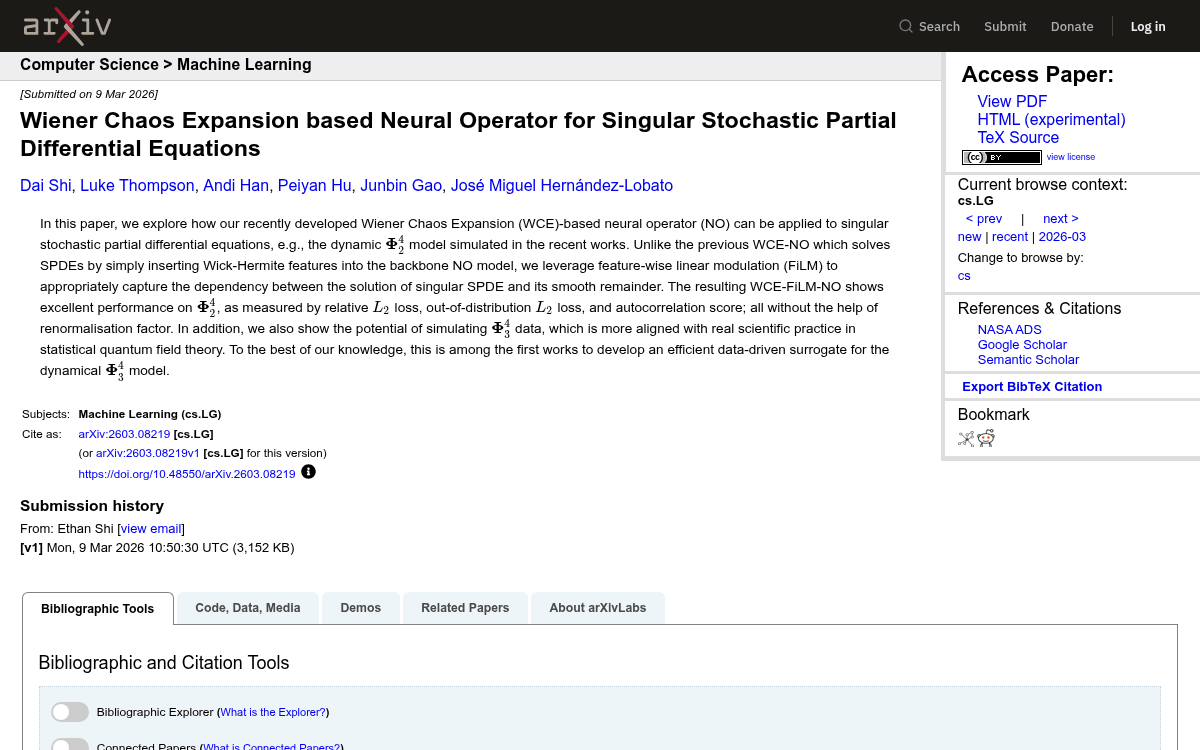
Stochastic partial differential equations (SPDEs) are the mathematical backbone of everything from turbulent fluid flow and climate modeling to quantum field theory. But a specific class of them, called singular SPDEs, has been a nightmare for numerical solvers and machine learning models alike. A new paper from researchers at Cambridge and Sydney introduces WCE-FiLM-NO, a neural operator that cracks this problem, winning a prize at the singular SPDE modeling competition in the process.
Why singular SPDEs break everything
A regular SPDE describes how a system evolves under noise. A singular SPDE is one where the noise is so rough that the equation itself becomes mathematically ill-defined. The canonical example is the dynamic Φ4 model, a workhorse of statistical quantum field theory. The construction of the Φ43 measure was one of the major achievements of constructive quantum field theory, and in the 1980s Parisi and Wu suggested viewing quantum field theory measures as invariant measures of certain stochastic PDEs. However, the highly singular nature of these equations prevented their application in rigorous constructions until recent breakthroughs.
The core problem is the cubic nonlinearity in the equation. Under space-time white noise, it produces terms that literally diverge to infinity. Classical solvers handle this via renormalization: you subtract a carefully computed diverging constant (called a counterterm or renormalization factor, denoted a_epsilon) to cancel out the infinity and recover a stable equation.
These methods are principled and often highly accurate, but they can become delicate for high-dimensional noise, rough drivers, or singular SPDEs.
The renormalization constant itself blows up as the resolution increases, making numerical simulation fragile and resolution-dependent.
Standard neural operators like the Fourier Neural Operator (FNO) fail outright on these problems. SPDEs are fundamental for modeling stochastic dynamics across the natural sciences and modern machine learning, and learning their solution operators with deep learning models promises fast solvers and new perspectives on classical learning tasks. But nobody had managed to build a reliable data-driven surrogate for the most challenging singular variants.
The WCE trick: turning randomness into determinism
The foundation of this work is Wiener Chaos Expansion (WCE), a classical mathematical technique that might be the most underused tool in scientific ML. WCE, also known as polynomial chaos expansion, is a classical technique in stochastic analysis that represents random processes via an orthogonal polynomial basis, originating from Norbert Wiener's homogeneous chaos in 1938.
The key insight is this: WCE transforms SPDEs into deterministic PDE systems for the coefficients, allowing for high-accuracy computation of moments and probability distributions. In other words, instead of solving one noisy, stochastic equation, you solve a collection of deterministic equations whose solutions, when combined with special polynomial basis functions called Wick-Hermite features, reconstruct the full stochastic solution. WCE allows one to expand the solution of an SDE or SPDE in terms of polynomial functionals with deterministic coefficients, known as propagators.
The team's earlier work, SDENO, showed this idea works for regular SPDEs. By projecting driving noise paths onto orthonormal Wick-Hermite features and using neural operators to parameterize the resulting chaos coefficients, full trajectories can be reconstructed from noise in a single forward pass. But singular SPDEs require something more.
The FiLM upgrade: teaching the network about structure
For singular SPDEs, the team uses a mathematical trick called the Da Prato-Debussche decomposition (DPDD). The idea: split the singular solution u into two parts: a rough stochastic part X_epsilon (the stochastic convolution, which absorbs all the divergences) and a smooth remainder v_epsilon that satisfies a well-behaved equation called the Shift Equation. The renormalization constant is algebraically absorbed into Wick powers of X_epsilon, making the divergences disappear from the equation you actually need to solve.
The previous WCE-NO approach just fed Wick features into an FNO backbone. That works for regular SPDEs, but for singular ones, the smooth remainder v_epsilon has a complex, nonlinear dependency on the stochastic driving terms. Simply concatenating features misses this structure.
Enter FiLM (Feature-wise Linear Modulation). FiLM is a neural network conditioning layer that uses learned affine transformations to modulate feature channels based on contextual signals. It applies feature-wise affine transformations to integrate external context into neural network activations, dynamically adjusting features via learned scaling (gamma) and shifting (beta) parameters. Originally developed for visual reasoning tasks, FiLM is here repurposed to let the Wick features dynamically control how the FNO processes the smooth remainder.

How it works, step by step
- Compute Wick-Hermite features up to order K=3 from the Q-Brownian motion increments. These encode the first three chaos levels of the noise, which are exactly what's needed to represent
X_epsilon,X_epsilon^(diamond 2), andX_epsilon^(diamond 3). - Feed Wick features into FNO to predict the smooth remainder
v_hat_epsilon(t, x). - Feed Wick features into a Conv2D conditioning network to produce FiLM parameters: a scaling field
gammaand a shifting fieldtau, both functions of space and time. - Apply the affine transformation: the final prediction is
u_hat = (1 + gamma) * v_hat + tau. This structure mirrors the DPDD decomposition, letting the network learn to add back the stochastic convolution in a data-driven way. - No renormalization constant needed: the model never sees
a_epsilon. The Wick feature structure handles the divergences implicitly.
The results: better generalization, no renormalization
The model was benchmarked on the Φ42 dataset from the recent SPDEBench work, tested under two noise truncation levels (epsilon=2 and epsilon=128) and crucially, in cross-truncation evaluation: train on one resolution, test on another. This is the hard test of generalization.
The competing baseline is NSPDE, the Neural SPDE model. The results tell a clear story:
- WCE-FiLM-NO achieves relative L2 errors of 0.004 (in-distribution, W-only setting) vs NSPDE's 0.010.
- In cross-truncation evaluation (train on
epsilon=2, test onepsilon=128), WCE-FiLM-NO scores 0.948 without renormalization, while NSPDE collapses to 4.087 without it and only recovers to 0.998 when given the renormalization constant. - WCE-FiLM-NO outperforms NSPDE in all settings, even when NSPDE has access to the renormalization factor and WCE-FiLM-NO does not.
The autocorrelation score, which measures whether the model captures the correct statistical structure of the field (not just pointwise accuracy), also shows strong performance. This matters for physics applications where correlation functions are the primary observable.
Opening the door to 3D quantum field theory
The paper's most forward-looking contribution is a simulation pipeline for Φ43, the three-dimensional version of the model. The construction of the measure of the Φ43 model in the 1970s was one of the major achievements of constructive quantum field theory. Numerically, it is far more singular than the 2D case and requires a more elaborate renormalization with two counterterms.
The team implements a semi-implicit Euler scheme on a 3D periodic lattice using FFT diagonalization for the stiff linear part, and computes the counterterms via FFT-accelerated quadrature. The paper is explicit that this is a prototype, with one counterterm contribution currently set to zero, but it demonstrates that data generation for this regime is feasible. Neural operator architectures with FiLM layers and Wick-Hermite feature conditioning have proven effective for data-driven surrogate modeling even in singular SPDE regimes.
What this unlocks, and where it falls short
The practical value here is as a fast surrogate simulator. Traditional solvers for singular SPDEs are iterative, resolution-sensitive, and require careful tuning of renormalization constants. A trained WCE-FiLM-NO runs in a single forward pass and generalizes across noise truncation levels. This is directly useful for:
- Statistical quantum field theory: sampling from Φ4 measures for lattice field theory computations.
- Uncertainty quantification in physics simulations where the noise structure is known but expensive to propagate.
- Climate and atmospheric modeling, where stochastic forcing terms appear in subgrid parameterizations.
The limitations are real, though. The cross-truncation error of 0.948 is still large in absolute terms. The Φ43 pipeline is a prototype and the authors acknowledge the missing counterterm. The model has only been compared against NSPDE; other baselines like NORS and DLR-Net are left for future work. And code is available only upon request, not as an open release.
Still, the core result stands: for the first time, a neural operator solves a singular SPDE benchmark without needing the renormalization factor, generalizes across resolutions, and opens a credible path toward data-driven surrogates for 3D quantum field theory models. That is a meaningful step for both the ML-for-science community and theoretical physicists looking for faster sampling tools.