
Cambridge Researchers Show GPT-5 Executes 2100 Steps Where Others Collapse at Six
New research shows tiny step-accuracy gains compound exponentially into long-horizon capability, exposing a self-conditioning bug that thinking models fix.
 Pro
Takeaways
- Small per-step accuracy gains compound exponentially into longer horizon lengths, hiding real progress.
- Long-task failures come from execution, not reasoning, even when knowledge and plan are provided.
- Models self-condition on their own errors, degrading further with each mistake in context.
- Scaling parameters doesn't fix self-conditioning, but thinking mode largely eliminates it.
- GPT-5 executes 2176 steps in one turn; Claude-4 Sonnet manages 432, Gemini 2.5 Pro just 120.
- Code and dataset released on GitHub and Hugging Face.
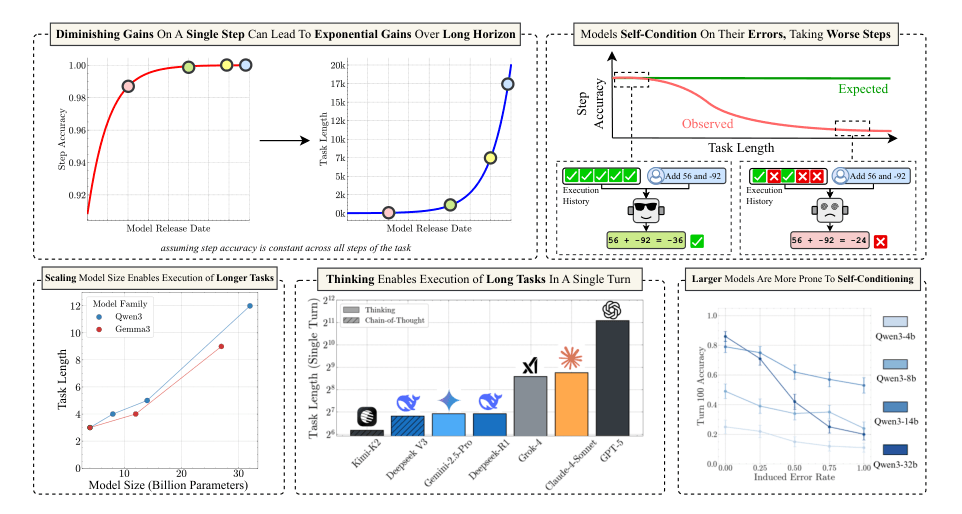
A new paper argues that the common complaint about large language models hitting a wall is a measurement artifact. When researchers isolate the ability to execute a long sequence of steps from the ability to plan or recall knowledge, they find that seemingly boring gains in per-step accuracy translate into exponential jumps in how long a model can keep going without falling apart. And they identify a strange failure mode along the way: models literally condition on their own prior mistakes and start making more of them.
The paper from researchers at Cambridge, Stuttgart, Max Planck, and ELLIS Tübingen reframes the debate sparked by Apple's "Illusion of Thinking" work. Rather than blaming failures on long tasks as an inability to reason, the authors argue those failures come from mistakes in execution, and they build a controlled benchmark to prove it. Code and the dataset are on GitHub and Hugging Face.
Why short benchmarks lie about progress
The core mathematical observation is simple but easy to miss. If a model succeeds at a single step with probability p, its probability of completing t steps without error is p^t. Flip that around and you get an ugly-looking hyperbolic relationship between step accuracy and how long a task the model can finish. Beyond roughly 80% single-step accuracy, which frontier models now hit on many question-answering benchmarks, horizon length grows sharply.
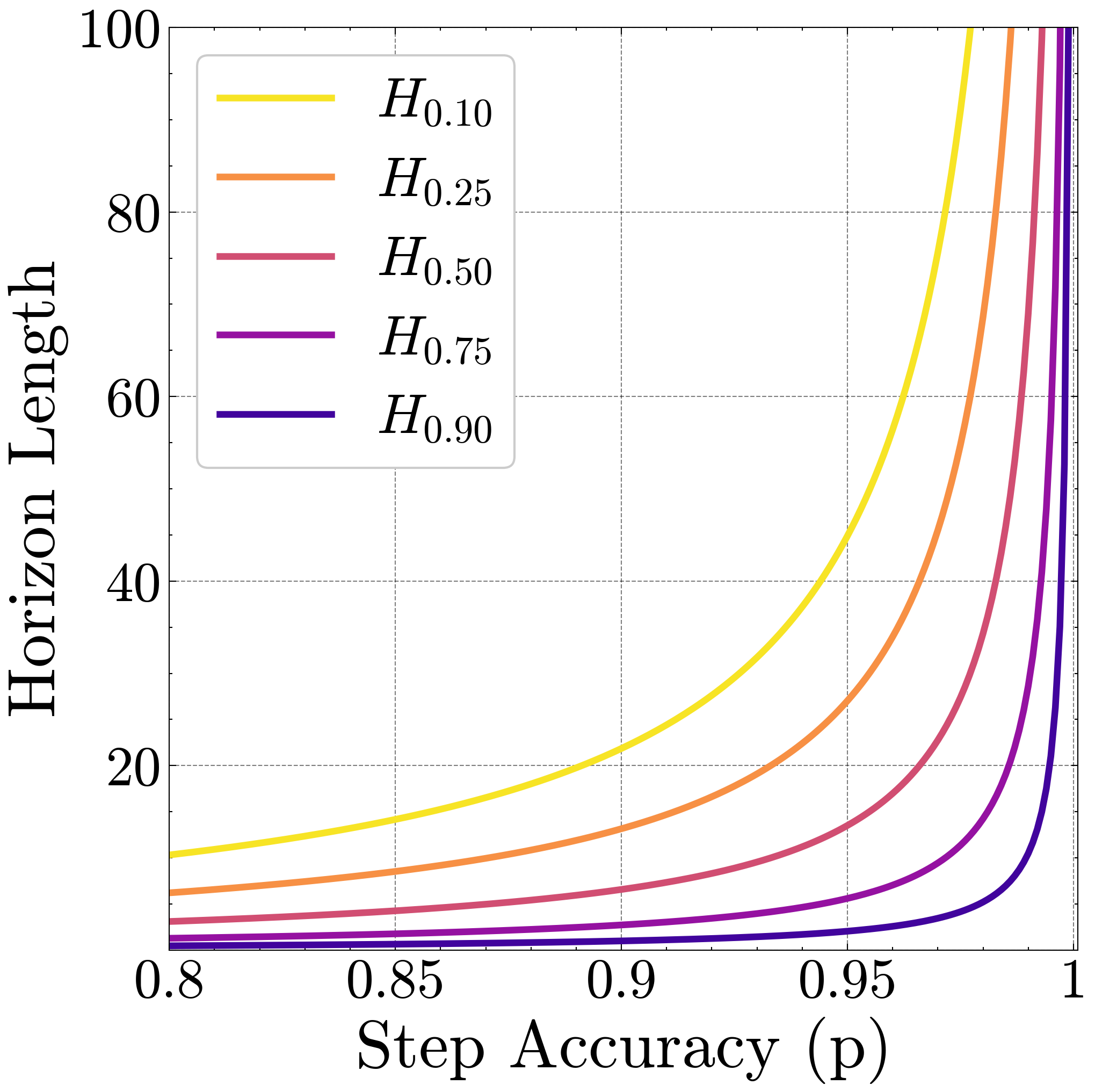
This matters because METR previously showed the horizon length of frontier software-engineering agents is doubling every 7 months. The authors show that even this exponential curve is compatible with diminishing returns on the underlying per-step metric. In other words, the industry can look like it's stalling on MMLU-style leaderboards while quietly unlocking dramatically longer autonomous work.
Isolating execution with a dictionary game
To separate execution from planning and knowledge, the authors design a deliberately simple task. The model gets an in-context dictionary that maps five-letter English words to integers in the range -99 to 99. Each turn, it receives a small set of keys (the "plan"), looks up the values, adds them to a running sum, and returns the new state. Everything the model needs is right there. There is nothing to reason about, nothing to remember from training, no ambiguity in the plan.
Two knobs control task length: the number of turns and the turn complexity K (keys per turn). The task decomposes into retrieval (looking up the integer for each key) and composition (summing values and adding to the previous state). In isolation, models nail both operations. Chained together over many turns, they fall apart.
Scaling isn't dead, it just wasn't being measured
Testing Qwen3 (4B to 32B) and Gemma3 (4B to 27B), the researchers find that nearly every model except the 4B ones hits near-perfect first-step accuracy, yet task accuracy collapses within a few turns. Qwen3-32B, the best of the bunch, drops below 50% within 15 turns. The key finding: scaling model size delivers non-diminishing gains in the number of turns a model can string together, even though the task is not knowledge-constrained and small models can already do one step perfectly.
Interestingly, this can't be reproduced with parallel compute. Simulating the redundancy of larger models by aggregating many parallel samples from a smaller model does not replicate the scaling gains. Whatever bigger models are doing internally to stay on-track over long horizons, majority voting doesn't emulate it.
The self-conditioning trap
Here's the weird part. Per-turn accuracy is supposed to be stable, so errors compound at a constant rate. Instead, per-turn accuracy degrades as the conversation goes on. To disentangle context-length effects from something else, the team ran a counterfactual: they surgically edited the chat history to contain a controlled fraction of injected errors, then measured accuracy at turn 100.

The result is striking. Even with a fully healed, error-free history, models perform worse at turn 100 than at turn 1 (the long-context effect). But as the fraction of injected errors climbs, accuracy at turn 100 keeps falling. Models are conditioning on their own mistakes and getting worse. Scaling to frontier 200B+ parameter models like Kimi-K2, DeepSeek-V3, and Qwen3-235B largely fixes the long-context degradation, but they remain susceptible to self-conditioning. The authors connect this to a broader pattern where hallucinations snowball and larger models drift more in personality during multi-turn conversations. Bigger models are better at predicting likely continuations of any context, including a context full of their own screwups.
Thinking breaks the loop
Turn on reasoning mode, and self-conditioning vanishes. Qwen3 thinking models maintain stable turn-100 accuracy regardless of how corrupted the history is. Two mechanisms likely explain this: RL post-training pushes models toward task success rather than blind context continuation, and thinking traces from prior turns are typically stripped from history so each turn's reasoning starts fresh. Inspecting the traces, the authors note that thinking models don't refer back to their prior answers.
Prompted self-verification alone doesn't help much. It burns through context, and thinking models sometimes make arithmetic errors during their own verification steps. Simple context engineering (a sliding window that drops old turns) works better, though obviously only for tasks without long-range dependencies.
Benchmarking the frontier
The most attention-grabbing chart benchmarks how long a task each frontier model can execute in a single turn, defined as the largest K at which accuracy stays above 80%. Without chain-of-thought, everyone fails past a handful of steps. With thinking enabled, the gap between labs opens wide.

The headline numbers:
- GPT-5 (Horizon): over 2100 steps
- Claude-4 Sonnet: 432 steps
- Grok 4: 384 steps
- Gemini 2.5 Pro: 120 steps
Without chain-of-thought, even frontier non-thinking models like DeepSeek-V3 (670B) and Kimi K2 (1026B) fail to execute a turn complexity of more than six. That is a stark result: reasoning tokens are not a nice-to-have for agentic execution, they are the difference between four steps and two thousand.
One architectural note worth flagging: Qwen3-Next, which combines Gated DeltaNet with standard attention and is designed explicitly for long-context tasks, outperforms even larger models that use only standard attention, suggesting hybrid attention architectures may matter for long-horizon reliability.
What this means in practice
If you're building agents, three things follow from this work:
- Reasoning before acting is non-negotiable for long chains. The ReAct pattern isn't just a nice ergonomic improvement, it appears to be a structural requirement for models to execute more than a handful of dependent steps without collapsing.
- Context hygiene matters more than you think. Errors in scratchpads and tool outputs poison future turns. Aggressively pruning failed attempts from history, or using thinking models that don't carry prior CoT forward, can dramatically extend usable horizons.
- Short-task benchmark gains still translate into real capability. A model that improves single-step accuracy from 96% to 98% roughly doubles its horizon length, even though the leaderboard delta looks trivial.
The authors are careful about limits. The task is synthetic, real agentic work involves choosing among many actions with varying difficulty, and self-correction can rescue trajectories in ways their metric doesn't credit. They also demonstrate self-conditioning in messier settings, estimating that roughly 20% of failed GAIA trajectories, 48% of ALFWorld failures, and 33% of WebShop failures resemble the pattern.
The bigger picture is a reframing of what "scaling" is supposed to deliver. Loss curves and single-question accuracy always looked like they were flattening. Measured against the length of task a model can actually finish, the curve is bending the other way.