
Cambridge Researchers' ExoPredicator Teaches Robots to Plan Around Background Physics
A new framework teaches robots to reason about the world's own dynamics, from boiling water to cascading dominoes, using symbolic causal processes.
 Pro
Takeaways
- ExoPredicator learns symbolic world models with both agent actions and autonomous background processes with stochastic delays.
- Combines LLM-proposed predicates and process conditions with Bayesian model selection and variational inference over delays.
- A big-step transition function lets an A* planner jump between abstract state changes instead of simulating frames.
- Near-perfect solve rates on five PyBullet domains (Coffee, Grow, Boil, Domino, Fan) from one or two demos.
- Beats HRL (MAPLE), VLM planning (ViLA with Gemini 2.5 Pro), and STRIPS operator learning baselines on held-out tasks.
- Paper on arXiv; builds on the earlier VisualPredicator framework.
Most world models in robotics assume the environment only changes when the robot acts. But real kitchens, factories, and physics puzzles do not wait for the arm to move. Water keeps heating after the burner is switched on. Dominoes keep falling after the first push. A new paper called ExoPredicator, from researchers at Cambridge, Cornell, Princeton, MIT and Basis, proposes a way to learn abstract world models that explicitly model these background processes and their delays, letting a planner reason about them without simulating every frame.
The core issue is that long-horizon embodied planning is challenging because the world does not only change through an agent's actions: exogenous processes (e.g., water heating, dominoes cascading) unfold concurrently with the agent's actions. Existing symbolic planners like PDDL treat actions as instantaneous, and while PDDL 2.1 adds durative actions, it still cannot cleanly model autonomous exogenous processes. Vision-language models can reason about causality in principle but generalize poorly to novel physical situations. ExoPredicator sits between these worlds: it learns a symbolic model, but one that understands time and background dynamics.

Predicates plus causal processes
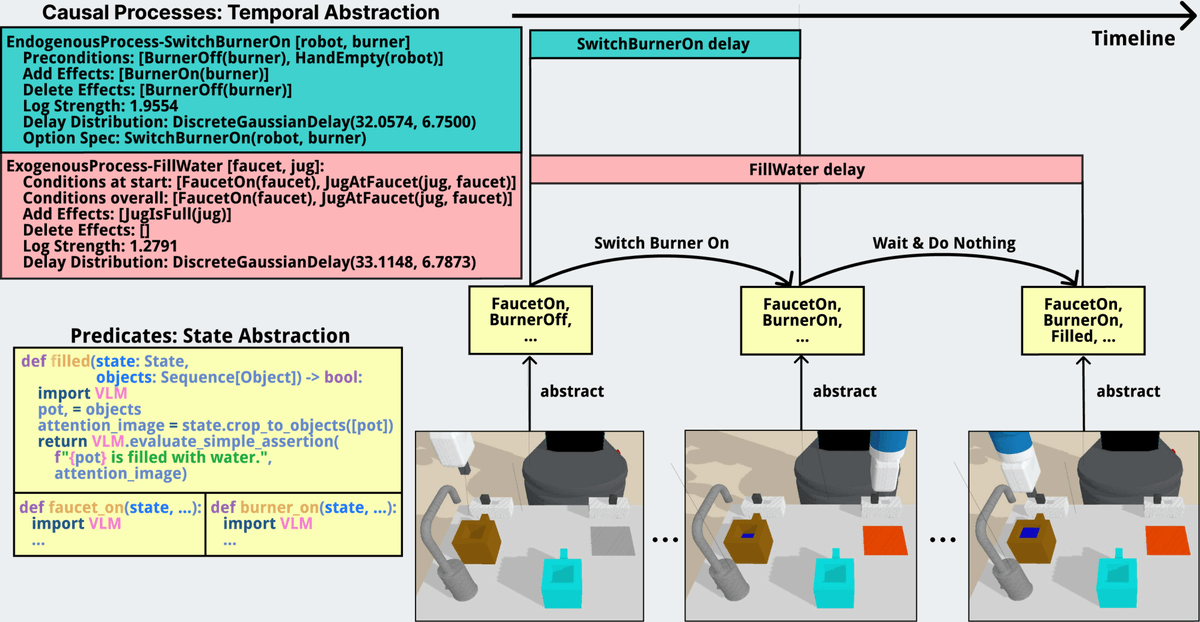
The framework has two learned components. The first is a set of predicates, which are short Python programs that read the raw scene and return booleans like JugIsFull or BurnerOn. A predicate is represented as a Python function that queries a VLM to inspect the robot's visual input. A set of predicates induces an abstract state corresponding to all the predicate/object combinations that hold in that state.
The second component is a set of causal processes, which describe how those symbolic facts change over time. Each process is defined by a schema containing parameters, a start condition, an overall condition that must persist, an add/delete effect set, a log-strength weight, and a delay distribution. Two kinds exist:
- Endogenous processes are skills the robot controls directly, like Pick, Place, or SwitchBurnerOn.
- Exogenous processes are background dynamics that unfold on their own once their conditions are met, such as a jug filling under a running faucet, or a domino toppling its neighbor.
Crucially, effects are not instantaneous. Each process carries a probability distribution over the delay between activation and effect, so the planner can reason that boiling takes longer than switching, and that the robot can chop vegetables while it waits.
Learning from a handful of demos
The agent starts with one or two demonstration trajectories and a small library of built-in skills, then bootstraps through online learning. Online learning involves planning to solve training tasks to collect further trajectories (when planning fails, random actions are taken). Three interleaved learning problems are solved:
- Parameter learning by variational inference. The delay distributions and process weights are fit by maximizing an ELBO. Because delays create combinatorially many timing assignments, the paper introduces variational distributions over the absolute arrival time of each effect, turning an intractable marginal likelihood into a tractable bound optimized with Adam.
- Structure learning with Bayesian model selection and LLM proposals. Trajectories are segmented at each abstract-state change, filtered to remove changes explained by known skills, and clustered by which atoms flipped. For each cluster, an LLM proposes candidate condition sets, and the Bayesian posterior (likelihood plus a minimum-description-length prior) picks the winner.
- Predicate invention. An LLM proposes candidate Python predicates from trajectory data, and a hill-climbing search greedily selects a subset that maximizes downstream planning quality.

Planning by jumping between abstract states
Once learned, the model supports fast forward search. The trick is a big-step transition function that fast-forwards the small-step semantics until an abstract state actually changes, so the planner never simulates the milliseconds between meaningful events. A special NoOp action lets the agent explicitly wait for exogenous processes to finish, and A* search over ground endogenous processes is guided by an adapted Fast-Forward heuristic that treats exogenous processes as zero-cost side effects.
Results across five tabletop worlds
The team evaluated on five PyBullet environments: Coffee (fill cups from a machine), Grow (water color-matched plants), Boil (fill and boil jugs without spilling), Domino (topple targets via cascades, including impossible-goal detection), and Fan (blow a ball through a maze with switchable fans). All results are averaged across five random seeds. For each seed, we train the agent with one or two training tasks, each of which includes one demonstration. Held-out tests use more objects and harder goals.
ExoPredicator reaches near-perfect solve rates across most domains, matching or beating a manually engineered symbolic baseline. It compares against:
- MAPLE, a hierarchical RL agent given 1000x more interactions, which struggles with sparse rewards.
- ViLA, a Gemini 2.5 Pro VLM planner that works on tasks close to the demo but fails on compositional generalization.
- VisualPredicator, a STRIPS-style operator learner that lacks the expressivity to represent stochastic delays and edge-triggered exogenous dynamics.
For each environment, ExoPredicator learns 1-4 exogenous processes and converges after at most three online interaction iterations. Once trained, it can solve nearly all tasks in Coffee, Domino, and Fan, and over 80% in Boil and Grow. Ablations confirm both pieces matter: dropping Bayesian scoring degrades reliability, and dropping the LLM proposer blows up the discrete search space to roughly 2^50 candidates per process.
What it is good and bad at
The system shines in structured tabletop domains where object-centric predicates carry the important state, and where delays and background dynamics are the actual bottleneck. It is data-efficient (one or two demos plus a few online rollouts) and produces inspectable symbolic models that a developer can read. The learned Domino model, for example, discovers a NOT-IsImmovable predicate on its own, letting it flag genuinely impossible red-domino tasks instead of thrashing.
Limits are honest. In Boil, the agent failed to learn the full disjunctive condition for spillage (empty faucet or full jug underneath), so it does not hit 100%. Perception is simplified: object features are assumed available rather than grounded from raw pixels. The environments are simulated tabletop scenes, not noisy real-world manipulation, and the framework assumes a fixed skill library like Pick, Place, and Switch. Scaling to messier perception and larger process libraries is explicitly left for future work.
Where this fits
ExoPredicator is a concrete answer to a growing tension in robot learning: end-to-end vision-language-action models like π0 or RT-2 are flexible but shaky on physical constraints, while classical symbolic planners are precise but brittle. This work uses foundation models as proposal engines for predicates and process conditions, then grounds those proposals in Bayesian evidence from real trajectories. The paper builds directly on the authors' earlier VisualPredicator line, extending predicate invention to environments with exogenous dynamics and delayed effects. Code has not yet been released alongside the preprint, but the appendix contains full prompt templates and learned process listings that make reimplementation plausible.