
Caltech's OverCite Kills LaTeX Citation Interruptions Without Leaving Your Editor
A Caltech astronomer built a browser and VS Code extension that turns rough placeholder cite keys into real BibTeX entries, without leaving Overleaf.
 Pro
Takeaways
- OverCite inserts BibTeX citations into LaTeX directly from Overleaf or VS Code, no context switching.
- Turns rough placeholders like
\citep{Perlmutter1999}into ranked matches from ADS/SciX with one shortcut. - Three search modes: contextual (uses sentence), simple author-year, and raw ADS query strings.
- Deterministic and rule-based, no LLM backend; users authenticate with their own ADS API token.
- Covers arXiv, INSPIRE, Crossref, PubMed, DataCite across physics, CS, math, biology, and astronomy.
- Open source, available on Firefox, Chrome, and VS Code marketplaces.
Anyone who has drafted a paper in LaTeX knows the interruption. You are mid-sentence, you know exactly which paper you want to cite, and then you leave the editor to hunt for a BibTeX entry, paste it into your .bib file, fix the cite key, and finally return to your sentence three tabs later. A new open source tool called OverCite, built by Caltech astronomer Cheyanne Shariat, tries to erase that round trip entirely.
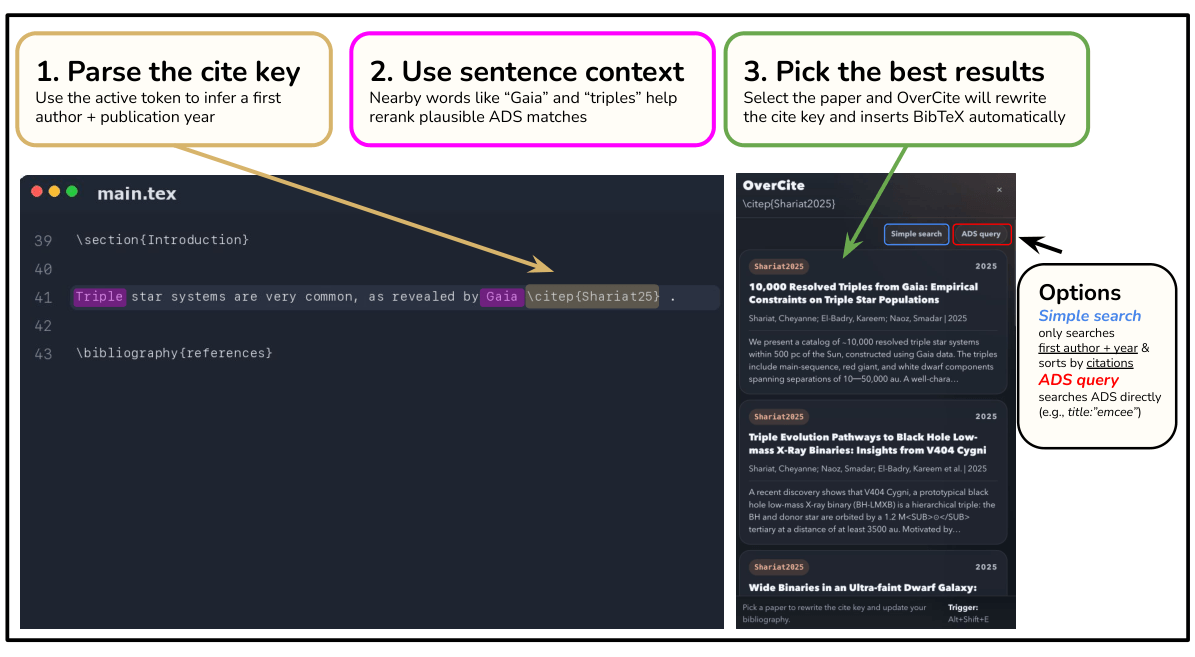
OverCite ships as an Overleaf browser extension and a companion VS Code extension for local projects. It queries NASA ADS/SciX, finds papers, and inserts the selected BibTeX entry into the project's .bib file. The default keyboard shortcut is Alt+Shift+E.
From placeholder to citation without leaving the line
The core idea is that the citation command itself becomes the query. You type something like \citep{Perlmutter1999} as a placeholder, drop your cursor inside the braces, and hit the shortcut. The active citation token is parsed and used to search ADS/SciX. A popup shows ranked candidates, and choosing one rewrites the cite key in your manuscript and appends the matching BibTeX entry to your bibliography file.
One design decision worth flagging: the implementation is deterministic, avoiding LLMs and focusing on precise in-editor insertion rather than comprehensive bibliography management. Ranking is rule based, using the typed token plus surrounding sentence context. That keeps the tool lightweight and predictable, with no shared inference backend to worry about.