
Caltech and NVIDIA's PANO Reconstructs 3D Medical Scans From 5% of Normal Data
Caltech's PANO neural operator reconstructs 3D photoacoustic scans in real time from sparse sensor data, beating the standard UBP algorithm by 33 points in image similarity
 Pro
Takeaways
- PANO is the first end-to-end neural operator for 3D photoacoustic tomography, mapping raw sensor signals directly to a 3D volume in a single pass.
- It outperforms the standard UBP algorithm by ~33 percentage points in cosine similarity on simulated data and 14 points on real phantom data.
- A single trained model handles any subsampling pattern without retraining, from 6x to 20x acceleration and limited-angle geometries.
- Inference takes 0.11 seconds for a 200x200x160 volume on an RTX 4090, enabling 9 Hz real-time 3D display.
- Architecture combines spherical DISCO convolutions, a Fourier Neural Operator, and a 3D U-Net, trained with a Helmholtz equation physics loss.
- Code is open-source at github.com/neuraloperator/pact3d; in-vivo validation is the stated next step.
Getting a 3D photoacoustic scan of a human breast today requires a dense ring of hundreds of ultrasound transducers and a breath-hold that can stretch to 10 seconds. That hardware cost and scan time have kept the technology largely confined to research labs. A team from Caltech and NVIDIA is now proposing a deep learning shortcut: train a neural operator to skip the slow physics solver entirely and map raw sensor signals directly to a 3D volume in a single forward pass.
The result is PANO (PACT Imaging Neural Operator), the first end-to-end deep learning framework for 3D photoacoustic computed tomography (3D PACT). The paper, from Anima Anandkumar's group at Caltech with co-authors including Zongyi Li and Kamyar Azizzadenesheli of NVIDIA, demonstrates that a physics-aware neural operator can reconstruct high-fidelity 3D images from as little as 5% of the normally required sensor measurements, in real time.
Why 3D PACT is stuck in the lab
Photoacoustic computed tomography is a hybrid imaging modality that combines the optical contrast of diffuse optical tomography with the spatial resolution of ultrasonography. By converting light absorption into ultrasonic waves through transient thermoelastic expansion, PACT enables noninvasive, high-resolution imaging at depths beyond the optical diffusion limit. That makes it uniquely useful for vascular imaging, cancer detection, and transcranial brain imaging without the ionizing radiation of CT or the cost of MRI.
Modern 3D PACT systems, employing arrays of hundreds to thousands of elements, have shown immense potential in wide-ranging pre-clinical and clinical studies. However, constrained by system manufacturing costs and physical restrictions on limited detection aperture, 3D PACT systems generally have sparse sensors and limited-view detection geometries. These limitations inevitably compromise signal acquisition and cause severe artifacts when using standard back-projection-based reconstruction algorithms like universal back-projection (UBP).
The dominant reconstruction algorithm, UBP, works by back-projecting each sensor measurement along a spherical wavefront and summing contributions across all sensors. It is fast and well-understood, but it degrades badly when sensors are sparse or the angular coverage is limited. The alternative, iterative solvers, can compensate for missing data but are roughly 10x slower. Deep learning denoisers have been stacked on top of UBP outputs to clean up artifacts, but this two-step approach inherits all of UBP's failures before the network even sees the data.
One pass, raw data to 3D volume
PANO is an end-to-end physics-aware neural operator that generalizes across input sampling densities without retraining and directly learns the inverse mapping from raw sensor measurements to a 3D volumetric image. Unlike two-step methods that reconstruct then denoise, PANO performs direct inversion in a single pass, jointly embedding physics and data priors.
The key conceptual shift is treating reconstruction as operator learning rather than image processing. A neural operator (NO) learns a mapping between function spaces rather than between fixed-size tensors. This means a single trained model can handle different sensor sampling patterns and densities without retraining, because the operator is defined continuously and evaluated at whatever grid points the sensors happen to occupy.

How PANO works, step by step
The architecture chains three components, each handling a different scale of the problem:
- Spherical DISCO (local features): The sensors sit on a hemispherical bowl. Applying standard 2D convolutions to a flattened projection of that hemisphere distorts the geometry near the poles, the same way Mercator maps inflate Greenland. PANO instead uses discrete-continuous (DISCO) convolutions defined natively on the sphere, preserving geodesic distances and rotational equivariance. Each frequency slice of the incoming radio-frequency signal is processed independently by its own DISCO block.
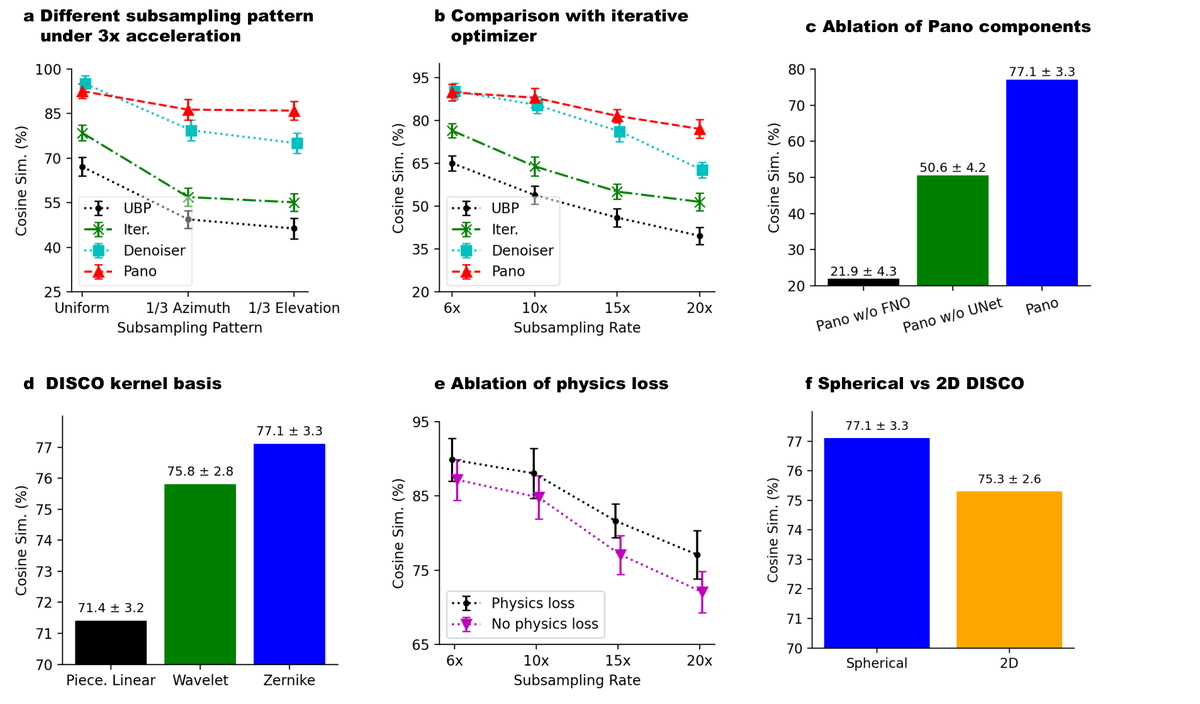
- Fourier Neural Operator (global features + coordinate transform): DISCO has a limited receptive field. The FNO block aggregates information across the entire detector dome by operating in the Fourier domain over the angular coordinates. Critically, it also performs the coordinate transform from spherical sensor space to the Cartesian voxel grid of the output volume. Ablation experiments show that removing FNO causes a 55.2 percentage point drop in cosine similarity, the single largest degradation of any component.
- 3D U-Net (fine detail): FNO operates in low-frequency space and misses fine vascular branches. A lightweight residual 3D U-Net with three down/up-sampling stages refines the prediction at full resolution. Removing it causes a 26.5 percentage point drop.
During training, PANO is anchored to physical reality through a combined loss: a voxel-wise L1 term comparing the predicted volume to ground truth, plus a physics consistency term that re-simulates the acoustic forward model on the predicted volume and penalizes deviations from the actual sensor measurements. This Helmholtz equation constraint is only applied during training, so inference remains a single fast forward pass. The physics loss yields an average gain of 3.9 percentage points across all tested subsampling rates, with the benefit increasing at higher acceleration where the inverse problem becomes more ill-posed.
# Conceptual PANO forward pass (simplified)
# Input: PA wave in frequency domain [N_theta x N_phi x N_k]
# Output: 3D initial-pressure volume [N_x x N_y x N_z]
for k in range(N_frequencies):
    features_k = spherical_DISCO(psi[:, :, k])  # local spherical features
global_features = FNO(concat(features_k))       # global + coord transform
volume = UNet3D(global_features)                # fine-detail refinement
Training on simulations, tested on real hardware
The team trained PANO on 7,000 synthetic 3D vascular phantoms generated with VascuSynth, a tool that procedurally grows anatomically plausible vessel trees. The acoustic forward model was simulated using the Helmholtz equation with realistic sensor noise, bandwidth limits, and per-channel gain offsets. To bridge the gap to real hardware, the model was fine-tuned on just 37 point-source calibration scans from the actual imaging system, a custom 1024-element hemispherical array at Caltech.
Evaluation used three metrics: cosine similarity (the primary metric, which normalizes both volumes before comparing, removing scale ambiguity), PSNR, and NMSE. Tests covered uniform subsampling at 6x, 10x, 15x, and 20x acceleration, plus limited-angle patterns where only a 120-degree arc of the hemisphere is used.

The numbers
PANO reconstructs high-quality images from both simulated and real data across diverse sparse acquisition settings, achieves real-time inference, and outperforms the widely-used UBP algorithm by approximately 33 percentage points in cosine similarity on simulated data and 14 percentage points on real phantom data.
The performance gap with the two-step Denoiser baseline widens dramatically at high acceleration. On simulated data at 20x subsampling, PANO leads the Denoiser by 14.4 percentage points in cosine similarity. On real phantom data at 15x subsampling, the Denoiser's performance collapses while PANO holds: the gap reaches 28.4 percentage points. Cosine similarity drops only 12.8 percentage points from 6x to 20x for PANO, versus 27.6 percentage points for the Denoiser, confirming that direct inverse operator learning is substantially more robust to sparse measurements than the two-step reconstruct-then-denoise paradigm.
| Method | 6x (sim) | 10x (sim) | 15x (sim) | 20x (sim) |
|---|---|---|---|---|
| UBP | 65.1% | 53.9% | 46.0% | 39.7% |
| Denoiser | 90.3% | 85.4% | 76.2% | 62.7% |
| PANO | 89.9% | 88.1% | 81.7% | 77.1% |
PANO reconstructs a 200x200x160 volume in 0.11 seconds on an NVIDIA RTX 4090 GPU, corresponding to an effective 9 Hz 3D display rate. That is comparable to UBP in speed while being far ahead in quality, and orders of magnitude faster than iterative solvers.
What it cannot do yet
The current model has real limitations worth knowing before getting excited about clinical deployment:
- Homogeneous tissue assumption: PANO assumes a uniform speed of sound and uniform optical fluence throughout the tissue. Real tissue has heterogeneous acoustic properties, and optical fluence drops off with depth in a wavelength-dependent way. This means the recovered pressure field conflates true absorption with fluence variations, which matters for quantitative imaging.
- No in-vivo validation: All experiments are on wire phantoms or synthetic data. Moving to living tissue will require handling motion, acoustic heterogeneity, and the impracticality of acquiring dense ground-truth scans in vivo.
- Heavy training hardware: Training requires an 80 GB NVIDIA A100 GPU due to the 3D input and output tensors at high resolution.
- Fixed output resolution: Unlike the input side, the output voxel grid is fixed at 200x200x160. Extending to higher resolutions would require architectural changes or implicit neural representations.
The broader implication
Learning physics-constrained inverse operators, rather than post-processing physics-based reconstructions, is a broadly applicable strategy for problems with expensive forward models. The authors explicitly note that the same principle should apply to ultrasound tomography, seismic imaging, radar, and optical tomography, anywhere the forward model is a wave equation and acquiring dense measurements is expensive or slow.
The official implementation is publicly available at github.com/neuraloperator/pact3d, built on PyTorch and the NeuralOperator library. Synthetic data generation scripts are included. Real experimental data is available from the authors on request. The next step the team is calling for is in-vivo animal studies, which would be the first real test of whether the sim-to-real transfer that works on wire phantoms holds up in living tissue.