
CAICL Pushes Robot Vision From 81% to 85.5% Without Any Training
A new prompting method forces vision-language models to slow down and compare confusable objects, lifting VIMA-Bench success rates to 85.5%.
 Pro
Takeaways
- New paper CAICL tackles shortcut learning in VLM-based robotic manipulation with a two-step prompting approach.
- Achieves 85.5% success on VIMA-Bench, beating vanilla VLM (81.2%) and learning-based VIMA (81.6%) at L1.
- Method first localizes visually confusable objects, then re-prompts VLM to reason over distinguishing features.
- Image recognition errors caused ~60% of failures on Task 17, with confusion being the dominant sub-cause.
- Performance stays stable from L1 to L3 generalization, unlike learning-based baselines that degrade with novel objects.
- GPT-4o and Gemini 1.5 Pro backbones dominate; smaller VLMs like LLaVA-v1.5 gain less from the prompting.
Vision-language models are good at telling a robot what it is looking at, until two objects on the table look almost the same. A new paper called Confusion-Aware In-Context Learning (CAICL) tackles that failure mode without any fine-tuning. The authors show that a simple two-step prompting recipe can push a vanilla VLM from roughly 81% to 85.5% success on the VIMA-Bench manipulation benchmark, mostly by cleaning up the errors that come from visually confusable objects.
Why VLM-driven robots keep grabbing the wrong block
VLM-based systems often lack robustness and produce unpredictable errors, particularly in scenarios involving confusable objects. The authors trace these failures to shortcut learning inside the VLM, which limits its ability to distinguish fine-grained features. Shortcut learning is the tendency of a model to latch onto whichever superficial cue produces a plausible answer fastest, rather than actually comparing candidates side by side. In a manipulation pipeline that means the robot picks the second-best match and then executes a completely wrong action.
The authors quantified this on VIMA-Bench Task 17 by manually attributing every failure. Image recognition accounted for about 60% of failures, making it the leading cause, and a large share of those errors were confusion cases where the model chose a visually similar but incorrect object. That is the gap CAICL is trying to close.

Make the model look twice, on purpose
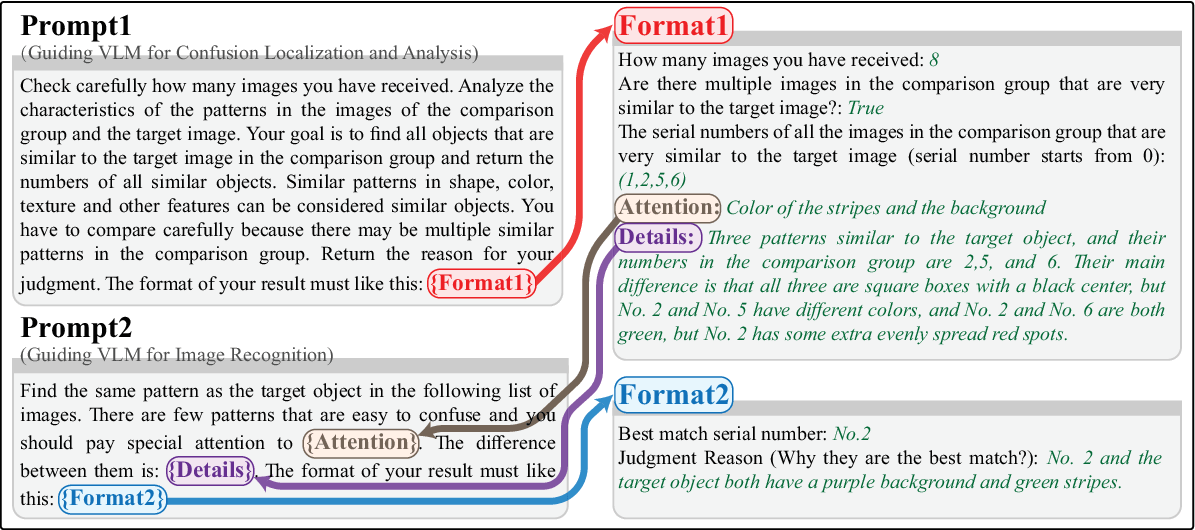
CAICL is a pure prompting framework built on top of an off-the-shelf VLM. It begins with confusion localization and analysis, identifying potential sources of confusion, then uses that information as a prompt for the VLM to focus on features most likely to cause misidentification. There is no new model, no training, no gradient step. The pipeline is built on Instruct2Act for code generation and action planning, and swaps in a GPT-4o based perception module combined with the large version of SAM for segmentation.
Concretely, it runs in two phases:
- Confusion localization and analysis. The VLM is asked to scan the whole scene, flag any objects that look visually similar to the target based on element composition and color, and then extract the fine features that actually distinguish them, like subtle texture or geometry differences.
- Confusion-aware image recognition. Those distinguishing features are injected into a second prompt that forces the model to produce structured, comparative reasoning, name the serial number of the best matching image, and justify the choice.
Rather than asking "which image matches?" and taking the first answer, CAICL asks "which images are dangerously similar, what tells them apart, and now match again using those features." It is chain-of-thought reasoning shaped specifically around the confusion structure of the scene.

The numbers on VIMA-Bench
The team ran evaluations on 12 of the 17 VIMA-Bench tasks across three generalization levels: L1 (placement generalization), L2 (combinatorial generalization), and L3 (novel object generalization). CAICL posts average success rates of 85.5% at L1, 85.0% at L2, and 84.9% at L3, edging out every baseline they tested. Two comparisons stand out:
- Against VIMA, the Transformer-based robot agent that encodes multimodal prompts and decodes actions via cross-attention, using an object-centric design that parses images into tokens, CAICL improves L3 from 79.0% to 84.9%. That matters because L3 introduces novel objects the learned baselines have never seen.
- Against a vanilla VLM using the same underlying model but without the confusion prompts, average L1 success climbs from 81.2% to 85.5%. The biggest jumps show up on tasks that stress fine discrimination, like Task 5 (73.2% to 85.5%) and Task 17 (84.1% to 92.2%).
Stability across generalization levels is arguably the more interesting result. Learning-based baselines like RT-2 degrade noticeably from L1 to L3 (72.8% down to 66.8%), while CAICL barely moves. Because the reasoning happens in prompt space over a pretrained VLM, novel objects are just more text to reason about rather than a distribution shift.
Model choice matters more than you might expect
The ablation swaps the backbone VLM while keeping the CAICL prompting fixed. Smaller open models trail badly, mid-size models close some of the gap, and frontier models pull ahead:
| Backbone VLM | Task 1 | Task 5 | Task 17 |
|---|---|---|---|
| LLaVA-v1.5 (7B) | 80.2 | 70.7 | 69.4 |
| Qwen2-VL (70B) | 85.0 | 76.8 | 78.4 |
| Gemini 1.5 Pro | 93.5 | 83.4 | 91.2 |
| GPT-4o | 93.8 | 83.5 | 91.7 |
CAICL is a wrapper, and it inherits the reasoning quality of whatever you put under it. On a 7B open model the confusion prompts still help, but you are capped by the base model's ability to actually notice subtle visual differences in the first place.
Where it fits, and where it breaks down
CAICL slots cleanly into any pipeline where a VLM handles perception and something else handles action planning, which describes most current Instruct2Act-style setups. It suits tabletop manipulation with a fixed candidate set, pick-and-place under clutter with lookalike items, and any scenario where robustness matters more than latency.
Two caveats are worth flagging. First, this is a two-pass prompt: you pay for an extra VLM call before every recognition, which is fine offline but adds real latency and cost in tight control loops. Second, the whole benefit rests on the base VLM being able to articulate what makes two objects different when asked. If your backbone cannot describe a fine texture difference in words, prompting it to compare textures will not save you.
The paper does not release code or a model, so reproducing the numbers means rebuilding the Instruct2Act plus GPT-4o plus SAM pipeline yourself and porting the two prompts shown in the paper. Given how small the method surface is, that is a weekend of work rather than a research project, and a cheap thing to try before reaching for fine-tuning when your robot keeps grabbing the wrong red block.