
C-t³VAE Fixes AI's Rare Class Blind Spot With 15-Point FID Gains
A new VAE variant uses per-class heavy-tailed priors to stop rare classes from getting squeezed out of latent space during generation.
Takeaways
- C-t³VAE assigns a heavy-tailed Student's t prior per class, giving equal latent mass to every category.
- Trained with a closed-form γ-power divergence objective and sampled via an equal-weight class mixture.
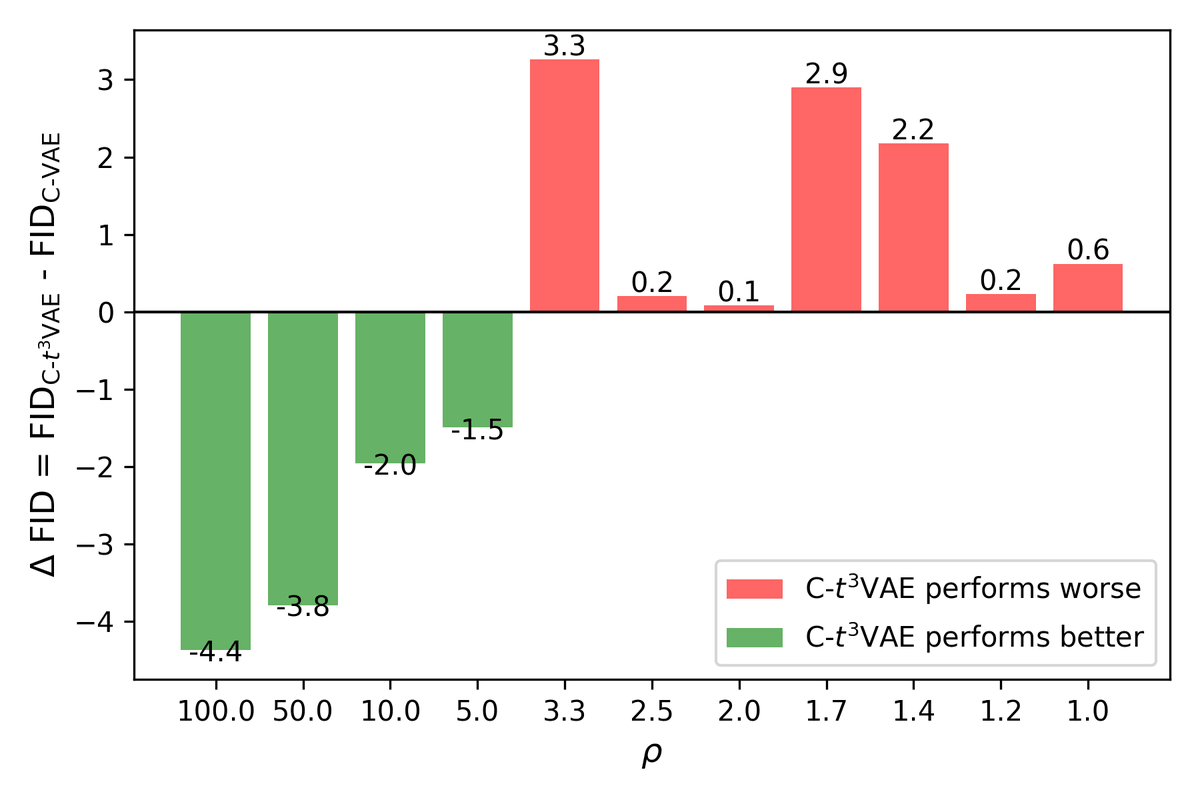
- Up to 15-point FID improvement over standard conditional VAEs on CIFAR100-LT under severe imbalance.
- Beats Gaussian-based conditional VAEs on per-class recall and F1 for tail classes, avoiding mode collapse.
- Identifies ρ ≈ 5 as the imbalance threshold above which heavy-tailed priors decisively outperform Gaussian ones.
- Same computational cost as a standard t³VAE, but the τ sampling parameter still needs dataset-specific tuning.
Generative models have a well-known blind spot: when training data is skewed, rare classes get drowned out. A new paper introduces C-t³VAE, a variational autoencoder variant that carves out equal latent-space real estate for every class using heavy-tailed per-class priors, delivering up to 15-point FID gains on long-tailed benchmarks.
Why rare classes vanish in latent space
The authors frame class imbalance as a geometric problem rather than a sampling one. When you optimize a VAE under the empirical data distribution, the model allocates latent probability mass in proportion to class frequency, so majority classes occupy larger effective regions of latent space while minority classes are confined to smaller regions with reduced representational capacity.
Previous work tried to fix this with heavier-tailed priors. The t³VAE replaced the standard Gaussian with a Student's t-distribution, which has fatter tails and better captures outliers. There was a catch, though: existing VAE approaches keep a single global prior, so the latent geometry stays frequency-aligned where class regions scale with empirical probability, and heavy tails alone do not eliminate this frequency-induced bias.