
Byz-NSGDM Shields Distributed AI Training from Hackers and Faulty Hardware
A new preprint proposes Byz-NSGDM, an optimizer that survives malicious workers even when gradients grow wildly, as in transformer training.
 Pro
Takeaways
- New preprint proposes Byz-NSGDM, a Byzantine-robust optimizer for distributed training.
- Works under
(L0, L1)-smoothness, matching gradient behavior seen in real transformer training. - Combines normalized momentum with robust aggregation plus Nearest Neighbor Mixing preprocessing.
- Proves O(K^-1/4) convergence up to a bias floor from robustness and heterogeneity.
- 2 to 10x lower final gradient norms than baselines on synthetic
(L0, L1)tasks. - Validated on heterogeneous MNIST, synthetic optimization, and small GPT on Shakespeare.
Distributed training assumes every worker plays fair. In reality, hardware faults, network glitches, and outright attackers can push arbitrary updates into the aggregation step. A new paper accepted to CPAL 2026 by Arman Bolatov, Samuel Horváth, Martin Takáč, and Eduard Gorbunov tackles this exact problem, but with a twist: it drops the classical smoothness assumption that most Byzantine-robust theory relies on.
The result is Byz-NSGDM, a normalized momentum SGD variant with theoretical convergence guarantees that hold for the kind of loss landscapes you actually see when training transformers.
Why classical smoothness assumptions break for LLMs
Almost every convergence proof in distributed optimization assumes L-smoothness, meaning the gradient's Lipschitz constant is bounded by a single number L everywhere. Empirical work on transformer training shows this is false. The local gradient smoothness scales with the gradient norm itself, which is why gradient clipping is not optional in practice.
The (L0, L1)-smoothness condition generalizes this by allowing the local Lipschitz constant to grow linearly with the gradient magnitude. It captures functions with state-dependent gradient Lipschitz constants, and the paper proposes Byz-NSGDM, a normalized stochastic gradient descent method with momentum that achieves robustness against Byzantine workers while maintaining convergence guarantees under this weaker assumption.
What Byzantine-robust actually means here
In a Byzantine setting, some fraction of the workers can send arbitrary vectors instead of honest gradients. A simple average is trivially poisoned by a single bad worker sending a huge vector. Robust aggregators like Krum, coordinate-wise median (CM), and geometric median (RFA) try to filter these out, but they degrade when honest workers have heterogeneous data because honest updates already look different from each other.
The authors' fix combines two ingredients. The algorithm combines momentum normalization with Byzantine-robust aggregation enhanced by Nearest Neighbor Mixing (NNM), a preprocessing step where each worker's update is replaced by the average of its nearest neighbors before aggregation. This shrinks the effective heterogeneity that adversaries can exploit.
The convergence result
The paper proves Byz-NSGDM achieves a convergence rate of O(K^-1/4) up to a Byzantine bias floor proportional to the robustness coefficient and gradient heterogeneity. Two things are notable:
- The rate matches known bounds for non-convex stochastic optimization even under the weaker
(L0, L1)assumption. - The residual bias vanishes when data is homogeneous, which is the best you can hope for since honest heterogeneity is genuinely indistinguishable from attacks.
The authors flag concurrent work by Yang et al. that derives a similar O(K^-1/4) rate, but under classical L-smoothness and homogeneous data, whereas this paper's results hold under the more general (L0, L1)-smoothness condition and accommodate bounded gradient heterogeneity among workers.
Experiments and what actually improves
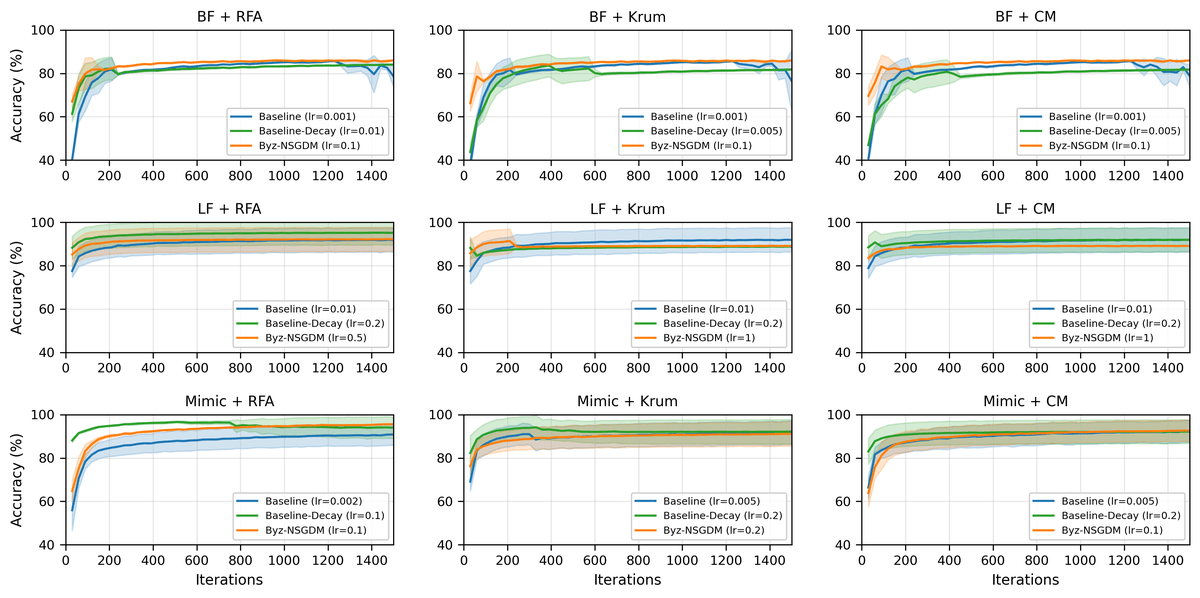
The empirical section spans three regimes: heterogeneous MNIST classification, a synthetic (L0, L1)-smooth objective, and character-level language modeling with a small GPT on Shakespeare text. The authors test against three attacks (Bit Flipping, Mimic, and ALIE) with 3 random seeds, reporting mean gradient norm evolution with standard deviation bands, and compare three optimizer variants (Baseline, Baseline-Decay, Byz-NSGDM) combined with three aggregators (Krum, RFA, CM).

On the synthetic task, Byz-NSGDM consistently achieves the lowest final gradient norms across all configurations, with values around 6 to 7 x 10^-6 compared to 1.3 to 1.4 x 10^-5 for Baseline and 4 to 9 x 10^-5 for Baseline-Decay, a 2 to 10x improvement over baselines. On MNIST, Byz-NSGDM consistently achieves the highest accuracy under Bit Flipping, reaching 78.8% for Baseline as the losing comparison point.

When it is worth using
Byz-NSGDM is a drop-in replacement for SGD-with-momentum in any federated or distributed training loop where you already use a robust aggregator. It is most useful when:
- Workers have non-IID data and you cannot rule out adversarial or faulty participants.
- The loss landscape has exploding-gradient regions, as in transformer or RNN training, where L-smoothness is a fiction.
- You want theoretical guarantees rather than heuristic gradient clipping.
The tradeoffs are also honest. There is still a Byzantine bias floor that scales with data heterogeneity, so the method cannot drive gradient norms to zero when workers hold genuinely different distributions. And the paper is 10 pages, 1 table, 4 figures, accepted to CPAL 2026, which means the scaling story beyond a small GPT is still open. The ablation shows the method is not fragile to momentum or learning rate choices, so tuning cost should be modest.
The CPAL proceedings entry and the arXiv HTML version are the places to go for the full proofs and hyperparameter tables.