
ByteDance's SEGA Builds a Driveable 3D Avatar From One Photo
SEGA turns a single photo into a fully drivable, 360-degree renderable 3D head avatar with real-time performance and identity preservation across novel views.
 Pro
Takeaways
- SEGA reconstructs a 360-degree drivable 3D Gaussian head avatar from a single photo, no multi-view capture required. Paper
- Hierarchical static-dynamic split: DINOv2 plus a UV-Alignment Transformer for rigid regions, VQ-VAE plus displacement VAE for expressions.
- Static Gaussians are precomputed once per identity, dropping inference to 50ms per frame on an A100.
- Beats GAGAvatar, LAM, Portrait4D-v2 on NeRSemble across PSNR, LPIPS, CSIM, and expression metrics.
- Two-minute person-specific finetuning boosts PSNR from 23.75 to 25.33 for identity-specific detail.
- Limits: struggles with glasses and dynamic hair; no public code release yet. Project page
Turning one casual photo into a fully animatable 3D head that can be rotated 360 degrees and driven by any facial expression has been an open problem for years. Most Gaussian Splatting avatar pipelines demand multi-view rigs or long video captures, which effectively locks the technology inside studios. A team from Tsinghua Shenzhen International Graduate School and ByteDance is proposing SEGA, a method that reconstructs photorealistic 3D Gaussian splats of a human head from a single image and then supports self and cross-identity reenactment in real time.
The one-photo bottleneck
Single-image avatar creation is fundamentally ill-posed: you have to invent occluded geometry, back-of-head texture, and expression-dependent deformation from one 2D observation. Existing approaches sit on two horns of a dilemma. 2D-driven methods like GPAvatar, GAGAvatar, and Portrait4D lean on large 2D datasets and generalize well across identities, but tend to break 3D consistency under novel viewpoints. On the other side, 3D-prior methods trained on multi-view capture rigs produce geometrically clean results but see too few identities during training, so they fumble on unseen faces.
SEGA's pitch is that you don't have to choose. The authors argue the real challenge is bridging the gap between 2D identity diversity and 3D geometric consistency in one framework, and disentangling identity from expression so it generalizes to unseen subjects while preserving multi-view consistency.
Two branches, one head
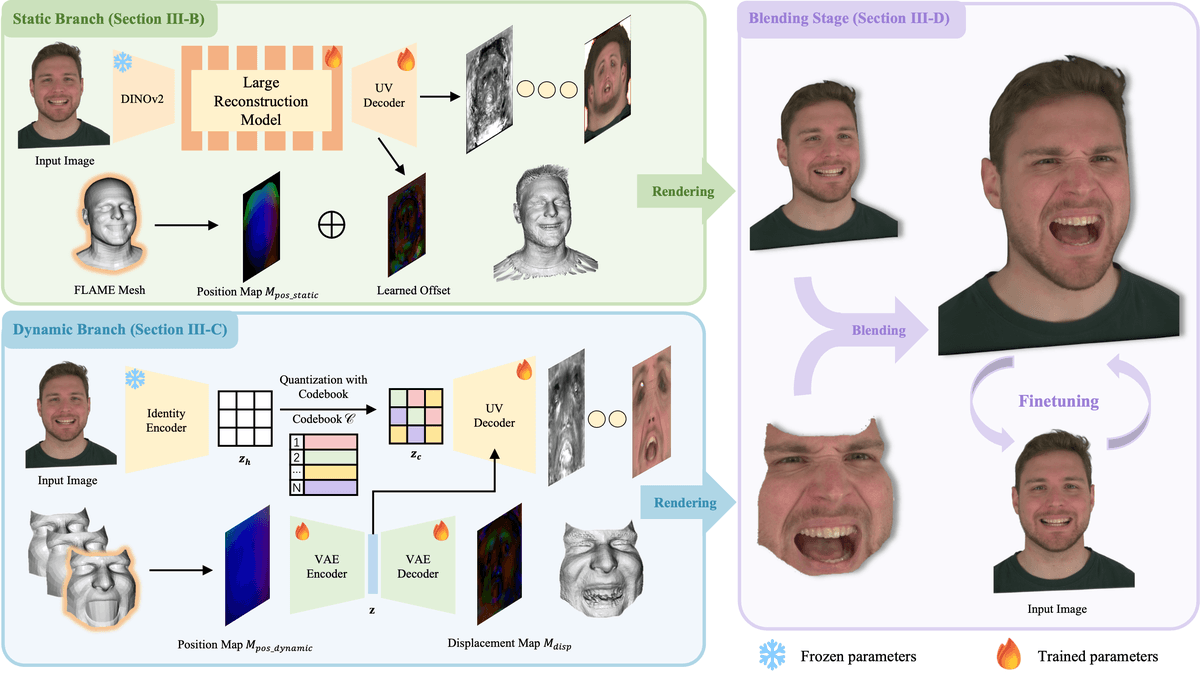
The core architectural bet is a hierarchical static-dynamic decomposition. Instead of asking one network to model both a person's identity and their moving mouth, SEGA splits the head into two specialists that share a common UV-space representation on top of a FLAME mesh (the standard parametric face model).
- Static Branch: A DINOv2 encoder pulls identity features out of the input photo. A UV-Alignment Transformer (a large reconstruction model with 10 self-attention layers) fuses those features into a 1024x1024 UV map. A decoder then predicts per-texel Gaussian color, opacity, rotation, scale, and a position offset from the FLAME surface. This branch owns rigid areas: forehead, scalp, hair, neck.
- Dynamic Branch: A frozen VQ-VAE encoder from CodeFormer produces a quantized identity code for the deformable regions, while a displacement VAE predicts per-vertex geometric offsets driven by an expression latent. A separate decoder emits Gaussian parameters for the mouth, eyes, and cheeks at a smaller 400x400 UV resolution.
Because the static parameters are expression-invariant, they can be computed once per identity and cached. Only the dynamic branch runs per frame. That's the trick that gets animation down to 50ms per frame on an A100, broken down as roughly 38ms for dynamic Gaussian generation and 13ms for rendering.
Why UV grid sampling matters
One easy-to-miss engineering detail is how Gaussians are placed on the head. The FLAME mesh has densely packed triangles around the eyes, nose, and ears but sparse coverage across the forehead and cheeks. Placing one Gaussian per face gives you a lopsided distribution that hurts training convergence.

SEGA instead samples Gaussians on a regular grid in UV space, then maps each sample back to 3D via the deformed mesh using barycentric averaging. The result is uniform Gaussian coverage over the whole head and appearance attributes that live as three-channel maps, so standard CNN and transformer decoders can process them directly.
The results
The team evaluated on the NeRSemble multi-view head dataset, using 110 subjects for training alongside 1,000 subjects from an internal capture, and holding out 34 identities for testing. Metrics were averaged across six camera viewpoints (frontal through side) and two expression sequences.
| Method | PSNR | LPIPS | CSIM | AKD |
|---|---|---|---|---|
| GPAvatar | 21.75 | 0.294 | 0.774 | 7.35 |
| Portrait4D-v2 | 22.22 | 0.268 | 0.806 | 8.23 |
| GAGAvatar | 23.18 | 0.252 | 0.835 | 6.23 |
| LAM | 22.81 | 0.292 | 0.819 | 7.35 |
| SEGA | 24.49 | 0.252 | 0.846 | 5.58 |
SEGA also wins on cross-identity reenactment (0.8517 CSIM versus 0.8438 for GAGAvatar) and holds up in a 60-participant user study across identity preservation, expression matching, and overall visual quality. Ablations show the hierarchical split is doing real work: cutting inference latency from 240ms (full-dynamic) to 50ms while improving PSNR from 24.94 to 25.33.
The real breakthrough
The headline is one-shot avatars, but the underlying insight is more general: rather than treating a face as a monolithic 4D field, decompose it by its physical behavior. Rigid regions need identity capacity and cross-view generalization, so throw a big 2D vision transformer and an LRM at them. Deformable regions need expression fidelity at low latency, so give them a lightweight quantized codebook and a small displacement VAE. The two priors that individually broke on the other axis can be trained jointly and blended with a UV-space alpha mask.
The other quiet contribution is the person-specific finetuning stage. After the generic feed-forward pass, SEGA spends about two minutes per branch finetuning the static and dynamic decoders on the input image using MSE plus perceptual loss. Without it, the ablation table shows PSNR drops from 25.33 to 23.75. It's a pragmatic acknowledgement that a one-shot prior can only take you so far, and that a few minutes of per-identity optimization is a fair price for a persistent avatar.
Where it falls short
The authors are candid about the limits. Subjects wearing glasses or other facial accessories confuse the model because the training data lacks such samples, and hair is treated as a rigid part of the static branch, so ponytails and long hair won't swing naturally. The framework is also strictly a facial-region method: no shoulders, no torso, no full-body driving.
As for availability, the project page is live but a code release has not been published; Papers With Code currently lists no code implementations for the paper. Anyone wanting to reproduce the pipeline today will need to reimplement it on top of gsplat, DINOv2, and a CodeFormer-style VQ-VAE, then supply their own multi-view training data.
What it unlocks
If the code drops, this is the sort of building block that changes a few workflows immediately:
- Telepresence and VR meetings: a user uploads a selfie once, gets a driveable avatar without a phone scan or a light stage.
- Game and film previs: rapid personalized digital doubles for stand-in animation, without a rigging pass.
- Cross-identity reenactment: puppeteering an avatar with a different driver's expression sequence, which the authors show works from in-the-wild smartphone photos under varied lighting.
SEGA doesn't invent a new representation, but it does show that the interesting frontier for Gaussian avatars is no longer squeezing more quality out of multi-view rigs. It's figuring out which priors to fuse, at what resolution, and which parameters you can afford to precompute so that a single photograph is enough.