
ByteDance's LibraGen Beats Kling and Vidu With Just 9,000 Training Samples
A research paper from ByteDance and Pazhou Laboratory reframes subject-to-video training as a balancing act, beating commercial models with only thousand-scale data.
 Pro
Takeaways
- Researchers from ByteDance and Pazhou Lab propose LibraGen, a subject-to-video training framework.
- Frames S2V as a balance between foundation model priors and new subject-consistency capability.
- Uses thousand-scale human-filtered data instead of noisy million-scale datasets.
- Merges in-pair and cross-pair LoRAs, plus Consis-DPO and Real-Fake DPO adapters.
- Introduces time-dependent CFG that shifts guidance from text to reference over denoising steps.
- Outperforms Kling O1, Vidu Q1, Phantom, and MAGREF on the authors' 200-case benchmark.
Subject-to-video (S2V) generation, where a model turns reference images plus a text prompt into a video that keeps the subject's identity consistent, has become the customization frontier for products like Kling, Vidu, and Sora 2. A new paper titled LibraGen: Playing a Balance Game in Subject-Driven Video Generation, from researchers affiliated with ByteDance and Pazhou Laboratory, argues the field has been fighting the wrong battle: chasing more data and stronger subject fidelity while quietly breaking the foundation model underneath.
The tug-of-war nobody was solving
Fine-tuning a text-to-video or image-to-video foundation model into an S2V model is a case of task-incremental learning, where the model has to pick up a new skill without losing what it already knows. The central challenge is to faithfully preserve the foundation model's intrinsic advantages, such as superior motion quality, appealing visual aesthetics, and strong prompt adherence, while simultaneously achieving robust subject-consistent video generation.
Prior work falls into two camps, and both have problems:
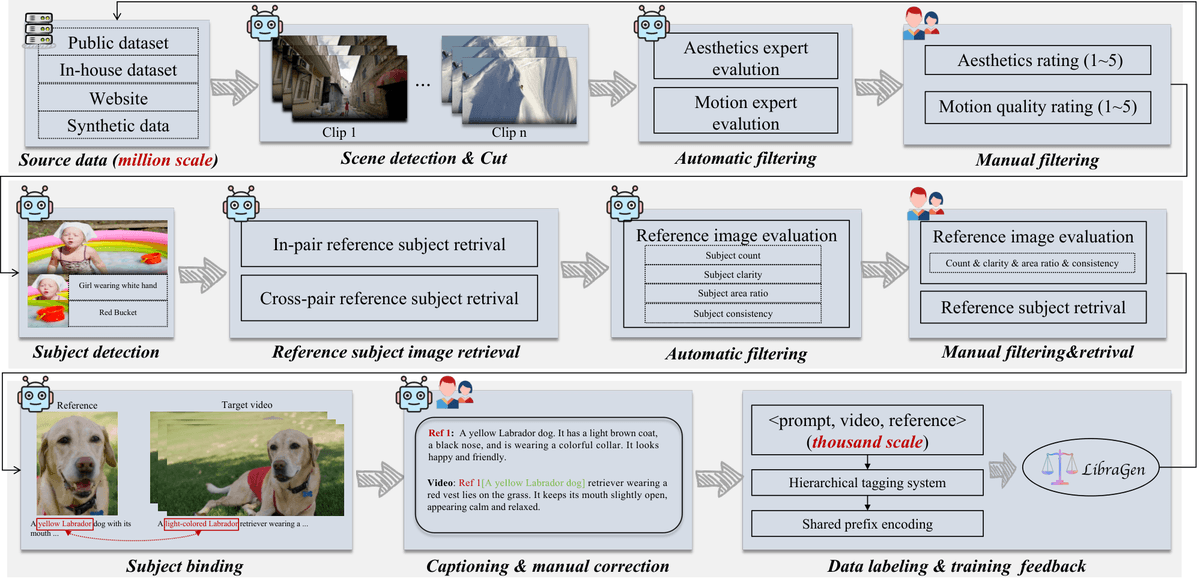
- In-pair training pulls the reference subject from a frame of the target video itself. This seemingly straightforward approach introduces severe reference content leakage during training, frequently resulting in undesirable copy-and-paste artifacts, killing motion and prompt adherence.
- Cross-pair training sources the reference from a different clip. It kills the copy-paste problem but significantly weakens the intrinsic correlation between the reference image and the target video content, often leading to compromised subject consistency.
The authors frame LibraGen around a philosophy they call "Raising the Fulcrum, Tuning to Balance", where data quality is the fulcrum and the training recipe is the balancing act.
Quality over quantity, aggressively
Instead of scaling to millions of noisy samples, LibraGen distills a million-scale raw dataset down to a thousand-scale, human-verified subset. The pipeline uses a dual-stage filtering process: first, clips are scored by motion and aesthetics experts, retaining the top 5%. Second, manual evaluations for motion coherence, amplitude, and aesthetics on a 1-5 scale keep only samples averaging 4 or higher. Both in-pair and cross-pair triplets are constructed, tagged with a five-level hierarchical scheme so the training mix can be tuned dynamically.

How the balancing act actually works
LibraGen is built on a Multi-Modal Diffusion Transformer backbone. Reference images and video frames are encoded by the same VAE, then concatenated along the temporal dimension with binary flags marking which tokens are references. This lightweight injection means neither additional vision encoders nor extra preprocessing steps such as subject segmentation are needed.
The training recipe, dubbed Tune-to-Balance, has three moving parts:
- Two LoRAs, then merge. The team fine-tunes two separate LoRA adapters, one on in-pair data and one on cross-pair data, then linearly interpolates their weights. Ablations settle on a merging coefficient of 0.15 for the in-pair LoRA, enough to lift subject fidelity without triggering copy-paste.
- Two DPO pipelines, then merge again. Consis-DPO improves identity consistency by generating negative samples through manipulated RoPE offsets on reference embeddings, holding motion and aesthetics constant. Real-Fake DPO uses real training clips as positives and outputs from the in-pair-trained model (which produces copy-paste artifacts) as negatives, restoring motion and visual quality.
- Time-dependent classifier-free guidance. Early denoising steps mostly commit to structure and motion from text, while later steps paint in texture from the reference. LibraGen linearly decreases the text guidance scale from 5 to 1 and increases the reference scale from 1 to 4 across denoising, giving cleaner control over the text-versus-reference tradeoff.

The numbers versus commercial systems
Evaluation runs on an in-house benchmark of 200 test cases spanning single- and multi-subject generation, with references distributed across 1 to 4 subjects. Baselines include commercial systems Vidu Q1 and Kling O1, plus open-source Phantom and MAGREF.
| Model | Motion Smoothness | Aesthetic | Text Align. |
|---|---|---|---|
| Vidu Q1 | 0.5373 | 0.6491 | 3.315 |
| Kling O1 | 0.4965 | 0.6479 | 3.567 |
| MAGREF | 0.3830 | 0.6356 | 1.784 |
| Phantom | 0.3844 | 0.6410 | 1.998 |
| LibraGen | 0.5380 | 0.6496 | 3.594 |
On subject consistency measured via GSB ratio (win minus loss over total), LibraGen posts positive ratios against every baseline, peaking at 0.700 against MAGREF in the four-reference setting. All of this was achieved with roughly 9,000 SFT samples plus a few thousand DPO pairs, not the millions typical of frontier video training runs.
Where it fits, where it does not
The paper positions LibraGen as a recipe for adapting off-the-shelf foundation models to S2V without full fine-tuning or million-scale corpora. That is a useful pattern if you already have a strong T2V or I2V base and want to add reference-driven customization without wrecking the base model's motion or prompt behavior. The authors also note the design principles extend to emerging audio-video generation models.
Some caveats worth flagging. The dynamic CFG schedule adds inference latency because it requires two extra velocity function evaluations per step. The MM-DiT backbone is Seedance-style, so reproducing results outside that architecture family requires porting the lightweight injection scheme. And this is a preprint on arXiv with a project page but no released weights or code so far, so the practical value today is the methodology rather than a drop-in checkpoint.
Still, the broader takeaway lands: for S2V post-training, a thousand carefully curated samples plus a disciplined merge-and-balance recipe can outperform brute-force scaling, and the balance framing (in-pair versus cross-pair, DPO for consistency versus DPO for realism, static versus dynamic CFG) gives a clean vocabulary for reasoning about what breaks when subject-driven fine-tuning goes wrong.