
ByteDance's COD Framework Predicts 70B Model Benchmarks With 1.55% Error
ByteDance's COD framework predicts 70B LLM benchmark scores from small models with just 1.55% error, solving the long-standing emergence problem in scaling laws.
 Pro
Takeaways
- COD framework from ByteDance Seed predicts 70B LLM benchmark scores using only small model runs, achieving 1.55% average error.
- Solves two core scaling law failures: emergence (capabilities appearing suddenly at scale) and heterogeneous difficulty across benchmark questions.
- Groups benchmark questions by their difficulty fingerprint across model sizes, fits separate scaling curves per cluster, then maps back to full benchmark score.
- Outperforms all baselines including loss-intermediate and end-to-end methods, which reach up to 13% max error on individual benchmarks.
- Difficulty clusters transfer across model architectures (dense to MoE), suggesting question difficulty is model-agnostic.
- No public code release, but full pseudocode and proofs are in the paper; compute overhead is ~0.002% of training cost.
Training a 70-billion-parameter language model costs tens of millions of dollars and months of compute. Before you commit, you want to know: will it actually be good at math? At reasoning? At code? The field has long relied on scaling laws -- mathematical relationships that predict how a model will perform as you throw more compute at it -- but those laws have a dirty secret: they work beautifully for training loss, and they fall apart for the benchmarks that actually matter.
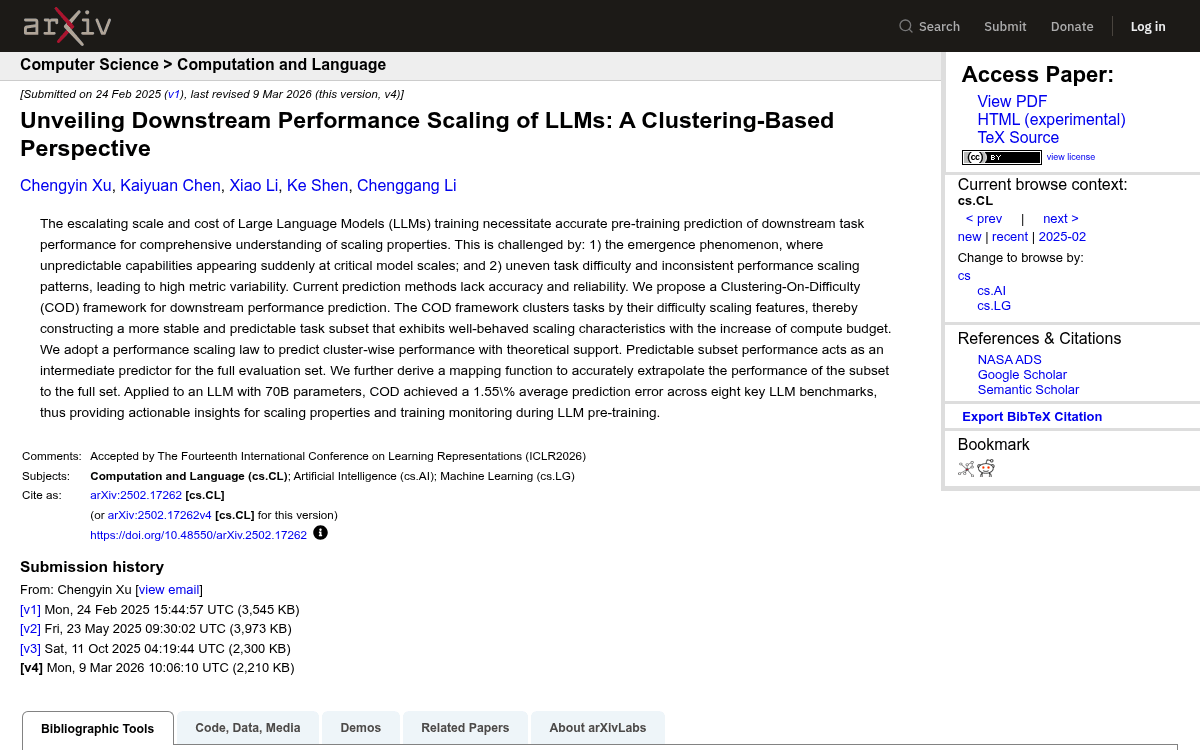
A team from ByteDance Seed has now published a framework called Clustering-On-Difficulty (COD) that cracks this problem. By grouping benchmark questions by how hard they are for small models and fitting separate scaling curves to each group, COD predicts the downstream benchmark performance of a 70B model with an average error of just 1.55% -- less than half the error of the best prior methods.
Why training loss is the wrong signal
LLM success heavily relies on scaling model parameters and pre-training data, with training loss empirically following a power-law relationship with compute. The problem is that this reduction in training loss primarily reflects an in-domain compression effect and does not necessarily indicate improved out-of-domain generalization or downstream performance. In other words, a model that memorizes its training data better is not necessarily a model that scores higher on MATH or BBH.
There is a second, nastier problem: emergence. Predicting downstream task performance remains a critical challenge due to emergent abilities in LLMs -- capabilities that manifest only after exceeding task-specific thresholds. A small model might score at random-chance on a reasoning benchmark, giving you no useful signal, and then a larger model suddenly jumps to 60% accuracy. Any extrapolation method that tries to fit a smooth curve through those early near-zero data points will fail badly.
The existing approaches split into two camps, and both have serious weaknesses:
- Loss-intermediate methods: Predict training loss first, then map loss to accuracy. These encounter a fundamental limitation: the inconsistent mapping between loss and performance metrics. The same loss value can correspond to wildly different benchmark scores depending on model size and learning rate schedule.
- End-to-end methods: Fit a single curve directly from compute to accuracy. These assume all benchmark questions follow the same scaling pattern -- an assumption the paper shows is simply false.
The core insight: questions are not all the same
The COD paper's central observation is deceptively simple: the COD framework clusters tasks by their difficulty scaling features, thereby constructing a more stable and predictable task subset that exhibits well-behaved scaling characteristics with the increase of compute budget. Even within a single benchmark like BBH, some questions are easy enough that small models already get them right, some scale smoothly with compute, and some are so hard that no model under 30B parameters gets them at all. Fitting one curve to all of them is like fitting one trendline to three completely different datasets.

How COD works, step by step
The pipeline has four stages:
- Build difficulty vectors. For each question in the benchmark, run 100 samples on each of several small models (ranging from 122M to 12B parameters in the paper's setup) and record the pass rate. Concatenate these pass rates into a vector ordered by model size. This vector is the question's "difficulty fingerprint" -- it captures not just how hard the question is, but how its difficulty changes with scale.
- Cluster by difficulty fingerprint. Group questions with similar fingerprints together using an improved MeanShift algorithm. The key requirement is tight intra-cluster similarity: questions in the same cluster should have nearly identical scaling behavior, so a single curve can fit all of them. Questions that don't fit any cluster cleanly (outliers, zero-performance questions) are set aside.
- Fit and extrapolate per cluster. For each cluster that shows clean scaling behavior (the "extrapolatable" clusters), fit the formula
y(C) = g + (1-g) * exp(-a*C^(-b) - c), wheregis the random-guessing baseline,Cis compute in FLOPs, anda,b,care fitted parameters. This formula is derived from first principles: it connects the well-established power-law scaling of training loss to the accuracy metric, accounting for the gap between geometric and arithmetic averaging of per-question pass rates. Clusters where small models show no improvement (non-emergent) or are already saturated are excluded from direct extrapolation. - Map the predictable subset back to the full benchmark. The extrapolatable clusters only cover a fraction of the questions. To get the full benchmark score, COD fits a smooth spline mapping from the predicted subset accuracy to the full-set accuracy, calibrated using a few anchor points from existing open-source models (e.g., Qwen2-72B). This works because the relative ordering between easy and hard questions is stable across model families.
The math behind the scaling formula
The fitting formula is not ad hoc -- it comes with a proof. The key insight is that accuracy on a set of questions equals the arithmetic mean of per-question pass rates, while loss scaling laws give you the geometric mean. Using Taylor expansion, the difference between arithmetic and geometric means can be approximated as σ²/(2μ), where μ and σ² are the mean and variance of the loss distribution. This approximation is accurate precisely when questions within a cluster have similar difficulty -- which is exactly what the clustering step enforces. The random-guess term g handles multiple-choice tasks where small models score above zero by chance.
Results that hold up under scrutiny
COD achieves an average prediction error of 1.55% on a 70B LLM, substantially outperforming existing methods and establishing a promising paradigm for accurate downstream performance scaling. The comparison against four baselines is stark:
| Method | Mean Error (%) | Max Error (%) |
|---|---|---|
| Loss-intermediate | 5.29 | 9.39 |
| End-to-end (exp) | 3.10 | 6.00 |
| End-to-end (passrate) | 5.02 | 8.80 |
| End-to-end (BNSL) | 5.17 | 13.05 |
| COD (Complete) | 1.55 | 2.68 |
The max error column is arguably more important than the mean. A prediction framework is only useful if you can trust it on every benchmark, not just on average. COD's worst-case error of 2.68% compares favorably to baselines that regularly exceed 5-13% on individual benchmarks like BBH or MMLU-pro.
The team also tested whether the difficulty clusters learned from dense models transfer to a 32B Mixture-of-Experts (MoE) architecture. They do -- COD still achieves the lowest average error in cross-architecture extrapolation, though accuracy drops somewhat compared to dense-to-dense prediction. The intuition is sound: question difficulty is an intrinsic property of the question, not of the model family.
What it's good for -- and where it breaks
COD is most useful for labs training models at scale who need to make go/no-go decisions before the full training run completes. Concretely:
- Training monitoring: Detect early if a 70B run is on track to hit target benchmark scores, using only checkpoints up to ~12B.
- Architecture comparison: Compare two training recipes by running small-scale ablations and extrapolating to 70B, without paying for the full run.
- Data mix optimization: Predict how changes to the pre-training data mixture will affect downstream benchmarks at scale.
- Continual pre-training: The paper shows COD extends to the high-quality data "decay phase" used by models like LLaMA 3 and DeepSeek-V3, achieving a 2.18% average error on continued pre-training predictions.
The framework has real limitations worth noting. It requires a sufficient number of test questions per benchmark -- too few and the clusters become unstable. It does not currently handle chain-of-thought evaluation (where models reason before answering), because the theoretical derivation assumes a direct answer-loss-to-passrate relationship that breaks down when reasoning traces are involved. It also struggles to predict performance of relatively small target models (around 10B), because the proxy models used for clustering are themselves tiny and most questions show non-emergent behavior at that scale.
There is no public code release mentioned in the paper, but the methodology is described in enough detail -- including full pseudocode for the improved MeanShift algorithm and proofs for the scaling law theorem -- that replication should be feasible. The compute overhead is negligible: the authors estimate the additional inference cost of running COD is roughly 0.002% of the total training cost for a 12B model.
The real breakthrough here is not the 1.55% number itself -- it is the demonstration that benchmark questions have intrinsic, model-agnostic difficulty structure that transfers across architectures and data distributions. That insight opens a path toward treating benchmark design as a first-class engineering problem: the paper even suggests that the fraction of "predictable" questions in a benchmark is a useful quality metric for the benchmark itself.