
Buffalo's InterventionLens Beats Autism Therapy Baselines by 20 F1 Points
A multi-agent pipeline built on Gemini and Whisper turns home videos of parents reading to autistic children into structured clinical assessments, with no fine-tuning.
 Pro
Takeaways
- InterventionLens automates detection of caregiver intervention strategies in home-based ASD shared reading videos.
- Multi-agent pipeline built on Gemini 3 Flash and Whisper, no fine-tuning required.
- Achieves 79.44 F1 on ASD-HI, beating the baseline by 19.72 points.
- Two-layer design: perception agents produce transcripts and book context; expert agents verify and refine segments.
- Ablating the Book Modeling Agent drops F1 by 10 points, confirming triadic caregiver-child-book grounding.
- Modeling strategy remains hard at 36.28 F1, partly due to inconsistent annotation across dataset splits.
Analyzing how parents help autistic children learn language usually involves a speech-language pathologist watching hours of home video and hand-labeling every prompt, pause, and response. A team from the University at Buffalo has now built InterventionLens, a multi-agent system that automates that annotation work using off-the-shelf large models and structured prompting, and it beats the previous published baseline by nearly 20 F1 points.
Why home videos are so hard to parse
Shared book reading is one of the most accessible interventions for children with autism spectrum disorder (ASD), and clinicians increasingly ask families to record sessions at home for expert review. That expert-driven annotation is labor-intensive, costly, and difficult to scale, creating a clear need to automatically detect intervention strategies from home-based videos.
The technical problem is nastier than it looks. Shared reading is a triadic interaction among a caregiver, a child, and a book, where caregivers coordinate speech with gaze, expressions, and gestures while ambient noise and non-fixed camera angles degrade mainstream ASR systems like Whisper. On top of that, the only relevant public benchmark is small, so training a specialized model from scratch is not really an option.
The paper targets three well-defined caregiver strategies from the Parent-Implemented Communication Strategies (PiCS) framework:
- Modeling: the caregiver demonstrates the target word or phrase for the child.
- Mand-Model: the caregiver prompts the child to respond and then provides a model when needed.
- Time Delay: the caregiver deliberately pauses to create an opportunity for the child to initiate or complete the response.
A two-layer stack of specialized agents
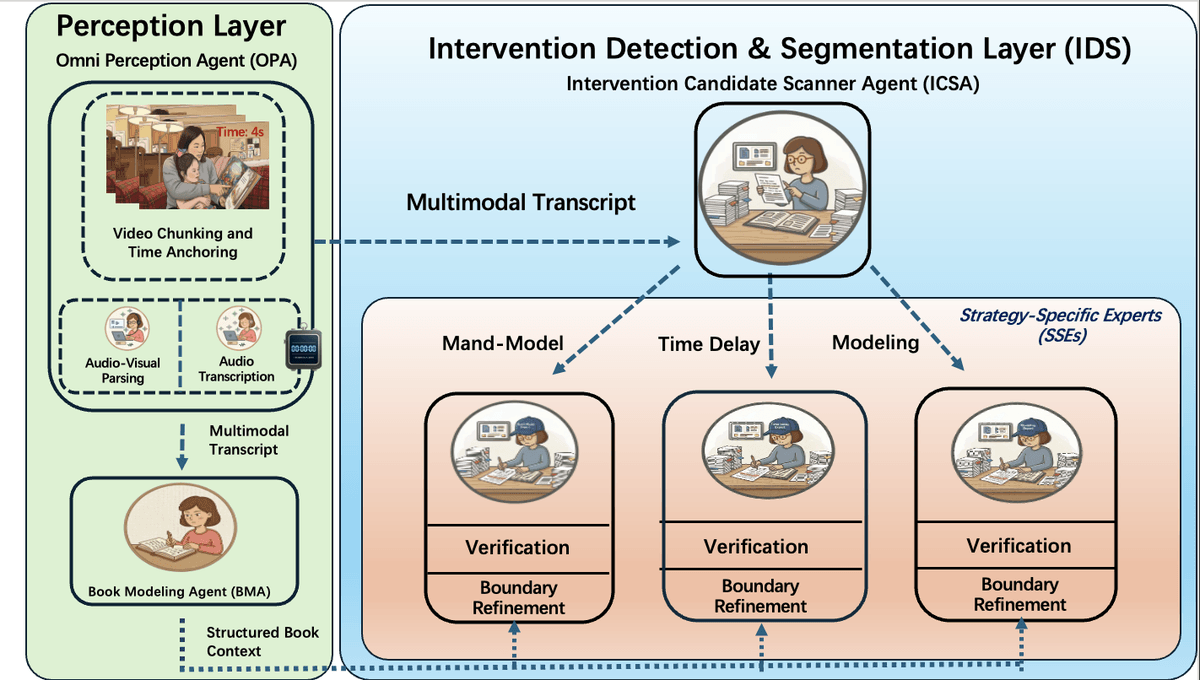
InterventionLens splits the task into a Perception Layer that turns raw video into time-aligned multimodal transcripts and structured book context, and an Intervention Detection and Segmentation (IDS) Layer that proposes candidate segments and hands them to strategy-specific experts for verification and boundary refinement. Every agent is a prompted Gemini 3 Flash call. No weights are updated.
The Perception Layer has two agents. The Omni-Perception Agent (OPA) does the multimodal parsing: it uses gemini-3-flash-preview to parse dialog and visible interaction cues, overlays a red timestamp in the bottom-right corner of each frame as an explicit temporal reference, and processes long recordings as sequences of 15-second clips. In parallel, Whisper transcribes the audio and the two streams are aligned under semantic and temporal consistency constraints, replacing Gemini's timestamps with Whisper's when a caregiver utterance matches closely. That fusion is what rescues them from Whisper's well-known trouble with child speech.
The Book Modeling Agent (BMA) is the more interesting piece. Rather than reconstructing the full book content, BMA extracts contextual cues such as recurring sentence patterns and potential target words from the interaction transcript, which is then used as semantic grounding for downstream expert modules. This encodes the paper's core assumption that shared reading is a triangle, not a dialogue.
Coarse-to-fine detection
The IDS Layer starts with the Intervention Candidate Scanner Agent (ICSA). It extracts two clinically meaningful candidate patterns: Complete Intervention Loops that follow a caregiver stimulus, child response, and caregiver reinforcement sequence, and Intervention Attempts where the caregiver provides a stimulus but the child does not respond. ICSA then tags each candidate MODEL-like, MAND-like, or TD-like as a routing signal.
Each candidate is dispatched to one of three Strategy-Specific Experts (SSEs). Every expert follows the same two-stage cascade: strategy-specific verification against constraints induced from the training set plus book-context cues, followed by temporal boundary refinement that trims adjacent turns that do not belong to the intervention itself.
Because there is no training loop, the authors add a substitute they call Progressive Knowledge Refinement. They initialize the agent's structured guidance from the ASD-HI annotation protocol, then iteratively run the full system on the training split, analyze recurrent failure cases, and update the rules based on the most frequent error patterns, stopping when F1 does not improve for three consecutive iterations. Effectively, the prompts get debugged the way you would debug code.
The numbers
Evaluation runs on the ASD-HI benchmark, which contains 48 complete shared-reading sessions from 3 families with expert-provided fine-grained annotations of caregiver intervention segments. Scoring is strict: a prediction counts only if the strategy label matches exactly, the segment captures the complete caregiver-child interaction, and the time interval aligns with the reference within a 1.0-second tolerance.
| Method | Precision | Recall | F1 |
|---|---|---|---|
| Baseline (Whisper + single LLM) | 50.21 | 73.68 | 59.72 |
| InterventionLens | 82.36 | 76.75 | 79.44 |
Precision jumps by 32 points while recall holds steady, meaning the system is not just predicting more aggressively but cutting false positives while keeping coverage of real intervention segments. Per strategy, Mand-Model reaches an F1 of 89.82, Time Delay 68.65, and Modeling only 36.28. The authors trace the Modeling gap partly to inconsistent labeling: in the training split repeated target-word expressions like "black sheep... black sheep" are labeled as Modeling, whereas similarly structured "red bird... red bird" utterances from the same caregiver are not labeled that way in the evaluation split.
Ablating the Book Modeling Agent is the most telling result. Without BMA, F1 drops from 79.44 to 68.97, with Modeling collapsing from 36.28 to 16.96 and Mand-Model falling from 89.82 to 80.27. Grounding utterances in what is actually on the page matters more than any single perception trick.
Where it fits and where it does not
This is a useful template for anyone building clinical or educational video analytics on top of frontier multimodal models. The recipe is worth stealing: convert a coding manual into agent roles, use OCR-style timestamp overlays for temporal grounding, align a multimodal model's transcripts with a dedicated ASR, and iterate on prompts against a small labeled set instead of fine-tuning.
Limits are real, though. The Modeling category is essentially broken at 36 F1. The evaluation covers only three families, and the authors themselves note that transferability across datasets, family settings, and annotation schemes still requires more systematic validation. And because every candidate involves multiple Gemini calls plus Whisper, throughput and cost per session will be nontrivial for anyone thinking about deployment.
The project page promises additional resources but no code or model weights are released with the paper, so reproduction currently means reimplementing the agent prompts against the ASD-HI dataset yourself.