
BSA-10 Teaches AI Surgery's 10 Atomic Moves Across 6 Specialties
A multi-institutional team built the largest surgical action dataset yet and a foundation model that recognizes 10 core actions across specialties.
 Pro
Takeaways
- Multi-institutional team releases BSA-10, the largest surgical action dataset with 11,915 clips across 10 actions and 6 specialties.
- Transformer model with space-time attention hits 91.98% sensitivity and 95.47% specificity in 10-fold cross-validation.
- Generalizes to unseen procedures: 88.23% AUROC on Chinese lobectomy, 90.83% on Singapore hepatectomy data.
- Action barcodes cleanly separate expert from novice surgeons using retry frequency and idle-time proportion.
- GPT-4o planner predicts next surgical action with 71.29% top-3 accuracy for cholecystectomy Critical View of Safety.
- Multinational surgeon review found 93.88%-100% top-3 alignment between AI recommendations and expert next-action choices.
A group of researchers from the Chinese University of Hong Kong, the National University of Singapore, Johns Hopkins, NVIDIA, and a network of hospitals across Hong Kong, Singapore, and mainland China have released a new paper that tries to do for surgery what ImageNet did for object recognition: define a small vocabulary of primitive actions, collect a huge labeled corpus, and train a foundation model on top of it.
The system, called BSA-10, targets what the authors call Basic Surgical Actions, the atomic gestures that make up every laparoscopic and robotic operation. The dataset covers 10 actions across 6 surgical specialties with 11,915 video clips, sourced from 15 public surgical datasets plus a new collection of credentialed YouTube videos the team calls SurgYT.
Why surgical video AI keeps hitting a wall
Most existing surgical AI models are trained on a single procedure, in a single hospital, with a single set of instruments. They rarely transfer. Recent foundation models and LLM technologies offer general-purpose recognition and reasoning capabilities, but existing surgical datasets, limited by their size and procedural scope, cannot fully unleash these powerful computational tools.
The BSA idea sidesteps this by working one level below procedures. A cholecystectomy and a nephrectomy look totally different anatomically, but both involve dissection, coagulation, clipping, and retraction. Model those primitives well and you have a substrate that generalizes.
The 10 actions in the catalog are:
- Aspiration (suctioning fluids)
- Clipping (applying clamps to vessels)
- Coagulation (thermal hemostasis)
- Dissection (separating tissue layers)
- Knot-tying
- Needle grasping
- Needle puncture
- Packaging (placing tissue in a sterile bag)
- Suture pulling
- Tissue retraction

Inside the model
The recognition model is a Transformer that operates on video clips. Given an input clip of T RGB frames, the model maps it to a probability distribution over the ten actions. Each frame is divided into non-overlapping patches following the ViT approach, and the encoder alternates temporal and spatial self-attention rather than doing full spatiotemporal attention over every token pair.
That factorization matters for cost. The space-time attention performs only N+T+2 comparisons per patch instead of NT, giving complexity O((N+T+2)d^2) versus O(NTd^2) for full spatiotemporal attention.
The other architectural wrinkle is a dual-head design to fight class imbalance. Dissection alone accounts for roughly 44% of clips, while packaging and knot-tying are rare. The team proposes a dual-head architecture that combines a standard multi-class MLP head with an imbalance compensation head, designed to mitigate biases arising from uneven class distributions. The compensation head produces a penalization weight for the dominant class and a compensation weight for the rest, reweighting the final probabilities.
Training details worth noting:
- ViT-B/16 backbone, 768-dim embeddings, 224x224 input frames
- 16 frames per clip, sampled every 4 frames after downsampling to 1 fps
- SGD with lr 0.005, momentum 0.9, batch size 6, 50 epochs
- Evidential loss to model prediction uncertainty via a Dirichlet distribution
- Four NVIDIA RTX 4090 GPUs, ~5 hours to train
How well it actually generalizes
Ten-fold cross-validation with video-level splits (not clip-level, which would leak) gives strong numbers. All ten surgical actions received recognition with AUROC scores above 0.9, with average sensitivity of 91.98% and average specificity of 95.47%.
The interesting test is on procedures the model never saw during training. The team collected lobectomy videos from Shenzhen People's Hospital and hepatectomy videos from National University Hospital in Singapore. On thoracic lobectomy data, the BSA foundation model achieved an AUROC of 88.23%, sensitivity of 82.30%, and specificity of 87.05%, despite very different anatomy (spongy lung tissue) and specialized tools like endostaplers. On Singapore hepatectomy data, the model achieved an AUROC of 90.83%, sensitivity of 81.72%, and specificity of 92.39%.

From recognition to skill scoring
Recognition is table stakes. The more interesting question is what you build on top. The paper demonstrates two downstream applications.
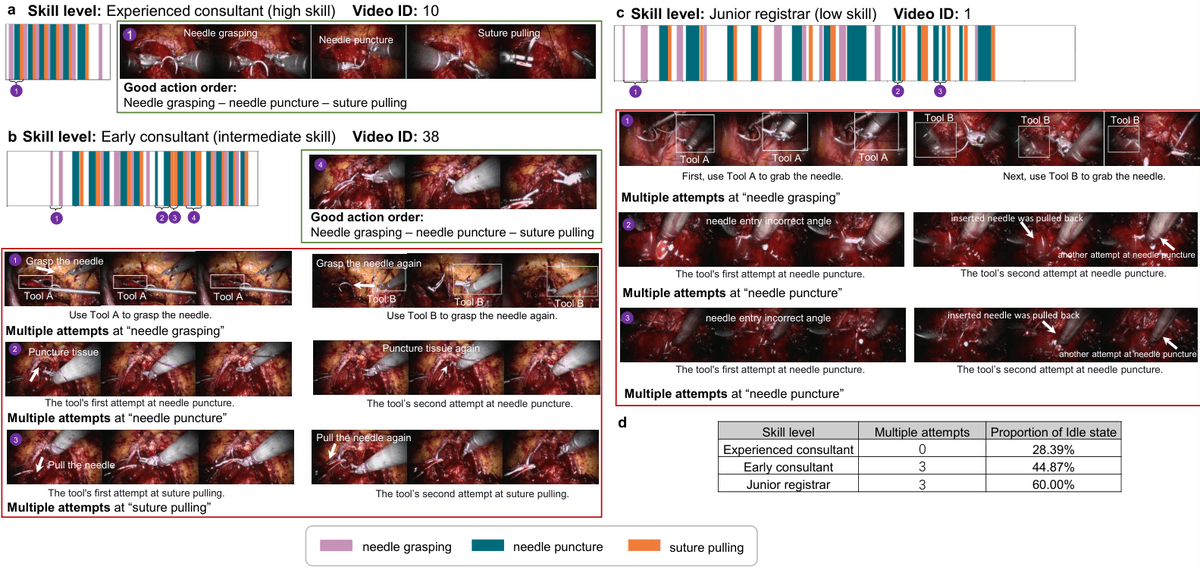
The first is skill assessment. Applied to the SAR-RARP50 robotic prostatectomy dataset, the model turns each surgery into an action barcode, a color-coded timeline of BSAs. Two signals fall out cleanly: how often a surgeon has to retry the same action, and how much of the procedure is idle time. An experienced consultant showed zero multiple attempts and 28.39% idle state over 2min 7s, while the junior registrar had multiple regrasping attempts and 60% idle state over a prolonged 9min 22s. That maps to expertise level without any subjective rubric.
An LLM planner for the next surgical move
The second application is surgical action planning with a vision-language model. The team wires GPT-4o into a lightweight agent that takes recent history plus a current frame and predicts the next 1-3 actions with reasoning.
The prompting scheme is worth flagging because it's deliberately minimal on distant history. The distant history is limited to the last 4 predicted BSAs, while the near history focuses on the clip-action pair corresponding to the most recent action, plus a single current frame. The system prompt includes surgical process rules, safety protocols, and action descriptions.
They tested this on two contexts:
- Cholecystectomy CVS: reaching the Critical View of Safety before cutting the cystic duct
- Nephrectomy renal cortex suturing: a three-action micro-sequence of needle grasping, puncture, and suture pulling
Results are mixed but revealing. For the cholecystectomy scenario, strict top-1 global accuracy was 34.00%, but top-3 global accuracy jumped to 71.29%, and relaxed top-3 local and global accuracies were 91.56% and 90.58%. In other words, the model's top guess often gets the exact next step wrong, but a clinically valid option almost always appears in its top 3.

To sanity-check the generated reasoning, two surgeons (Hong Kong and Singapore) scored 98 samples on terminology, correctness, completeness, safety, and next-action reasonableness. Top-3 inclusion of surgeon-recommended actions reached 93.88% to 100% across regions, though the two reviewers often disagreed on strictness, which itself hints at the variability the system will face in deployment.
What is not there yet
The authors are honest about the ceiling. The framework is limited to predefined BSA categories, which restricts discovery of novel surgical actions, and real-time robotic integration remains unexplored. It also lacks continuous learning capabilities.
Some other gaps to keep in mind:
- No public code or model weights are announced in the paper
- Nephrectomy planning accuracy is capped by BSA recognition itself, which only hit 62.10% on that specialty
- Hysterectomy remains the hardest procedure at 85.67% AUROC
- The planner leans on GPT-4o, so the reasoning quality is bounded by a closed commercial API
Still, the direction is worth watching. If surgery really can be factored into a small alphabet of primitives, then the next generation of surgical assistants, robotic controllers, and objective skill scorers can be trained on shared substrates instead of one-off datasets per hospital. This work is the most concrete argument so far that the alphabet exists and can be learned.