
Brown University's Residual RL Fix Trains Robots Faster Without Breaking Base Policies
A new take on residual reinforcement learning uses base policy uncertainty to guide exploration and adds an asymmetric critic for stochastic policies.
 Pro
Takeaways
- New residual RL method uses base policy uncertainty to constrain exploration, accepted at IEEE RA-L. Paper
- Residual policy only activates when the base policy is uncertain, with an exponentially decaying threshold.
- Asymmetric actor-critic learns Q over the combined action while the actor predicts only residual actions.
- Outperforms DPPO, IBRL, and Policy Decorator across Robosuite and D4RL Franka Kitchen tasks.
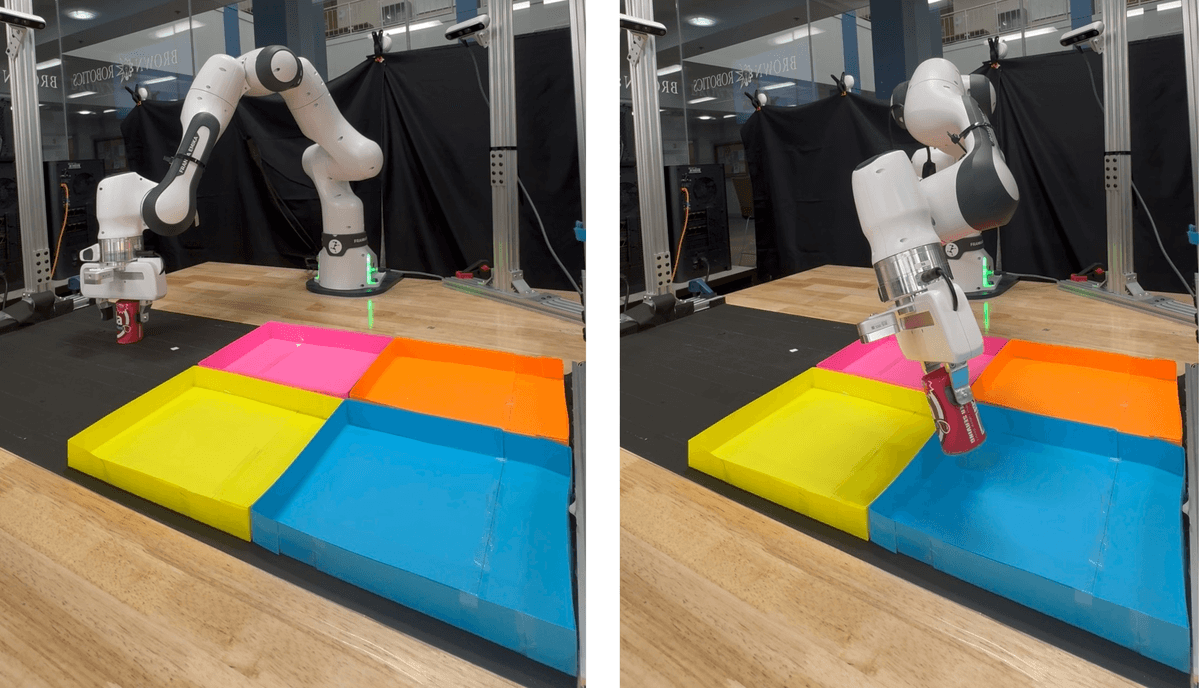
- Zero-shot sim-to-real transfer demonstrated on a Franka arm doing the Can pick-and-place task.
- Code available on GitHub; project page.
Fine-tuning a pretrained robot policy with reinforcement learning sounds simple until you actually try it. Full fine-tuning of a diffusion policy or a large behavior cloning model is expensive, unstable, and easy to break. Residual RL sidesteps that by freezing the base policy and learning a small corrective policy on top, but existing methods explode the exploration space and assume the base policy is deterministic, which most modern imitation policies are not.
A team from Brown University and the Robotics and AI Institute has a fix. Their new paper, Accelerating Residual Reinforcement Learning with Uncertainty Estimation, accepted to IEEE Robotics and Automation Letters, proposes two changes that make residual RL both faster to train and compatible with stochastic policies like Diffusion Policy and Gaussian Mixture Model behavior cloning. Code is on GitHub.

The two things residual RL keeps getting wrong
Standard residual RL learns corrective actions uniformly across the state space. That means the residual agent burns interactions trying to fix parts of the trajectory where the base policy was already doing fine. Combined with sparse rewards, this leads to slow, unstable training.
The second issue is more subtle. Off-policy residual methods learn a Q-function only over the residual action, Q(s, a_r), which implicitly assumes the base action can be inferred from the state. With a stochastic base policy that samples different actions from the same state, that assumption breaks and the critic gets confused about what actually happened in the environment.
Uncertainty as an exploration budget
The first fix is intuitive. If the base policy is confident about what to do, let it drive. Only invoke the residual correction when the base policy is uncertain. The paper formalizes this with a threshold on an uncertainty metric:
if uncertainty(s) < tau:
    action = a_base
else:
    action = a_base + a_residual
The threshold tau starts high and decays exponentially toward zero over training, so the residual gradually takes over as it improves. The method is agnostic to how you measure uncertainty. The authors test two options:
- Distance-to-data: the minimum L2 distance from the current state to any state in the demonstration dataset. Simple, works well when demos are clean.
- Ensemble variance: variance across an ensemble of base policies. More robust when the demonstration data is noisy or contains random play data.
An asymmetric actor-critic for stochastic bases
The second contribution is a small but meaningful tweak to Soft Actor-Critic. The actor still predicts only the residual action a_r, but the critic learns Q(s, a_c) where a_c = a_b + a_r is the full combined action executed in the environment. Both the base action and combined action are stored in the replay buffer so target computation can reconstruct the total action correctly.
This makes the critic invariant to how the total action is split between base and residual, and it gives the Q-function the information it needs to handle a noisy base policy. Ablations show that for stochastic bases, learning over the residual action alone barely trains at all, while the combined-action formulation converges cleanly. For deterministic bases, either formulation works.
How it stacks up on Robosuite and Franka Kitchen
The team evaluated on Lift, Can, and Square from Robosuite plus Kitchen Complete from D4RL, using both GMM and Diffusion base policies. Baselines include DPPO for diffusion fine-tuning, IBRL and IBRL-RPL for demo-augmented RL, and Policy Decorator for the closest residual RL competitor.

Highlights from the results:
- With GMM base policies, the distance-to-data variant outperforms every baseline on all three Robosuite tasks.
- With Diffusion base policies, the method beats DPPO and Policy Decorator on Kitchen Complete and Can, and matches DPPO on the harder Square task.
- Learned policies transfer zero-shot to a real Franka robot on the Can task, retaining most of their simulation performance while the base behavior cloning policies degrade significantly.
- The approach also works with image observations when using ensemble variance instead of distance-to-data.
Where it breaks and what it is good for
The method leans on a key assumption: when the base policy is confident, it is also correct. That holds up when demonstrations are relatively clean, but breaks on the Kitchen Partial and Kitchen Mixed datasets, where base policies are trained on undirected play data. In those cases, distance-to-data fails to outperform the base policy, though ensemble variance partially rescues performance. Picking the right uncertainty metric matters, and neither is universally best.
Practically, this is a useful tool if you have a pretrained imitation policy that mostly works but fails in specific regimes, and you want to improve it online without the cost or instability of full fine-tuning. It fits naturally between imitation learning and full RL, and the modifications are small enough to layer onto an existing SAC implementation. The authors suggest that with better epistemic uncertainty metrics, the same approach could extend to robot foundation models.