
Brown University's PSW Teaches Robots to Transfer Skills From One Object to Any
A new robotics method breaks objects into semantic parts before transferring skills, letting robots generalize a single demo to wildly different shapes.
Takeaways
- Brown and Northeastern researchers introduce Parts-Based Shape Warping for one-shot robot skill transfer across novel object geometries.
- Objects are decomposed into semantic parts, each modeled by a small PCA generative model trained on 5-10 examples.
- The system autonomously picks which part relationships matter for a given skill from a single demonstration.
- Mug-on-Rack success climbed to 0.78 versus 0.64 for Interaction Warping and 0.42 for R-NDF in simulation.
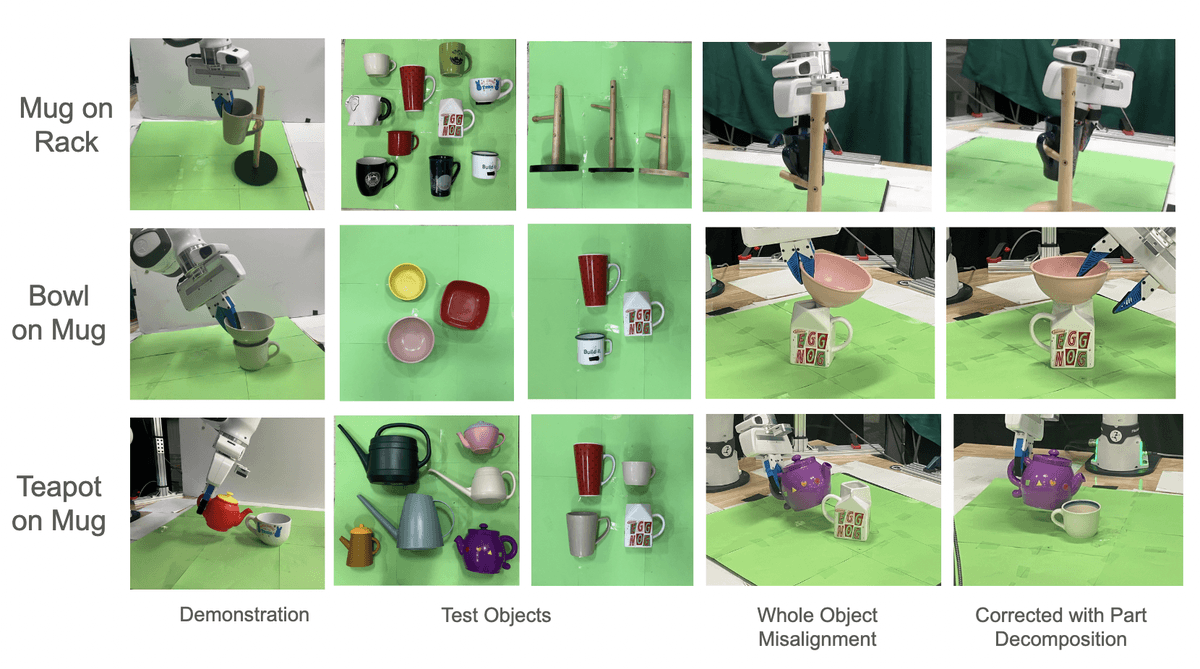
- On a real robot, PSW hit 23 of 27 placements on mug-on-rack, more than double the whole-object baseline.
- Method enables cross-category transfer, treating watering cans as teapots via shared parts; accepted at ICRA 2026.
Teaching a robot to pour tea from one teapot and expecting it to pour from any teapot sounds trivial. In practice, swap in a vessel with a long spout and a stubby handle, and most one-shot imitation methods fall apart. A team from Brown University and Northeastern has a fix: stop treating the object as one blob of geometry, and start reasoning about it as a composition of parts.
Their paper, One-Shot Cross-Geometry Skill Transfer, introduces Parts-Based Shape Warping (PSW). The method decomposes objects into semantic parts like handle, body, spout, and lid, then transfers a demonstrated manipulation skill by aligning only the parts that actually matter for the task. Accepted at ICRA 2026, the work shows meaningful success-rate gains over strong baselines like Neural Descriptor Fields and whole-object Interaction Warping.
Why one-shot skill transfer keeps breaking
Skill transfer from a single demo comes down to this: given a demonstration trajectory on objects A and B, predict a trajectory that works on new objects A' and B' from the same category. Existing approaches fail to generalize to geometries substantially outside their training context, especially when few demonstrations or object examples are available.
Most methods learn a single monolithic mapping from the demo object's shape to the novel object's shape. When a teapot's handle sits high instead of low, or when a mug's handle is thin and asymmetric, that monolithic warp gets confused, keypoints land in the wrong place, and the robot rams the object into the rack.