
Brown and Berkeley Expose How Multilingual AI Benchmarks Hide 30% Performance Gaps
Researchers built CL-GSM Symbolic and CL-IFEval to expose how much multi-lingual LLM scores collapse when prompts are dynamically templated instead of fixed.
 Pro
Takeaways
- New benchmarks CL-GSM Symbolic and CL-IFEval extend functional evaluation to French, Spanish, Hindi, Arabic and Yoruba: paper
- Performance drops 24%, 17% and 18% moving from M-GSM to CL-GSM Symbolic in English, French and Spanish
- Belebele to CL-IFEval drop ranges 15 to 24 percentage points across languages; M-MMLU tracks CL-IFEval within 3 points
- Aya Expanse-32B language gap grows from 5.89% on static to 25.88% on functional benchmarks across the same three languages
- Yoruba shows complete failure on Start/End instruction category; probabilistic reasoning template fails universally
- Datasets released on Hugging Face: CL-GSM Symbolic and CL-IFEval
A trio of researchers from Brown and UC Berkeley just poked a large hole in how the field measures multi-lingual competence in language models. Their argument is simple: the benchmarks everyone quotes are static lists of translated questions, and models trained on the open internet have almost certainly seen them. When you swap those fixed prompts for templated ones that generate fresh variations on demand, scores fall off a cliff in every language they tested.
To prove it, they built two new evaluation sets, Cross-Lingual GSM Symbolic and Cross-Lingual IFEval, and ran six popular open-weight models through them. The benchmarks were built by translating existing functional benchmark templates from English to five additional languages that span the range of resources available for NLP: French, Spanish, Hindi, Arabic and Yoruba.
Why static benchmarks quietly lie
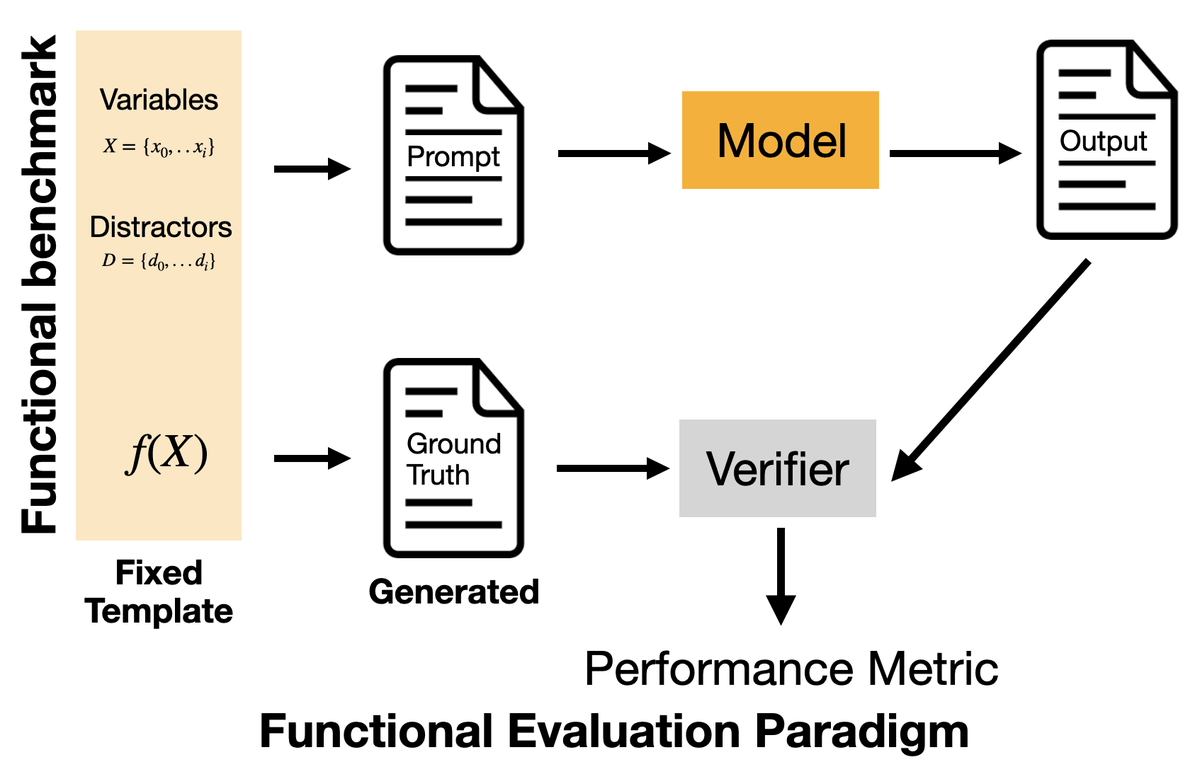
Static multi-lingual benchmarks like M-MMLU, M-GSM and Belebele are fixed question banks. A functional benchmark instead defines a template with variable slots (names, numbers, colors) and a ground-truth function that computes the correct answer from those variables, so every evaluation run instantiates fresh prompts. That closes off memorization and lets you measure whether a model actually executes the task or just recognizes the surface form.

The gap this exposes is not subtle. Across models, there is a 24%, 17% and 18% decrease in performance between M-GSM and CL-GSM Symbolic in English, French and Spanish respectively, and instruction-following drops between 15 and 24 percentage points when moving from Belebele to CL-IFEval. Functional and instruction-following tasks induce drops of 15 to 30 percentage points in cross-lingual fidelity compared to static benchmarks, amplifying gaps masked by multiple-choice accuracy.
How the benchmarks were built
The team started from 100 English GSM-Symbolic math templates and 541 English IFEval instruction prompts, ran them through Google Translate into all five target languages, then had native-speaker volunteers validate every item against a structured rubric. Prompts that could not be meaningfully evaluated in a target script (for example, uppercase-only constraints in Arabic or Hindi, which lack case distinctions) were dropped, leaving 371 IFEval prompts per language. Each GSM template was then instantiated into 50 variants per language, yielding 5,000 QA pairs per language.
Six open-weight models were evaluated using the EleutherAI lm-eval harness with 8-shot native chain-of-thought prompting for math:
- Qwen3-8B
- Gemma-2-9B-it
- Aya Expanse-32B
- Aya 23-35B
- Mistral-7B-Instruct-v0.3
- Mixtral-8x7B-Instruct-v0.1
The multilingual marketing gap
The most striking finding is what happens to models sold on their multi-lingual chops. Cohere's Aya Expanse-32B posts a 5.89 percent average error gap between English, Spanish and French on static benchmarks, but that gap balloons to 25.88 percent on CL-IFEval across the same three high-resource languages. Qwen3-8B tells a similar story: a tight 3 to 5 percent language gap on M-MMLU and Belebele explodes to 31 percent on the functional instruction benchmark.

Model rankings also shuffle. Aya 23-35B outranks Aya Expanse-32B and Qwen3-8B in Yoruba on Belebele, but the ordering flips on CL-IFEval. Aya 23-35B beats Gemma-2-9b-it on the static M-GSM but loses to it on the functional CL-GSMSym for the same languages. If you were picking a model based on a leaderboard, you would pick differently depending on which benchmark family you trusted.
Where the models actually break
Instruction-group breakdowns show Yoruba failing across the board, with a complete zero on the Start/End category for all three models the authors profiled in detail. Yoruba is an extreme case with roughly 0.0009 percent share of CommonCrawl, and it shows: CL-GSMSym accuracy in Yoruba tops out at 13.8 percent for Qwen3-8B and sinks to 3.8 percent for Aya-23-35B.
On the math side, one particular template kept blowing up. Template 3 involves probabilistic inference (comparing the probability of one dice event against a compound event) and produced the lowest accuracy across every model and every language. Interestingly, middle-resourced Arabic and Hindi were sometimes more robust than French or Spanish on specific templates, suggesting the intuitive resource hierarchy does not cleanly predict where a model will be brittle.
What you can actually do with this
Both datasets are on Hugging Face under CC BY, and evaluation is orchestrated through the standard lm-eval harness, so plugging this into an existing pipeline is straightforward. The practical value is threefold:
- Sanity-checking multi-lingual claims. If your model shows a small gap on Belebele but a huge gap on CL-IFEval, you are probably measuring translation quality rather than instruction-following.
- Diagnosing failure modes per language. The instruction-group and template-level breakdowns tell you exactly which capability collapses where, rather than giving you a single opaque accuracy number.
- Contamination-resistant regression testing. Because prompts are regenerated from templates, benchmark leakage into training data is much harder.
The obvious caveat is that Google Translate seeds the initial translations, which the authors flag as a real limitation for Yoruba specifically and for unit conversions between metric and imperial. The evaluation is also open-weight only, so proprietary frontier models are absent from the comparison. But as a way to stress-test multilingual claims that leaderboards no longer reliably distinguish, functional benchmarking looks like the direction of travel.