
Brain-Inspired Co4 Beats Vision Transformers Using Half the Parameters
A biologically inspired transformer variant pre-filters queries, keys, and values before attention, hitting 75% on ImageNet-1K with half the parameters.
 Pro
Takeaways
- Co4 adds triadic Q-K-V modulation loops before attention, inspired by pyramidal two-point neurons. Paper
- Hits 75.01% on ImageNet-1K with 41.6M params vs 74.80% for a 12-layer ViT at 86M params.
- Complexity is O(N) with an MLP readout or O(N+k²) with top-k attention, breaking the quadratic bottleneck.
- Single-layer Co4 beats single-layer ViT by 25+ points on Mini-ImageNet, Tiny-ImageNet, and CIFAR-10.
- Multi-head attention becomes largely optional: 1 vs 12 heads changes ImageNet accuracy by under 1%.
- Open-source code, checkpoints, and configs available at the TREND project repo.
A new architecture called Co4 (Cooperative Context-sensitive Cognitive Computation) is claiming something unusual: it beats a standard Vision Transformer on ImageNet-1K while using roughly half the parameters, one attention head, and shallower stacks. The trick is a set of pre-attention modulation loops between queries, keys, and values inspired by how pyramidal neurons in the mammalian neocortex fire bursts when sensory evidence and top-down context agree.
The paper, from Ahsan Adeel and M. Bilal under the UK ARIA-funded TREND project, extends earlier work in the Cooperation Is All You Need line and provides a mathematical formulation plus scalability experiments. Code is open source, including training scripts, configs, and pretrained checkpoints.
Attention doesn't know if it's looking at anything relevant
The core complaint is straightforward. In a standard Transformer, Q, K, and V representations are largely treated as unconstrained learned features and lack intrinsic predictive mechanisms during the feedforward phase to evaluate whether they are coherent, consistent, contextually appropriate, or even relevant prior to attention. Attention has to do all the sorting after the fact, which is one reason it needs deep stacks, many heads, and the notorious O(N2) token comparisons.
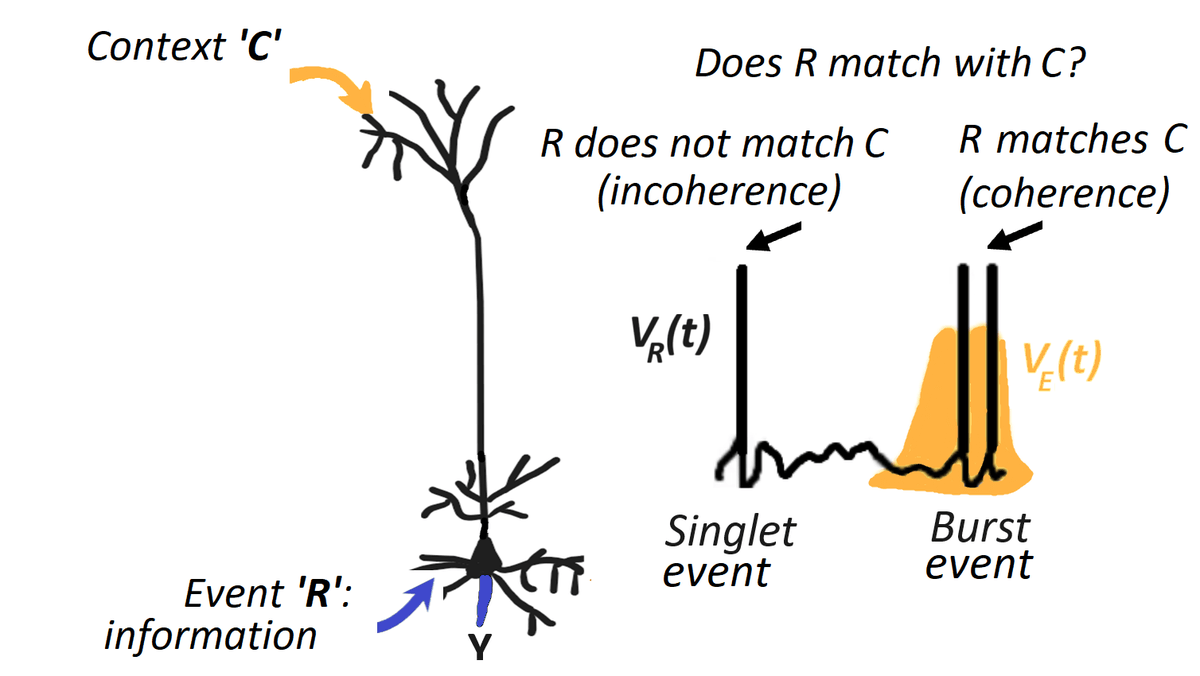
The authors' alternative comes from cellular neurobiology. Layer 5 pyramidal two-point neurons (TPNs) integrate two distinct input streams: feedforward sensory evidence arriving at basal dendrites, and contextual input arriving at apical dendrites. When basal and apical compartments are simultaneously depolarized, TPNs generate brief high-frequency bursts, signaling coherence between evidence and context. In other words, biology has a cell-level mechanism for asking "do the incoming data and my prior beliefs agree?" before passing signal forward.
Four modes borrowed from wakefulness and sleep
The paper leans on four operational regimes for these neurons, each corresponding to a mental state:
- Apical amplification (AA): high evidence, moderate context. Bursting driven by evidence but modulated by context. This is typical wakeful perception.
- Apical drive (AD): low evidence, high context. Bursting driven by context alone, associated with REM sleep and internally generated imagery.
- AD + Awake: both high. Maximum bursting, linked to imaginative cognition during wakefulness.
- Apical isolation (AI): context has no effect, associated with slow-wave sleep.
Co4 implements analogs of AA, AD, and AD+Awake as differentiable modulation functions that gate representations before attention is applied.
Triadic loops that refine Q, K, and V into each other
In Co4, each of Q, K, and V has its own TPN-like population. Each population treats its own latent representation as evidence (R) and takes contextual input (C) from the other two evolving populations, plus a shared belief state μ acting as a precision-like gain signal.

Concretely, when latents are initialized from input projections, the modulation reduces to compact update rules like:
Q_m = Q_L + Q_L * K_X
K_m = K_L + K_L * Q_X
V_m = ReLU6(V_L^2 + 2*V_L + Q_m*K_m*(1 + |V_L|))
These are three flavors of a general MOD(R, C) cooperation law derived from bursting-probability transfer functions. The shape matters more than the exact algebra: coherent (R, C) pairs get amplified, incoherent ones get attenuated, and gradients flow along a well-conditioned surface rather than through raw input space.

Once modulated, only the top-k most coherent tokens are passed to a small attention block, or Vm is fed straight into an MLP with no attention at all. Applying attention only to the top-k relevant tokens operates at O(N+k²) complexity, where k ≪ N and k ≤ √N, resulting in near-linear scaling with respect to the number of tokens N. Replacing attention with a simple MLP applied to the modulated V yields strictly O(N) complexity.
ImageNet-1K, with far fewer parts
The headline result: a 6-layer Co4 model with 4 Co4 layers and 2 standard multi-head self-attention layers hits 75.01% top-1 on ImageNet-1K with 41.6M parameters and a single head. The 12-layer ViT baseline reaches 74.80% with 86M parameters and 12 heads. An 8-layer pure-Co4 model gets 70.24% at 53.4M parameters.
On smaller datasets the gap is much wider at low depth:
| Dataset | Model (1 layer, 1 head) | Params | Accuracy |
|---|---|---|---|
| Mini-ImageNet | Transformer | 2.2M | 14.60% |
| Mini-ImageNet | Co4 | 2.0M | 39.20% |
| Tiny-ImageNet | Transformer | 1.9M | 9.50% |
| Tiny-ImageNet | Co4 | 1.8M | 30.90% |
| CIFAR-10 | Transformer | 1.8M | 44.60% |
| CIFAR-10 | Co4 | 1.6M | 75.20% |
The authors argue this is because Co⁴ establishes coherent internal representations with significantly fewer layers than standard Transformers. A single layer already does the work that a ViT needs several layers to approximate.
Counterintuitive scaling behavior
Two ablation results stand out. First, adding attention heads barely helps. Going from 1 to 12 heads on ImageNet-1K improves accuracy by less than 1%, suggesting the triadic modulation already performs the mixing job that multi-head attention is supposed to do.
Second, and more unusually, reducing the number of generated tokens via top-k feature leads to improved performance in Co⁴ whereas the same top-k feature approach in ViT reduces the performance. This sharply contrasts with the typical behavior of Transformer-based models, which often benefit from increased context length. In Co4, aggressive filtering is a feature. The system does better when it looks at less, provided it's looked at the right stuff.
Reinforcement learning gains too
On permutation-invariant RL benchmarks from the sensory-neuron-as-transformer setup, Co4 consistently converges faster than the Transformer baseline. On PyBullet Ant after 1K episodes, Co4 scores 1170 versus 121 for the Transformer. On CartPole with injected noise dimensions, attention heatmaps show the ViT wastes attention on noise channels while Co4 suppresses them and focuses on the physically meaningful state variables.
What's actually new here
The real contribution is not another linear-attention variant. It's the idea of shaping the representation surface before the readout using a biologically motivated cooperation law. Vanishing and exploding gradients get reinterpreted as "regimes" of the R-C interaction, and the model reduces reliance on depth because reasoning happens within a single layer via continuous cooperation dynamics rather than by stacking transformations.
Caveats worth naming
- Experiments were run under constrained compute; the full compound effects at large scale are not yet evaluated.
- Comparisons to modern ViT successors (Swin-T, DeiT-S, VMamba-T) are listed as ongoing work, not done.
- The best MOD formulation is task-dependent. AA-like laws work better for RL; AD-like laws work better for image classification with normal-initialized latents.
- Whether Co4 improves asymptotic scaling at very large compute budgets is explicitly flagged as an open question.
If the results hold at larger scale, the practical implication is a class of context-conditioned architectures where a single lightweight layer plus a cheap MLP readout replaces deep attention stacks. For anyone stuck fighting the quadratic wall on long-context tasks, that's a direction worth watching.