
Boston University's DCP-PD Spots Lung Nodules 89% Better on CT Scans
A new framework guides chest CT report generation with swappable discriminative classifiers and dropout tricks, pushing macro F1 on CT-RATE from 0.501 to 0.603.
 Pro
Takeaways
- DCP-PD boosts macro F1 on CT-RATE from 0.501 to 0.603, and Rad-ChestCT from 0.266 to 0.503.
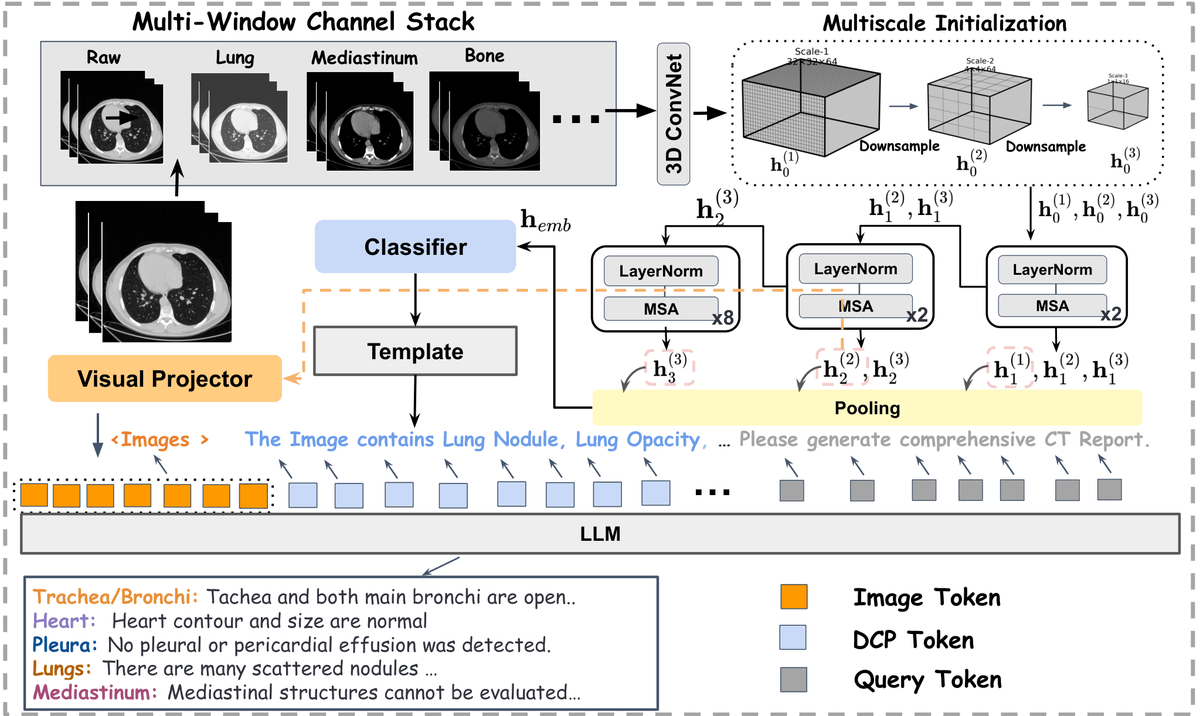
- Discriminative classifiers pipe predictions into a natural-language prompt, keeping the LLM decoupled from any specific helper model.
- Prompt dropout randomly hides cue entities during training, forcing the model to actually look at the CT scan.
- New hierarchical evaluation protocol tests presence, then laterality, then lobar location for spatial grounding.
- Built on Pillar-0's Atlas backbone and LLaMA-3 8B with LoRA, trained in about 8 hours on 4 H200 GPUs.
- Fine-grained lobar localization remains the hardest task, with classifier F1 averaging just 0.315.
Radiology report generation from 3D chest CT scans has been creeping toward clinical usefulness, but the models still trip over the details that matter most: which lung, which lobe, and whether a subtle nodule is actually there. A team from Boston University and Siemens Healthineers has proposed a framework called Discriminative Cue-Prompting with Prompt Dropout (DCP-PD) that plugs specialized classifiers into a vision-language model as natural-language hints, and it lands sizable jumps on the two main chest CT benchmarks.
Why holistic training keeps missing the small stuff
The paper frames two persistent problems with current CT report generation systems. Training supervision is often coarse, aligning a whole CT volume with a full free-text report without explicit alignment for fine-grained attributes or pathology locations. Evaluation is typically holistic, based on lexical overlap, entity matching, or LLM-as-a-judge scores that fail to probe spatial grounding.
Prior fixes tried anatomy segmentation or auxiliary disease classifiers piped into the prompt, but both approaches hard-wire the vision-language model to a specific helper architecture. Swap in a better classifier later and you have to retrain the whole generator. The authors also flag a subtler issue with the de facto evaluation standard, a RadBERT-RoBERTa-4m model trained on 1,000 manually annotated reports to extract 18 high-level abnormality types: it only checks whether a finding is mentioned, not where.