
Bosch's ALOOD Teaches Self-Driving Cars to Spot Unknown Objects Using Language
ALOOD uses CLIP's text encoder to flag unknown objects in LiDAR scans at inference time, without ever seeing OOD examples during training.
 Pro
Takeaways
- ALOOD is a post-hoc method that adds OOD detection to frozen LiDAR detectors by aligning their features to CLIP's text embedding space.
- It requires no OOD training data -- unknown objects are flagged at inference time via cosine similarity to precomputed class text embeddings.
- On the nuScenes OOD benchmark, ALOOD achieves best-in-class AUROC (90.15% voxel, 91.18% pillar) and competitive FPR-95 scores.
- The CLIP text encoder is not needed at inference -- ID embeddings are precomputed once and cached, keeping latency low.
- Key design choices: linear (not MLP) alignment, bounding-box-enriched features, and feature-norm scaling for the OOD score.
- Code is open-source at github.com/uulm-mrm/mmood3d, built on MMDetection3D.
Self-driving cars are trained to recognize a fixed set of object categories -- cars, pedestrians, cyclists, trucks. But the real world doesn't care about training sets. A deer crossing a highway, a fallen tree, an overturned shopping cart: to a standard 3D detector, these are just blobs of LiDAR points that get shoved into the nearest known category with high confidence. That overconfidence is a safety problem, and it's exactly what a new paper from Ulm University and Robert Bosch GmbH sets out to fix.
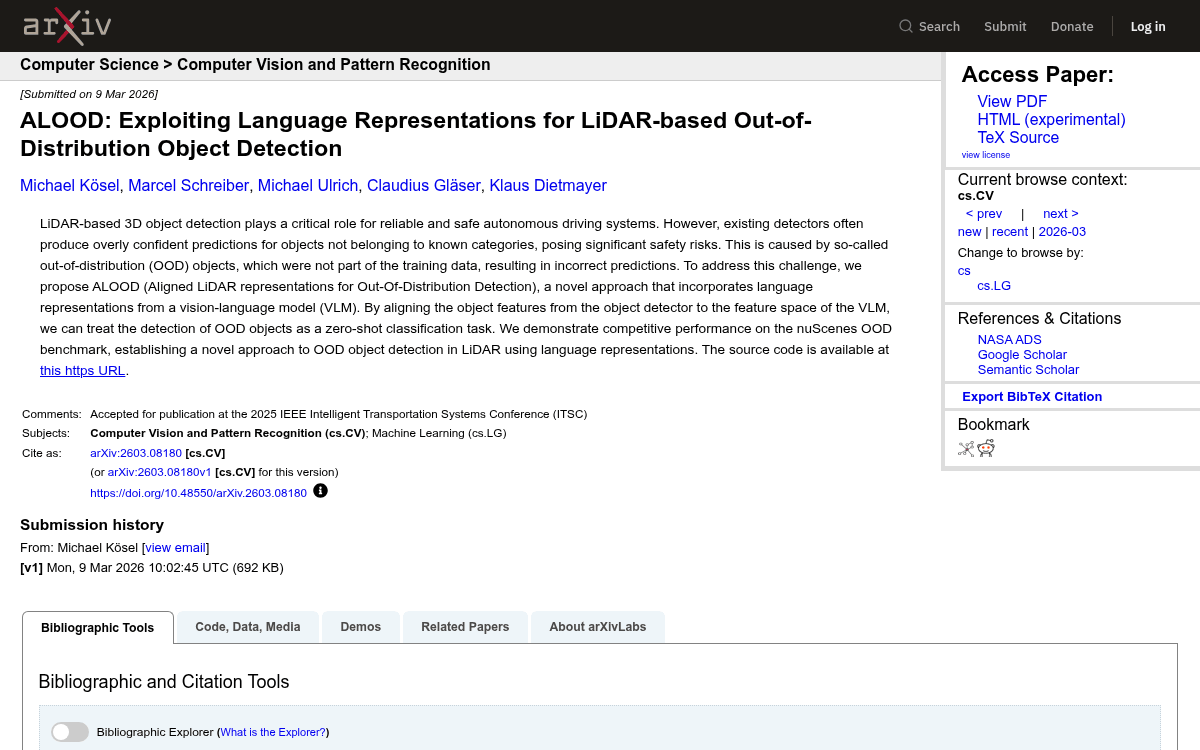
The paper introduces ALOOD (Aligned LiDAR representations for Out-Of-Distribution Detection), a method that teaches a LiDAR object detector to say "I don't know what this is" -- without ever being shown an unknown object during training. The trick is borrowing the semantic knowledge already baked into CLIP's language model.
Why detectors go confidently wrong
Most 3D object detectors operate under what researchers call the closed-world assumption: they treat every detected object as belonging to one of their training categories. Object detectors face a critical challenge when dealing with unknown foreground objects, particularly those not present in their original training data -- these out-of-distribution (OOD) objects can lead to misclassifications, posing a significant risk to the safety and reliability of automated vehicles.
OOD detection for 3D LiDAR data remains relatively underexplored. Prior approaches to the problem mostly fall into two camps: methods that synthesize fake OOD objects by distorting known ones, and methods that require actual OOD examples at training time. Both have obvious limitations -- you can't anticipate every weird thing a car might encounter, and collecting labeled OOD data is expensive and incomplete by definition.
The language shortcut
ALOOD's central insight is that CLIP already knows what a "deer" or a "shopping cart" is, even though it has never seen one in a LiDAR point cloud. Rather than teaching the detector to recognize unknown shapes, ALOOD teaches the detector's internal features to live in the same embedding space as CLIP's text descriptions. Once that alignment is done, OOD detection becomes a simple similarity check.

The method is also post-hoc: it attaches to a frozen, already-trained CenterPoint detector and adds only a small number of trainable layers on top. The base detector's accuracy is completely untouched.
How it works, step by step
- Feature extraction: A lightweight CNN (two 3x3 conv layers with batch norm and a residual connection) is applied to the neck feature map of the frozen CenterPoint detector, producing an improved feature map. For each detected bounding box, a local feature vector is pulled from that map using center pooling.
- Context fusion: A global scene feature (via adaptive max-pooling over the entire feature map) is blended in with a small weight (lambda = 0.1), and the raw bounding box geometry is projected into a 64-dimensional vector and concatenated. This gives the model both local object appearance and global scene context.
- Text prompt generation: For each detected object, a natural language description is generated. Two formats are used randomly during training: a simple
"This object is a [cls]."and a spatial version that includes position, dimensions, and orientation:"This object is a [cls] located at ([x, y, z]), with dimensions ([w, l, h]) and orientation [yaw] rad." - Modality alignment: A single linear layer projects the object features into CLIP's embedding space. A modified contrastive loss (InfoNCE adapted for multiple objects sharing the same class) pulls each object's feature vector toward its corresponding text embedding.
- Inference (no VLM needed): At test time, the ID class text embeddings are precomputed once and cached. Each detected object's aligned feature is compared to all cached embeddings via cosine similarity. The final OOD score is the maximum similarity value, scaled by the feature vector's norm -- a trick that sharpens the separation between known and unknown objects.

The norm-scaling step deserves special attention. Since only ID objects are seen during training, OOD objects lead to different activations, making the feature norm a good indicator for OOD objects. Empirically, scaling by the norm consistently tightened the score distributions for known vs. unknown objects across all scoring functions tested.
What the numbers say
The method is validated on the nuScenes OOD benchmark, which treats the dataset's 9 "void" classes as OOD objects, and only uses scenes without any OOD objects for training. The key metrics are FPR-95 (false positive rate when 95% of known objects are correctly flagged as known -- lower is better), AUROC, and AUPR.
| Method | FPR-95 ↓ | AUROC ↑ | AUPR-S ↑ | AUPR-E ↑ |
|---|---|---|---|---|
| Default Score | 63.00 | 85.10 | 99.70 | 7.91 |
| MSP | 44.60 | 88.87 | 99.79 | 13.74 |
| Rescaling (prior SOTA) | 36.96 | 88.96 | 99.73 | 24.68 |
| ALOOD (voxel) | 37.26 | 90.15 | 99.81 | 21.52 |
| ALOOD (pillar) | 38.78 | 91.18 | 99.72 | 24.66 |
On the pillar-based CenterPoint variant, ALOOD greatly outperforms the rescaling-based method, confirming that the approach generalizes better without any special tuning. The voxel-based results are competitive: ALOOD leads on AUROC and AUPR-S, while the prior rescaling method edges it on FPR-95 and AUPR-E -- likely because that benchmark contains many small OOD objects that the rescaling augmentation was specifically designed to handle.
What the ablations reveal
The paper runs thorough ablations that surface some non-obvious design choices:
- Linear alignment beats MLP: Adding nonlinearity (ReLU) to the alignment module hurts performance. A plain linear projection converges faster and more stably, likely because the CLIP feature space is already well-structured.
- Bounding box features are the biggest single gain: Including encoded box geometry (position, size, orientation) in the object feature significantly boosts all metrics. Spatial prompts in the text description provide a matching benefit on the text side.
- Prompt wording matters:
"This object is a [cls]"outperforms both the neutral"A [cls]"and the standard CLIP-style"A photo of a [cls]"-- which makes sense, since LiDAR data is not a photo. - Global scene context helps, but only with the CNN: The scene-level feature alone doesn't help much. Combined with the CNN-adapted feature map, it produces a meaningful improvement.
What it's good for -- and where it falls short
ALOOD is a strong fit for any production LiDAR perception stack that needs a safety net for unknown objects. Because it's post-hoc, it can be dropped onto an existing trained detector without retraining or degrading detection performance. Because it requires no OOD training data, it avoids the chicken-and-egg problem of needing to know what unknowns look like before you can detect them.
The current limitations are worth noting:
- The method was only validated on CenterPoint (both voxel and pillar variants). The authors note that extending to two-stage detectors is future work.
- Performance on very small OOD objects lags behind the rescaling baseline, which was specifically tuned for that case.
- The approach still requires a threshold delta to be set, typically calibrated so that 95% of ID objects are correctly passed through.
The source code is available at github.com/uulm-mrm/mmood3d, built on top of the MMDetection3D framework. The real breakthrough here is conceptual: by grounding LiDAR perception in language, the detector inherits the open-world knowledge of a vision-language model without needing cameras, image encoders, or OOD labels. That's a meaningful step toward perception systems that know what they don't know.