
Bosch Drops the Hungarian Algorithm and Cuts Object Detection Training Time in Half
A new match-free training scheme for DETR-based detectors cuts matching latency by 53% and outperforms Hungarian-based baselines on large objects
 Pro
Takeaways
- Match-free DETR training: Researchers propose replacing the Hungarian algorithm in DETR with a learned cross-attention module called CAQS.
- 2x faster matching: Training latency drops from 53ms to 25ms per step, with the new method covering both forward and backward passes.
- Better large-object detection: AP_L improves by +4.2 points (37.1 to 41.3) on MS COCO val2017 over the Deformable DETR baseline.
- Fully GPU-native: Replaces the CPU-bound O(N³) Hungarian solver with differentiable tensor operations, eliminating CPU-GPU data transfers.
- Small-object tradeoff: AP_S drops slightly (11.2 to 10.7), a known weakness of attention-based correspondence for low-resolution targets.
- No code released yet: The paper is a proof of concept on Deformable DETR; no public implementation is available at this time.
Every modern DETR-based object detector hides an uncomfortable secret inside its training loop: the Hungarian algorithm. This classical combinatorial solver is responsible for deciding which of the model's learned "object queries" should be responsible for which ground-truth box in each training image. It works, but it is slow, CPU-bound, and fundamentally at odds with the GPU-parallel world that deep learning lives in. A new paper from researchers at Bosch and Durham University argues you do not need it at all.
Why the Hungarian Algorithm Is a Problem
To understand the fix, you need to understand what bipartite matching actually does in DETR. During training, the model produces N predictions (say, 300 object queries), but an image might only contain 5 real objects. The model compares the predicted classes and bounding boxes of each of the N object queries to the ground-truth annotations, and the Hungarian matching algorithm finds an optimal one-to-one mapping of each query to each annotation. This is elegant in theory, but brutal in practice.
The problems are twofold:
- Cubic complexity: The Hungarian algorithm runs at O(N³), where N is the number of queries. As modern detectors scale up their query banks for better precision, the matching overhead grows non-linearly.
- Hardware mismatch: The algorithm is a discrete combinatorial solver with complex branching logic. It runs on the CPU, not the GPU, forcing expensive data transfers back and forth during every training step.
DETR's discrete bipartite matching introduces instability because a small change in the cost matrix may cause an enormous change in the matching result, leading to inconsistent optimization goals for decoder queries. Prior work like DN-DETR tried to paper over this with denoising tricks, but the reliance on the Hungarian algorithm for bipartite matching still introduces computational overhead and complicates the training dynamics.
The Core Idea: Let the Model Figure It Out
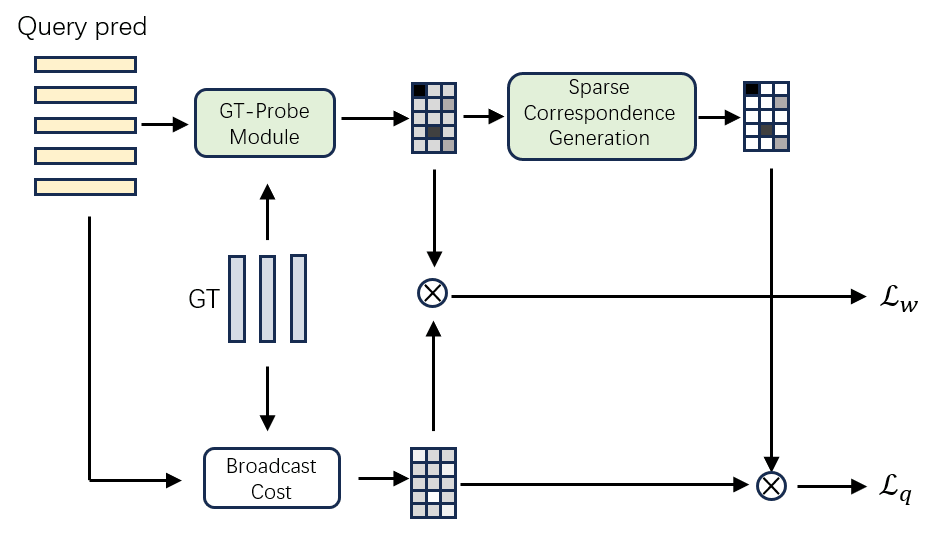
The paper introduces a Cross-Attention-based Query Selection (CAQS) module that replaces the Hungarian solver entirely. The key intuition is simple: instead of using a hand-crafted cost function to assign ground truths to queries, why not let the model learn the assignment itself through a differentiable attention mechanism?
The pipeline works in two flows:
- Correspondence Learning Flow: Ground-truth objects and predicted queries are both projected into a shared embedding space via MLPs. The GT embeddings then act as "probes" that query the decoder's query bank through cross-attention, producing a dense M×N correspondence matrix A where each entry A[i,j] represents how strongly the j-th query should be responsible for the i-th ground truth.
- Supervision Construction Flow: The dense matrix is sparsified by a Sparse Correspondence Generation (SCG) module, which uses bidirectional max-filtering and dynamic thresholding to keep only the highest-confidence query-to-GT assignments. This sparse matrix then gates the final detection loss.

The final training objective combines two losses. A Correspondence Weight Loss (L_w) supervises the GT-Probe module itself, pushing the attention weights toward query-GT pairs that already have low prediction cost. A Sparse Query Loss (L_q) then uses the sparsified correspondence matrix as a mask to apply direct supervision only to the selected high-confidence queries. The total loss is simply L_total = α·L_w + β·L_q, with both weights set to 1.0 in the default configuration.

The Numbers That Matter
The method is evaluated on the MS COCO 2017 benchmark against Deformable DETR as the baseline, using a ResNet-50 backbone, 300 object queries, and 8 NVIDIA A100 GPUs. Both models are trained for 20 epochs under identical settings.
| Method | AP | AP50 | AP75 | AP_S | AP_M | AP_L | Latency |
|---|---|---|---|---|---|---|---|
| Deformable DETR (baseline) | 25.4 | 43.4 | 26.3 | 11.2 | 28.5 | 37.1 | 53ms |
| CAQS (ours) | 26.1 | 43.5 | 27.1 | 10.7 | 29.1 | 41.3 | 25ms |
The headline efficiency result is striking: the matching latency drops from 53ms to 25ms, a more than 50% reduction. Crucially, the 53ms baseline figure only covers the forward matching pass, while the 25ms figure for CAQS includes both forward and backward passes. The model is doing more work and still finishing in less than half the time.
The accuracy gains are modest overall (+0.7 AP), but the large-object improvement is substantial. The +4.2 AP_L gain (37.1 to 41.3) suggests that the flexible, learned correspondence is better at handling large objects where multiple queries might reasonably compete for the same target, a scenario where rigid one-to-one Hungarian assignment can create ambiguity. The one regression is small objects, where AP_S drops slightly from 11.2 to 10.7, which the authors attribute to the difficulty of forming stable attention-based correspondences for targets with limited feature resolution.
The Real Breakthrough
The deeper significance here is not just the 2x speedup. It is a proof of concept that the Transformer's own attention mechanism is expressive enough to self-organize query-to-target assignment without any external combinatorial solver. The paper demonstrates that explicit matching is not a prerequisite for end-to-end set prediction. The model can learn the correspondence implicitly, as a continuous optimization problem, which is both more GPU-friendly and more mathematically consistent with how the rest of the network trains.
This matters practically for anyone training DETR variants at scale. The O(N³) matching cost becomes a real bottleneck as query banks grow, and the CPU-GPU transfer overhead compounds with batch size. By replacing the solver with differentiable tensor operations, the entire training loop stays on the GPU, enabling larger batches and more extensive query banks without a proportional increase in training time.
Limitations and What's Next
The paper is an early-stage result. The experiments are limited to Deformable DETR as the base architecture, and the absolute AP numbers (26.1 at 20 epochs) are well below the state of the art from models like DINO-DETR. The small-object regression is an open problem, and the authors note that multi-scale probing strategies will be needed to address it. No code or pretrained models have been released publicly at this time.
The authors plan to extend the paradigm to instance segmentation and multi-object tracking. If the approach generalizes, it could become a standard drop-in replacement for Hungarian matching across the entire DETR family, which now includes RT-DETR, Co-DETR, and a long tail of production deployments in robotics, autonomous driving, and industrial inspection.