
BizChat Cuts Business Plan Writing From 6 Months to an Hour
A field study of BizChat, an LLM business plan drafter, shows entrepreneurs cutting drafts from six months to minutes but rarely iterating alone.
 Pro
Takeaways
- BizChat deployed to 30 entrepreneurs at Prototype PGH, a feminist makerspace, over eight months in 2025.
- Draft times collapsed from six months to minutes; one user won entry to an international fashion event.
- Users averaged only 0.77 rich-text edits and 0.77 AI-applies per session after onboarding.
- Onboarding averaged 6.54 conversational turns, with prompt suggestions clicked half the time.
- Built on Next.js, Firebase, TipTap; uses GPT-4 Turbo for onboarding and GPT-4o for the assistant.
- Freely available at bizchat-io.vercel.app; paper on arXiv.
A team of researchers spent eight months embedding an AI business planning tool inside a feminist makerspace in Pittsburgh, then watched what happened when small business owners tried to use it. The result is one of the more grounded pictures we have of how generative AI lands in resource-constrained entrepreneurial communities, and where the standard chat-first design pattern quietly breaks down.
The tool, called BizChat, is an LLM-powered web app that helps product- and service-based entrepreneurs draft business plans. The paper reports on log data from 30 users and 10 follow-up interviews across four workshops at Prototype PGH. It is scheduled for CHI 2026 and builds on an earlier paper describing BizChat's interface design.
The problem hiding behind the ChatGPT tab
The starting point is a gap the authors have documented in prior fieldwork: business plans are the gatekeeping document for grants, loans, and accelerators, but writing one requires both business expertise and fluency in what participants called the language of business. General purpose chatbots don't fix this. They assume users already have what the researchers call a hidden curriculum of accessory skills, from browser literacy and password management to file conversions and prompting.
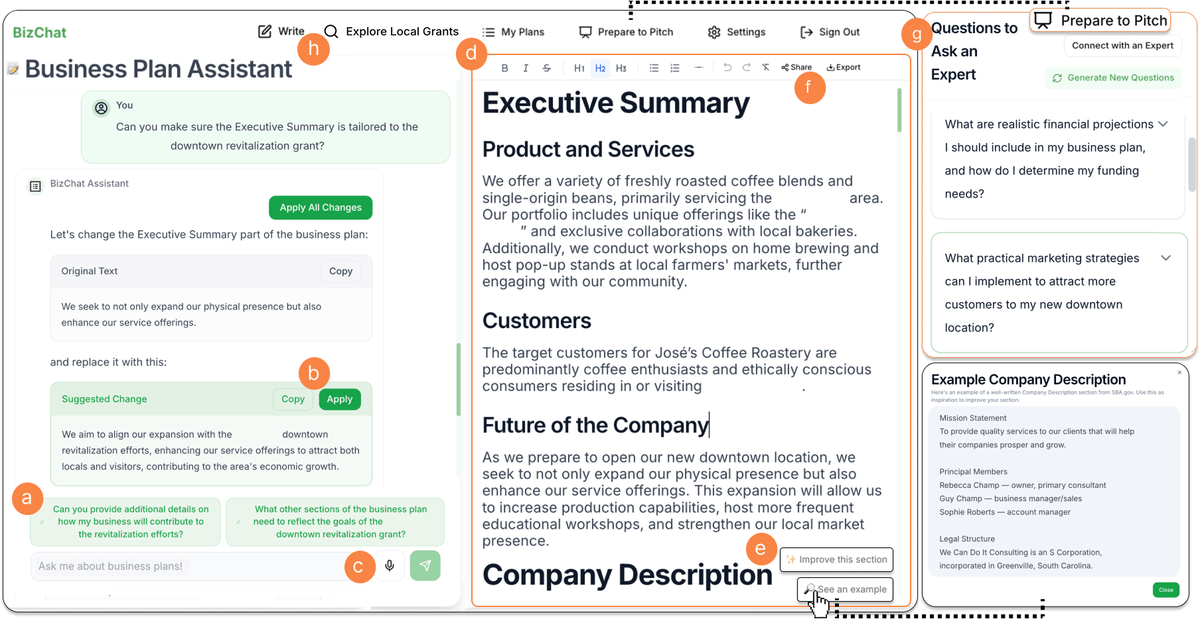
BizChat's design tries to lower that floor without capping the ceiling. The interface pairs a chat panel with a rich-text editor built on TipTap, adds voice-to-text at every step for entrepreneurs with limited typing proficiency, and offers one-click Apply buttons that insert AI suggestions directly into the plan. Under the hood, it's a Next.js app on Vercel with Firebase for auth and telemetry. Onboarding uses GPT-4 Turbo Preview to fill a structured business plan JSON field by field, with an observer LLM extracting business details from user answers. Once minimum fields are populated, asynchronous GPT-4 Turbo calls generate each section in roughly 8 to 15 seconds, few-shot prompted with SBA.gov exemplars. The main writing assistant runs on GPT-4o.