
Berkeley Lab's FAIR Universe Challenge Exposes Where AI Fails Dark Matter Mapping
A new benchmark and open competition tests how well ML models infer cosmological parameters from weak lensing maps when simulations and reality disagree.
Takeaways
- First weak lensing ML benchmark with realistic systematics like baryonic feedback and photometric redshift uncertainty.
- Two-phase challenge: Phase 2 on OoD detection is open through October 2026.
- Dataset spans 101 cosmologies × 256 realizations of HSC-like convergence maps with 5D labels.
- Neural baselines nearly double power-spectrum scores in-distribution (8.68 vs 4.58).
- CNN baselines lose to power spectrum on out-of-distribution detection (0.11 vs 0.21).
- Full code and starter kits available in the GitHub repository.
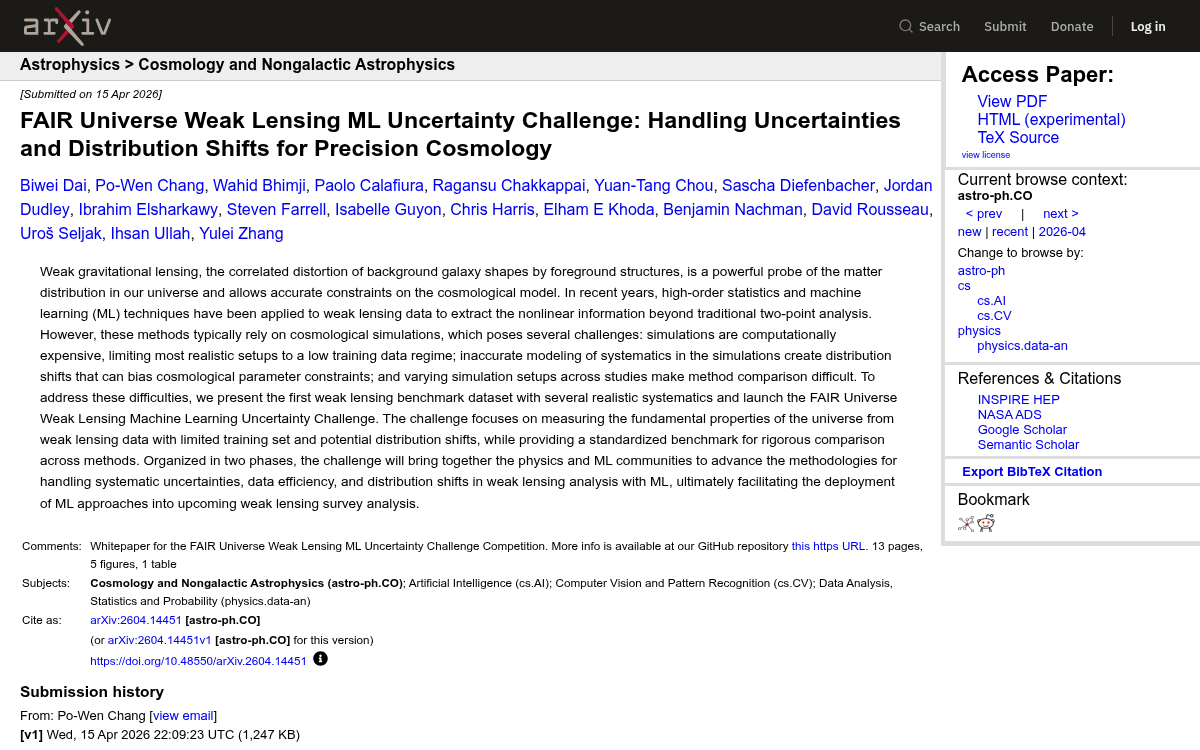
Weak gravitational lensing is one of the most information-dense probes cosmologists have, but wringing precise numbers out of it is starting to hit a wall. The standard toolkit relies on two-point statistics that discard most of the non-Gaussian structure in the cosmic web, and the neural networks meant to fill that gap keep running into the same problem: they are only as trustworthy as the simulations they were trained on. A new benchmark and open competition, the FAIR Universe Weak Lensing ML Uncertainty Challenge, tries to make that gap measurable.
Why weak lensing broke the usual ML recipe
Weak gravitational lensing refers to the subtle, coherent distortions in the observed shapes of distant galaxies caused by the deflection of light as it traverses the inhomogeneous matter distribution of the universe. Statistically stacking those distortions yields a map of where matter, including the dark kind, actually lives. The catch: different analyses assume different dataset setups and produce different results, making direct comparisons difficult, and most methods lean heavily on simulations that may misrepresent real observations because of modeling approximations and missing systematics.
Expensive simulations, model mismatch, and no shared yardstick are exactly the kind of problems benchmarks exist to solve. The team, based largely at Lawrence Berkeley National Laboratory, has built one.