
Ben-Gurion Study Reveals How Tiny Bilingual AI Models Learn Smarter on Less Data
A controlled study extends BabyBERTa to French, revealing when child-directed speech, Wikipedia, and bilingual pretraining actually pay off in compact language models.
 Pro
Takeaways
- BabyBERTa extended to English-French bilingual pretraining under strictly size-matched data conditions.
- Wikipedia training wins on semantic tasks; child-directed speech wins on grammatical judgments in monolingual setups.
- Bilingual pretraining boosts textual entailment sharply, with French gaining more than English (61.74 vs 37.88 XNLI).
- Combining CHILDES with Wikipedia recovers most losses versus Wikipedia-only, especially for the weaker language.
- Same patterns hold across BabyBERTa, RoBERTa, LTG-BERT, and T5-tiny, ruling out architecture-specific effects.
- New French QAMR and QASRL datasets plus code released at NLU-BGU/Compact-Multilingual-LMs.
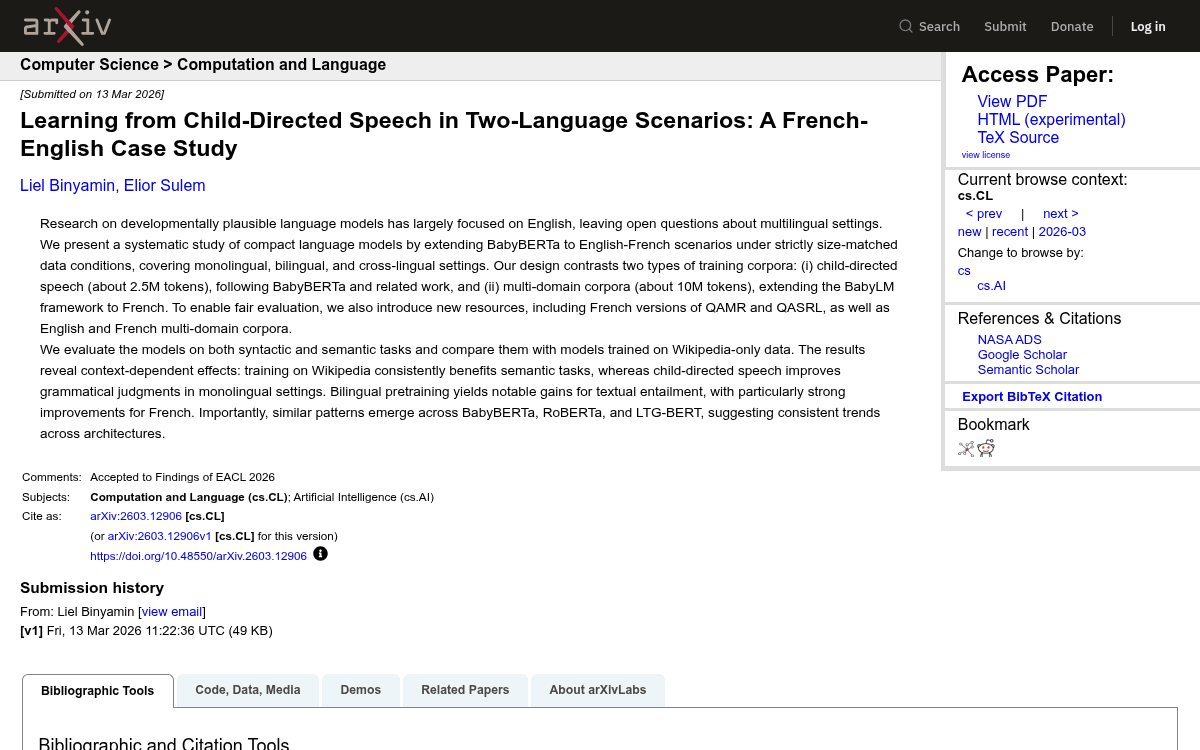
Most of what we know about training tiny language models on human-scale data comes from English experiments. A new study out of Ben-Gurion University pushes that work into bilingual territory, systematically comparing English and French pretraining under strictly matched data budgets, and finds that the right recipe depends heavily on the task, the language, and whether you are training on toddler talk or Wikipedia.
The paper extends BabyBERTa, a compact RoBERTa variant, into monolingual, bilingual, and cross-lingual setups, and releases code and data along with new French versions of two semantic evaluation datasets. The findings replicate across BabyBERTa, RoBERTa, LTG-BERT, and T5-tiny, so they are not artifacts of a single architecture.
Why child-scale training still matters
BabyBERTa showed that compact architectures trained on just 5 million words of child-directed speech could match larger models' grammatical proficiency while dramatically reducing computational costs. The follow-up BabyLM Challenge established that developmentally plausible training corpora, approximating the linguistic input children receive, can produce models with strong capabilities under significant resource constraints.
But that whole line of work has a blind spot. The foundational studies focused mainly on monolingual English settings, and evaluations of models trained on child-directed speech concentrated on grammatical competence rather than semantic understanding through tasks like question-answering and textual entailment. Earlier bilingual attempts trained sequentially (language 1, then language 2) and evaluated only in English, which is not how bilingual children actually learn.
The experimental grid
The authors built a controlled matrix with two corpus types and three language configurations. Child-directed speech corpora were capped at about 2.5M words, constrained by French CHILDES availability, alongside matched Wikipedia-only corpora, plus multi-domain corpora of about 10M words adapted from the BabyLM framework to an English-French comparison.
The multi-domain corpus is a mix of registers, blending CHILDES, dialogue (British National Corpus for English, Claire French Dialogue Dataset for French), children's books, Gutenberg prose, OpenSubtitles, educational video subtitles, Wikipedia, and Vikidia (a simplified encyclopedia). Everything is size-matched across languages so any difference reflects the language or corpus, not the token count.
Three pairing strategies were tested:
- Monolingual: pretrain and test in the same language.
- Bilingual: simultaneous exposure to English and French during pretraining, with monolingual fine-tuning and evaluation.
- Cross-lingual: pretrain in one language, evaluate in the other.
Evaluation covered SQuAD, QAMR, and QASRL for question answering, XNLI for textual entailment, and CLAMS for grammatical minimal pairs. Because French versions of QAMR and QASRL did not exist, the authors built them by translating with Google Translate, aligning answer spans using Levenshtein and Jaro-Winkler similarity, and filtering pairs where SentenceBERT similarity dropped below 0.75.
What the numbers say
The headline pattern is that corpus type dictates whether a model leans semantic or syntactic. Wikipedia-trained models excel on QA and entailment, reflecting stronger factual alignment, while CHILDES-trained models perform better on CLAMS, confirming that conversational data supports grammatical learning.
Bilingual pretraining is not a free lunch, but it has one very clear win: textual entailment. For French, improvements are dramatic (En-Fr-Wikipedia: 61.74 vs. Fr-Wikipedia: 37.88), and for English bilingual pretraining also outperforms monolingual baselines (65.25 vs. 61.70). The weaker language benefits disproportionately, which mirrors what you might expect from cross-lingual regularization when data is scarce.
Grammar shows an interesting inversion. In monolingual training, CHILDES beats Wikipedia on CLAMS, but in bilingual training the pattern flips and Wikipedia wins. The authors attribute this to Wikipedia's consistent register facilitating cross-linguistic grammatical generalization better than the variability of conversational input.
The bilingual advantage shrinks with scale. At 10M tokens, monolingual models trained on larger multi-domain corpora often dominate in absolute performance, but modest bilingual advantages persist for semantic inference, indicating that the benefits of multilingual exposure weaken with scale but remain detectable.
Combining CHILDES with Wikipedia
One of the more practical takeaways is that mixing conversational and encyclopedic data helps, especially in the weaker language. In monolingual English, combined training improves QAMR performance over CHILDES-only (51.95 vs. 38.54), while in French the gains are larger on transfer-sensitive tasks such as XNLI (60.36 vs. 28.27). The effect holds whether you shuffle or reverse the order of exposure, so it is not simply a curriculum artifact.
Where this is useful, and where it is not
If you are working with a low-resource language and cannot afford to pretrain a large model, this study gives you a concrete playbook:
- Match your pretraining register to your target task. Wikipedia-style text for factual QA and entailment; conversational data for syntactic competence.
- Consider bilingual pretraining specifically when the target task involves inference, and especially when one language is data-poor.
- Blend child-directed speech with encyclopedic text rather than choosing one, particularly for the weaker language in a pair.
The limitations are worth being honest about. The original pretrained RoBERTa-base and CamemBERT-base achieve the highest absolute scores, serving as upper bounds, so compact developmentally plausible models are not competitive with full-scale pretraining in raw performance. The study also only covers two closely related Indo-European languages, and it does not touch decoder-only GPT-style architectures. Extending to typologically distant languages or generative models is left as future work.
Still, the fact that the same relative patterns hold across four different architectures suggests these effects reflect something about how small models learn from limited multilingual input, rather than quirks of any single training recipe. For teams building efficient multilingual systems on tight compute or data budgets, that consistency is exactly the kind of signal worth designing around.