
Beijing University's SFed-LoRA Fixes Federated AI Training With One Formula
SFed-LoRA fixes a fundamental instability in federated LoRA fine-tuning with a single theoretically-derived scaling factor that accounts for both adapter rank and client count
 Pro
Takeaways
- Core finding: Standard LoRA scaling in federated learning causes gradient collapse at high ranks because it ignores variance reduction from client averaging.
- The fix: A new scaling factor
γ_z = α√(N/r)accounts for both adapter rank r and client count N, derived from infinite-width feature learning theory. - No overhead: SFed-LoRA requires no architecture changes, no extra communication, and adds zero inference latency — it's a one-line hyperparameter change.
- Key results: On GLUE at rank 512, SFed-LoRA achieves 87.72% vs. 81.25% for the standard baseline; perplexity stays stable from N=5 to N=20 clients.
- Practical impact: High-rank LoRA adapters (r=128, 512) now work reliably in federated settings, removing a major constraint on model expressiveness.
- Code available: Implementation is included in the paper appendix; tested on LLaMA2-7B and RoBERTa-large across GSM8K and GLUE benchmarks.
Fine-tuning large language models across distributed, privacy-sensitive data is one of the most practically important problems in applied ML today. The standard recipe combines LoRA (Low-Rank Adaptation), which freezes the base model and trains only small low-rank matrices, with Federated Learning (FL), which lets multiple clients train locally and share only model updates rather than raw data. The problem is that this combination breaks down in a subtle but severe way as soon as you push to higher ranks or more clients , and a new paper from Beijing University of Posts and Telecommunications pinpoints exactly why, and fixes it with a single elegant formula.
The hidden failure mode nobody was scaling for
To understand the bug, you need to know how LoRA works.
Full fine-tuning is impractical, so LoRA optimizes low-rank matrices A and B
instead of the full weight matrix. The update to the weights is γ · B · A, where γ is a scaling factor. In the original LoRA paper, γ = α/r (alpha divided by rank). The problem:
aggregating updates from multiple clients introduces statistical variance that scales with the client count, causing gradient collapse when using high-rank adapters.
A prior fix called rsLoRA (Rank-Stabilized LoRA) addressed gradient collapse in standalone training by changing the scaling to γ = α/√r. But
existing scaling factor candidates, such as the one used by Rank-Stabilized LoRA, ignore the interaction caused by the aggregation process.
When you average adapter matrices across N clients, the variance of the averaged matrix shrinks by a factor of N , and rsLoRA has no idea this is happening. The result is that high-rank adapters in federated settings still collapse, just for a different reason than before.
The intuition is straightforward: averaging N independent random matrices reduces their variance by 1/N. If your scaling factor was calibrated for a single client, it is now systematically too small for the federated setting. The more clients you add, the worse it gets.
One formula to rule them all
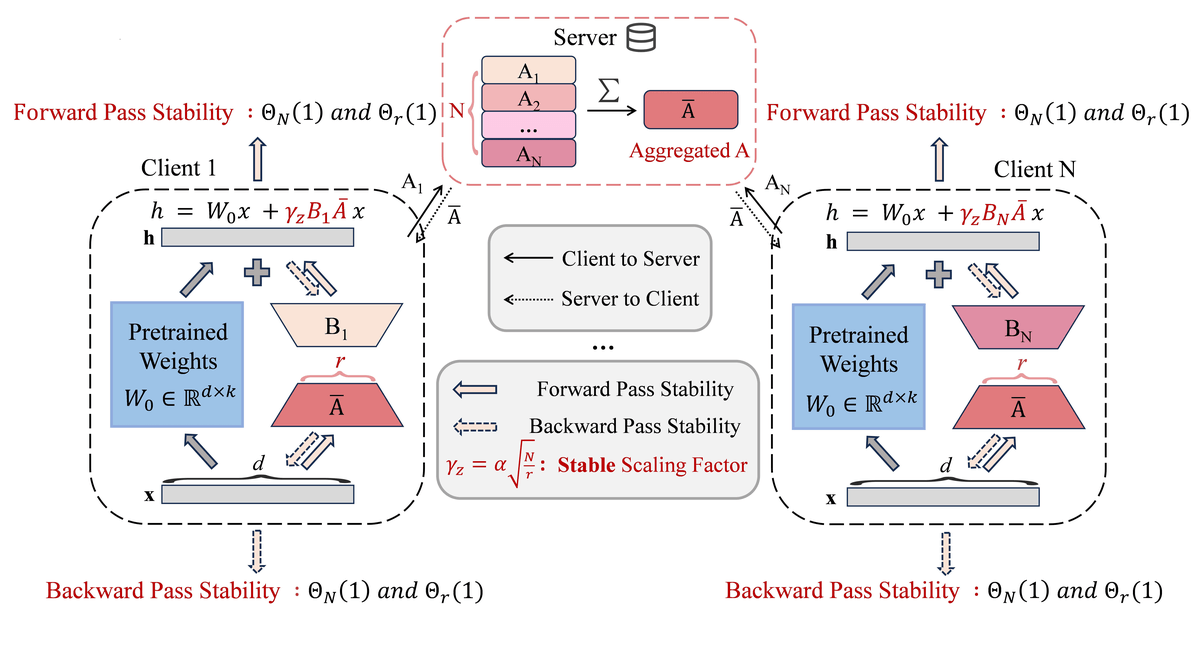
The paper proposes Stabilized Federated LoRA (SFed-LoRA), a framework that precisely captures the role of the aggregating matrix and derives an optimal scaling factor by explicitly integrating the client count N to normalize the variance accumulation. The resulting formula is:
γ_z = α * sqrt(N / r)Where N is the number of federated clients and r is the LoRA rank. This is a clean generalization: when N=1 (single client), it reduces to rsLoRA's α/√r scaled by a constant. As N grows, the scaling factor grows proportionally with √N, compensating exactly for the variance reduction caused by averaging across clients.
SFed-LoRA integrates this scaling mechanism while preserving the original LoRA adapter structure, thereby incurring no additional inference latency.
The theoretical derivation uses the infinite-width feature learning framework , a mathematical tool for analyzing how signals and gradients propagate through neural networks as layer width grows. The authors extend this framework to the federated setting by tracking how the aggregated A matrix evolves across rounds, proving that γ_z ∝ √(N/r) is the unique scaling that keeps both forward activations and backward gradients bounded regardless of rank or client count.
How SFed-LoRA actually works
SFed-LoRA builds on the FedSA-LoRA framework, which uses a clever split-aggregation strategy:
- Each client trains both A and B matrices locally on its private data.
- Only matrix A is uploaded to the central server. Matrix B, which captures client-specific knowledge, stays local.
- The server averages all A matrices and broadcasts the result back.
- Each client updates its local model using the shared global A and its own local B.
Why only share A? Because averaging the product BA across clients is not the same as the product of the averages , it introduces an algebraic error. By keeping B local and only averaging A, the framework isolates the source of aggregation error and makes the scaling analysis tractable. SFed-LoRA then plugs in γ_z = α√(N/r) as the scaling factor applied during local computation, correcting the variance mismatch before it can compound across rounds.

What the numbers show
Experiments on benchmark datasets including GSM8K and GLUE, using models such as LLaMA 2 and RoBERTa-large, reveal that SFed-LoRA can remarkably suppress gradient collapse and aid stable training at higher ranks. The key results:
- Perplexity on Alpaca (LLaMA2-7B): Competing methods stagnate or diverge at rank 512. SFed-LoRA converges to the lowest perplexity across all ranks from r=4 to r=512, with all curves tightly clustered.
- Gradient norms: With standard FedSA-LoRA, gradient norms at r=512 are orders of magnitude lower than at r=4 , the high-rank parameters are effectively frozen. SFed-LoRA keeps gradient norms consistent across all ranks.
- Scaling with clients: Baseline perplexity deteriorates significantly as client count grows from N=5 to N=20, jumping from approximately 7 to nearly 15. SFed-LoRA converges to approximately 3.0 perplexity regardless of whether N=5 or N=20.
- GLUE (RoBERTa-large, non-IID): At rank 512, SFed-LoRA achieves 87.72% accuracy vs. 81.25% for standard FedSA-LoRA , a 6.47 point gap that grows with rank.
- GSM8K math reasoning: At rank 512, SFed-LoRA reaches 17.22% accuracy vs. 14.44% for FedSA-LoRA, a margin that holds across all ranks tested.

The real breakthrough: rank is no longer a liability
The deeper implication here is that federated LoRA has been operating under an artificial constraint. Practitioners have been forced to use low ranks (typically r=4 or r=8) not because higher ranks don't help, but because they cause training instability in the federated setting. SFed-LoRA restores the efficacy of high-rank adaptation without altering the original model architecture or increasing inference latency. This means you can now actually exploit the expressive power of higher-rank adapters in privacy-preserving distributed training.
The fix is also remarkably lightweight. There are no new trainable parameters, no architectural changes, no extra communication rounds. It is a single change to the scaling hyperparameter , one that is now a function of N and r rather than just r. In practice, if you are already using FedSA-LoRA, the migration is a one-line change:
# Before (rsLoRA scaling)
gamma = alpha / math.sqrt(r)
# After (SFed-LoRA scaling)
gamma = alpha * math.sqrt(N / r)  # N = number of federated clients
When to use it , and what to watch for
SFed-LoRA is most valuable in cross-silo federated learning scenarios: hospitals collaborating on a clinical NLP model, financial institutions fine-tuning a shared model on transaction data, or enterprises adapting a foundation model across regional offices. The gains are most pronounced when using high ranks (r ≥ 32) and more than a handful of clients (N ≥ 5).
There are a few caveats worth noting. The theoretical guarantees address numerical stability and gradient collapse prevention for large r, but do not explicitly model how feature quality varies with rank or client count. The paper also notes that increasing N or r might not always justify the associated resource costs if feature quality remains independent of these parameters. The experiments were conducted in cross-silo settings with up to 20 clients , behavior in massive cross-device FL with hundreds or thousands of clients remains an open question.
Extensive experiments in diverse tasks, model architectures, and heterogeneous data distributions validate the results, demonstrating that SFed-LoRA prevents high-rank collapse and achieves significantly improved stability and faster convergence compared with state-of-the-art baselines. Code is included in the paper's appendix, and the full paper is available on arXiv.