
Beijing University's FMASH Pushes AI Herb Recommendations 28% Higher Using Molecular Chemistry
A new framework fuses molecular structure with symptom-herb graphs to recommend Traditional Chinese Medicine formulas, outperforming prior state-of-the-art models.
Takeaways
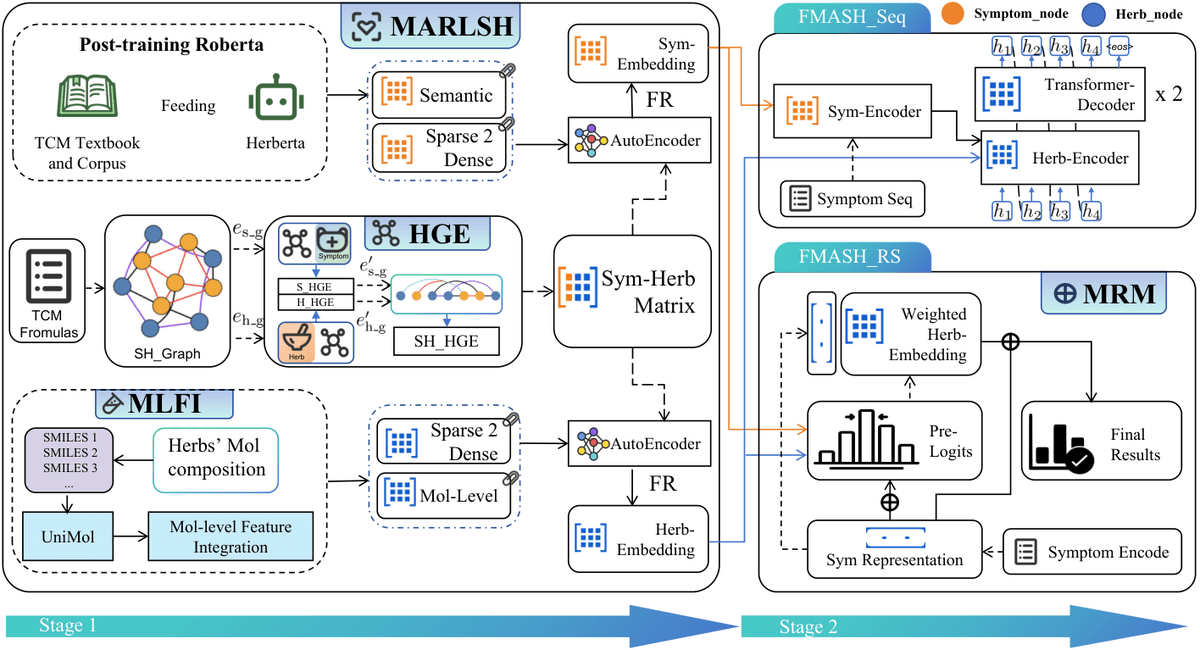
- FMASH fuses molecular-scale herb features with symptom-herb graphs for TCM formula recommendation, paper here.
- Beats prior SOTA TCMRGCL by 3.38% Precision@5 and 3.89% Recall@5 on Dataset1.
- Sequential variant FMASH_Seq improves matched precision by 28.35% at k=5 versus baseline.
- Uses Uni-Mol to encode SMILES strings of herb ingredients into 3D molecular embeddings.
- Combines GCN local aggregation with bidirectional Mamba for long-range graph relations.
- Code and data are available on request rather than in a public repository.
Recommending Traditional Chinese Medicine (TCM) formulas with machine learning has mostly been a text-matching game: models learn which herbs co-occur with which symptoms across thousands of prescriptions and predict combinations from there. A new framework called FMASH argues that this approach throws away the most important signal, the actual chemistry of the herbs, and proposes a fix that pushes benchmark scores meaningfully higher on two standard datasets.
The paper, Fusion of Multiscale Associations of Symptoms and Herbs, comes from researchers at Beijing University of Posts and Telecommunications and collaborators. Its core claim is that combining molecular-scale features of herbs with graph-based symptom-herb relationships produces sharper embeddings, and that treating formula generation as an ordered sequence rather than a bag of herbs reduces the risk of recommending combinations that are pharmacologically incompatible.
Why bag-of-herbs recommenders keep failing
Prior graph neural network approaches like SMGCN, KDHR, and TCMRGCL model herbs and symptoms as nodes in a heterogeneous graph and learn embeddings from co-occurrence statistics or knowledge-graph triples. These GNN-based models operate at a purely symbolic level, representing herbs through co-occurrence counts, categorical property labels, or knowledge-graph relations, without leveraging the three-dimensional molecular structures that ultimately govern pharmacological activity.