
Beijing Researchers Beat a 6x Bigger Chemistry AI by Routing Smarter
Researchers show that Mixture-of-Experts routing per atom type beats dense scaling for physics simulations, hitting state-of-the-art on three major benchmarks.
 Pro
Takeaways
- MoE beats dense scaling: Element-wise Mixture-of-Experts on the DPA3 backbone outperforms a 6x-larger dense model on energy and force prediction.
- Key design rules found: Sparse activation + ~50% shared experts + nonlinear expert outputs + per-atom routing are all required for stable, large gains.
- Global routing catastrophically fails: Averaging routing vectors across all atoms in a configuration causes training divergence; per-element routing is essential.
- State-of-the-art on three benchmarks: MoE-E achieves top results on OMol25, OMat24, and OC20M, with the biggest gains on molecular and catalytic tasks.
- Periodic table emerges spontaneously: PCA of routing weights shows the model self-organizes experts along periodic-table trends with no explicit chemical supervision.
- No code/weights released yet: This is a research architecture study; distributed expert-parallel training infrastructure is flagged as future work.
Scaling up AI models for chemistry is not as simple as making them bigger. A new paper from researchers at the AI for Science Institute in Beijing shows that injecting Mixture-of-Experts (MoE) architecture into Machine Learning Interatomic Potentials (MLIPs) -- the neural networks that simulate how atoms interact -- delivers better accuracy than simply widening or deepening the underlying network, and does so at a fraction of the parameter cost.
The problem with brute-force scaling
MLIPs have emerged as a powerful approach for atomistic simulation, enabling near ab-initio accuracy at significantly reduced computational cost. By learning energy and force representations from quantum mechanical data like DFT, they provide a practical alternative to traditional force fields while remaining orders of magnitude faster than electronic structure methods. In other words, they let you simulate millions of atoms without running a full quantum mechanics calculation on each one.
The field has been chasing scaling laws similar to those in LLMs: bigger models trained on more data perform better. Simply expanding model capacity through deeper or wider dense architectures remains computationally prohibitive. Two primary bottlenecks hinder this approach: the all-to-all computational dependency in dense models limits parallel efficiency, and as depth and width increase, the optimization landscape grows increasingly complex, resulting in diminishing returns and heightened training instability.
The natural solution -- standard MoE from the LLM world -- hits a physics wall. Standard MoE designs are often incompatible with the equivariant representations employed by MLIP architectures based on equivariant graph neural networks. Unlike the discrete token representations in language models where sparse expert activation is natural, MLIPs model continuous potential energy surfaces. Abrupt expert switching can introduce numerical instabilities or non-physical discontinuities, potentially violating the law of energy conservation.
The prior art: Meta's MoLE
Meta FAIR's UMA models introduced a workaround called Mixture-of-Linear-Experts (MoLE). UMA explores techniques for training MLIPs across diverse DFT tasks using nearly 500 million training examples gathered over numerous datasets. By taking advantage of scaling relationships between dataset size, model capacity, and loss, they are able to train models competitive with task-specialized models. Naive approaches to scaling model parameters would result in an accurate but slow model; to address this, they introduced Mixture of Linear Experts, a method to increase model capacity while maintaining inference efficiency.
Unlike standard Mixture of Experts, MoLE ensures smooth energy surfaces and equivariant outputs -- crucial for physical accuracy in tasks like molecular dynamics and force prediction. But MoLE has a trade-off: by keeping the mixing linear, it sacrifices the expressive power that nonlinear expert specialization provides.
The new approach: element-wise nonlinear MoE
The Beijing team built their MoE on top of DPA3, a graph neural network that uses only invariant (rotation-independent) features rather than equivariant ones. DPA3 is a message-passing neural network built upon line graph series specifically designed for the era of large atomistic models. The model is designed to exhibit scaling laws, whereby its generalizability improves consistently with increases in model size, training data, and computational budgets. Because DPA3 uses invariant features, it sidesteps the equivariance compatibility problem entirely -- nonlinear operations on expert outputs are now valid.
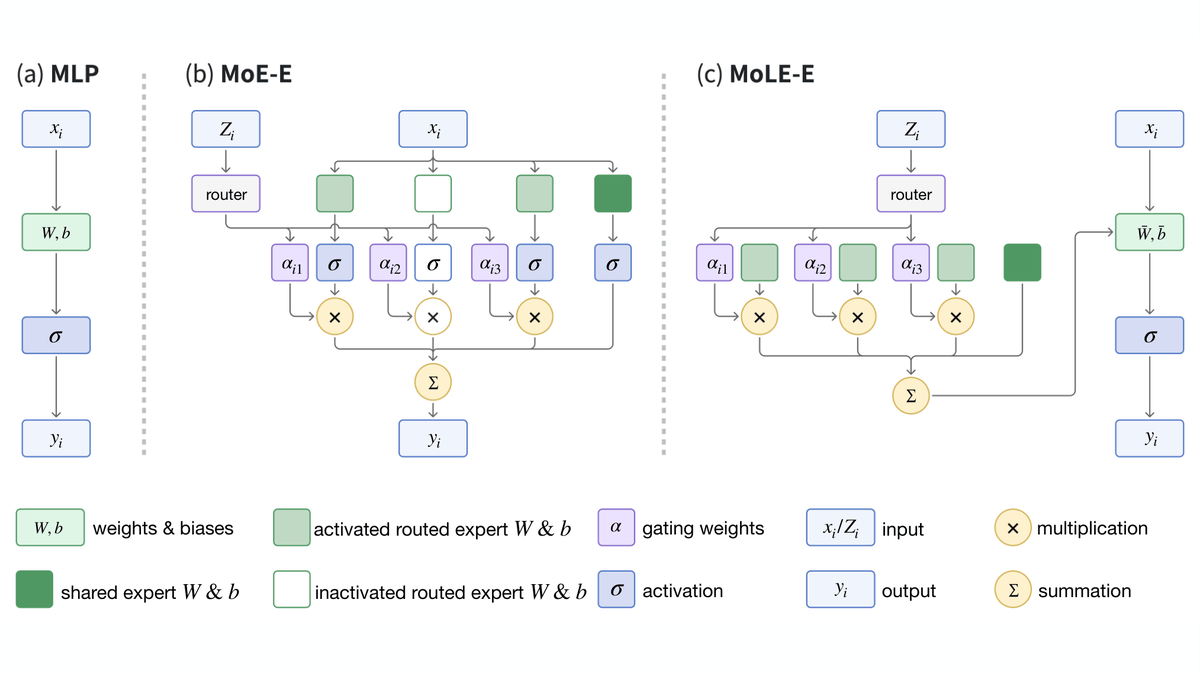
The key architectural innovation is element-wise routing: instead of computing a single routing vector averaged across all atoms in a configuration (as UMA does), each atom gets its own routing decision based purely on its atomic number. The routing works like this:
- Each atom's atomic number is one-hot encoded and projected into a continuous embedding via a small MLP.
- A learned routing matrix scores that embedding against all available experts.
- A Top-K selection activates only a sparse subset of experts for that atom type.
- A fixed set of shared experts is always active, regardless of element, to capture universal chemistry.
- Outputs from routed and shared experts are nonlinearly combined to produce the atom's contribution to total energy.
This element-wise routing mechanism enables atom-type-dependent expert selection while preserving smoothness and differentiability, which are essential for stable and physically consistent interatomic potential modeling.
Here is a simplified sketch of the MoE transformation for a single atom:
# Pseudocode for element-wise MoE layer
def moe_layer(x_i, atomic_number_Z):
    # Embed atomic identity
    u_i = mlp(one_hot(atomic_number_Z))  # shape: [M]
    # Compute routing scores over I routed experts
    scores = softmax(W_router @ u_i)     # shape: [I]
    # Sparse TopK selection
    alpha = topk_gate(scores, K_prime)   # zeros out non-top experts
    # Routed expert outputs (nonlinear)
    routed = sum(alpha[j] * sigma(W_j @ x_i + b_j) for j in range(I))
    # Shared experts always active
    shared = sum(sigma(W_j @ x_i + b_j) for j in range(I, N))
    return routed + shared
What the ablations revealed
The paper is unusually thorough in its ablation studies. The team systematically varied the number of total experts (N), activated experts (K), and shared experts across both MoE and MoLE formulations. Several non-obvious findings emerged:
- Shared experts are not optional. Introducing shared experts consistently improves model performance. For K=8, increasing the number of shared experts from zero to six reduces the normalized MAEs for energy and force by 0.269 and 0.200, respectively. Without them, performance can actually degrade relative to the dense baseline.
- The sweet spot is roughly half-and-half. Performance is optimized when the number of shared experts approaches approximately half of the activated experts. Beyond this regime, further increasing the fraction of shared experts yields diminishing returns or even slight performance degradation.
- Nonlinear MoE beats linear MoLE once shared experts are present. MoE-E demonstrates a substantially stronger response to the introduction of shared experts. For the same transition from zero to two shared experts, MoE-E achieves a larger reduction in normalized energy MAE, ranging from 0.18 to 0.23, and a decrease in normalized force MAE of approximately 0.13 to 0.14.
- Global routing is catastrophically unstable. The MoE-G architecture suffers from catastrophic training failure: its energy and force MAEs exhibit severe numerical instability and fail to converge. Configuration-level averaging destroys the per-element signal the router needs.
- Element-wise routing beats global routing even in MoLE. MoLE-E achieves approximately 5-10% lower MAEs in both energy and force predictions across all values of N compared to its global counterpart MoLE-G.
Benchmarks and results
The three benchmarks used span very different chemistry:
- OMol25: A large-scale DFT dataset offering high-precision quantum chemistry calculations across 83 million molecular systems with extensive chemical diversity, covering organic molecules, biomolecules, metal complexes, and electrolytes.
- OMat24: The Open Materials 2024 dataset comprising over 110 million DFT calculations across diverse chemistries, materials, and configurations -- focused on solid-state inorganic materials.
- OC20M: A subset of the Open Catalyst 2020 dataset targeting catalytic surface reactions.
MoE-E consistently outperforms MoLE-E across all evaluated benchmarks. Specifically, a reduction in normalized Energy MAE of 0.10, 0.02, and 0.03, complemented by a decrease in normalized Force MAE of 0.10, 0.03, and 0.04 on the OMol25, OMat24, and OC20M datasets, respectively. The gains are largest on molecular and catalytic tasks, and more modest on solid-state materials -- likely because the DPA3 backbone was originally optimized for molecular systems.
Perhaps the most striking result: MoE-E even surpasses a dense baseline with 6x the parameter count, yielding additional error reductions of up to 0.07 in Energy and 0.05 in Force. You get better accuracy than a model six times larger, just by routing smarter.
The periodic table emerges for free
The most conceptually interesting finding is what the model learned without being told to. The team ran a PCA (principal component analysis -- a technique that compresses high-dimensional data into a 2D map) on the routing weight distributions across all elements. The first two principal components account for 93.57% of the total explained variance. Clear chemical groupings emerge: lanthanides and actinides cluster on the left side of the PCA manifold, while transition metals predominantly occupy the central region.
Elements within the same group arrange themselves diagonally from the top-left to the bottom-right of the PCA space. This spatial ordering correlates strongly with increasing atomic number, with lighter elements located in the top-left region and heavier elements positioned toward the bottom-right. The model essentially rediscovered Mendeleev's periodic table from scratch, using only the signal of which experts fire for which atoms.
Limitations and what comes next
The paper is candid about one major gap. The current implementation does not yet exploit a fully distributed training and inference framework specifically optimized for sparse expert parallelism. While MoE architectures are intrinsically well-suited for distributed environments and offer substantial theoretical scalability advantages over dense scaling, realizing these benefits in practice requires dedicated expert-parallel system design, communication scheduling, and load-balancing strategies. In short: the computational efficiency gains that MoE promises in LLMs have not yet been harvested here.
On the practical side, the gains are uneven. The model shines on chemically diverse molecular and catalytic systems but offers only marginal improvements on solid-state materials. Teams working primarily on inorganic crystal structures may see limited benefit over a well-tuned dense baseline.
No pretrained model weights or code repository were released alongside the paper. The work is a research-level architecture study built on the DPA3 framework, which is available through the DeepModeling ecosystem. As the field moves toward foundation models for atomistic simulation that need to cover the entire periodic table simultaneously, the element-wise MoE design offers a principled and interpretable path forward -- one where the model's internal routing structure mirrors the chemistry it was trained to learn.