
Beijing Normal University's BarbieGait Teaches AI to Identify People Despite Clothing Changes
Researchers at Beijing Normal University built a synthetic gait dataset with 100 outfits per person and a normalization trick that survives cloth changes.
Takeaways
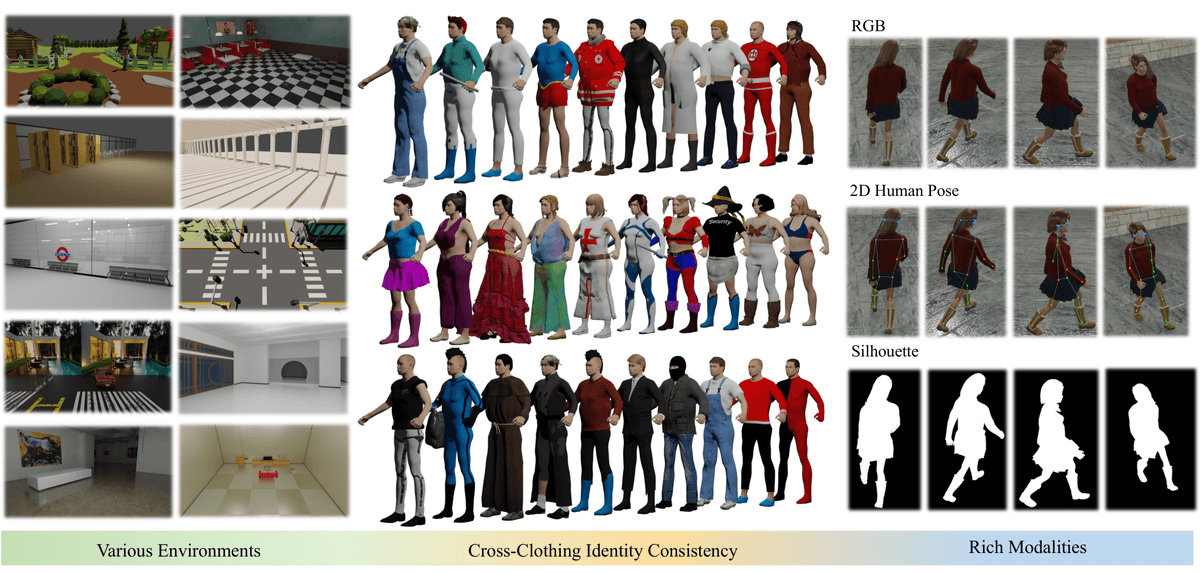
- BarbieGait ships 1.2M gait sequences from 521 subjects with 100 outfits each, all identity-consistent synthetic renders.
- Real subjects captured by six cameras get cloned as MakeHuman avatars, then dressed and animated in Blender.
- Identity fidelity is 12.2mm mean joint position error and 0.02 degrees joint angle error versus real walks.
- GaitCLIF uses Gait-Oriented Normalization on horizontal body strips to strip out clothing-specific statistics.
- Hits 65.7% mAP on BarbieGait and adds 2.3% mAP on CCPG plus gains on SUSTech1K, Gait3D, GREW.
- Code on GitHub, dataset release pending; accepted at CVPR 2026.
Gait recognition, identifying people by how they walk, works well in the lab but stumbles the moment someone swaps a hoodie for a puffy jacket. A team from the School of Artificial Intelligence at Beijing Normal University, together with collaborators from AMAP (Alibaba Group) and WATRIX.AI, tackles this in a CVPR 2026 paper that pairs a new synthetic dataset called BarbieGait with a baseline model, GaitCLIF, designed to ignore clothing while holding onto identity cues.
The core idea is simple to state and hard to execute: take real people, clone them into a game engine as identity-matched avatars, then dress those avatars in 100 different outfits without ever changing how they walk. The paper argues this is the only tractable way to study cloth-invariance at scale, because real-world capture sessions with dozens of outfits per person are logistically impossible.
Why clothing breaks gait recognition
Gait is attractive as a biometric because it works at a distance and does not require cooperation from the subject. Clothing is the elephant in the room. Wardrobe variations introduce significant intra-class variance, making it difficult for models to extract stable, identity-discriminative features. A long coat hides leg motion. A backpack reshapes the silhouette. Existing real-world datasets typically capture only two or three outfits per subject, which is not enough signal for a model to separate what covers the body from the body itself.
The authors' key observation is that features from different parts of the body are affected by clothing to varying degrees, and preserving fine-grained motion information helps a model learn cloth-invariant features across body regions. That insight drives both halves of the paper.