
Beijing Institute of Technology's Mocap-2-to-3 Cuts 3D Pose Error by 64% Without Cameras
A new diffusion framework recovers metric-scale 3D human motion from a single camera by pretraining on 2D data and lifting through synthesized views.
 Pro
Takeaways
- Mocap-2-to-3 lifts monocular 2D poses to metric-scale 3D motion via multi-view diffusion synthesis. Paper
- Two-stage training: 2D pretraining on internet-scale poses, then multi-view fine-tuning on 3D data.
- A decoupled representation separates local pose from global movement, preserving fine motion detail.
- Ground-plane pointmaps injected via cross-attention cut training time by more than 50%.
- Beats GVHMR+SMPLify on RICH with 26.2 mm PA-MPJPE and Abs-MPJPE of 156.8 mm without scene scans.
- Requires calibrated cameras and clean 2D keypoints; code and weights not yet released.
Getting a person's 3D pose out of a single video is a well-worn problem, but most methods still cheat on one thing: they only recover motion relative to the first frame. If you want a character that actually sits on a real chair or walks a real distance in world coordinates, that is not good enough. A new paper called Mocap-2-to-3 from Beijing Institute of Technology, BIGAI, Deep Glint, Zhejiang University, HKU and Shandong Agricultural University attacks both the generalization and the absolute-scale sides of this problem at once, using an unusual trick: train a diffusion model on cheap 2D pose data, then fine-tune it to hallucinate consistent extra camera views of the same motion.
The two things monocular mocap keeps getting wrong
Current state-of-the-art methods heavily rely on precise 3D motion capture data for training, which is costly and requires specialized equipment and controlled environments, limiting accessibility for many research institutions. That is the first failure mode: models overfit to indoor mocap studios and fall apart on out-of-distribution actions like handstands or squatting. The second is metric scale. Prior methods recover only relative positions in the world coordinate system, typically via alignment with the ground truth's initial frame, limiting practical deployment. Absolute positioning supports broader applications by requiring environmental awareness and spatial reasoning to infer complex interactions, including human-human, human-object, and human-scene relations.
The authors' bet is that 2D pose data from internet videos, which is essentially free at scale, can supply the missing action diversity, while a small amount of 3D data can supply the geometric grounding.
Turning 2D-to-3D into a multi-view generation problem
Instead of regressing 3D joints directly from 2D keypoints, Mocap-2-to-3 reframes the task as multi-view synthesis. Given the input 2D pose sequence from one camera, a diffusion model generates geometrically consistent 2D pose sequences for three other virtual cameras, and the 3D motion is then recovered by classical triangulation across those views.

Training happens in two stages:
- Single-view 2D pretraining. A transformer-based diffusion model is trained to generate 2D motion from arbitrary camera views, learning geometric relations from large-scale 2D data. This gives the model motion priors across diverse viewpoints, accelerating convergence during fine-tuning.
- Multi-view fine-tuning. The number of viewpoints is set to 4, including a primary camera used at inference and three virtual cameras whose poses are randomly sampled from the pretraining distribution. A View Attention layer is inserted to enforce cross-view consistency.
Because no image is used, only 2D pose sequences, the authors can aggressively augment: random rotation, translation, and camera viewpoint augmentation such as modifying pitch, yaw, roll, and distance, which enables large-scale virtual data generation from limited samples.
Splitting pose from position
The second key idea is a decoupled motion representation. If you just ask the network to predict projected global 2D coordinates directly, the position term dominates the loss and the network stops caring about elbows and knees. So the paper splits each 2D motion into two heads: a local pose (joint keypoints inside a normalized bounding box, root-centered) and a global movement vector (the trajectory of the bounding box center plus its horizontal and vertical scale over time). At inference, local poses are rescaled and re-shifted by the global movement to recover the per-view global 2D coordinates, which are then triangulated into a 3D absolute pose.

Encoding the ground as pixel-to-world pointmaps
Depth from a single view is fundamentally ambiguous, so learning where a person is standing in the world converges painfully slowly, even with camera parameters as input. The authors' fix is a lightweight geometric prior: for each camera they compute the intersection of every pixel ray with the ground plane, producing a pointmap that directly maps pixels to world coordinates. That pointmap is encoded with a ResNet-18 and fed into the diffusion model through cross-attention.
Crucially, only the ground plane is included rather than full environmental point clouds, as pointmaps can be computed directly from camera poses without additional sensors or ground-truth scans. Ablations show this cuts training time by more than half at equivalent accuracy.
The numbers
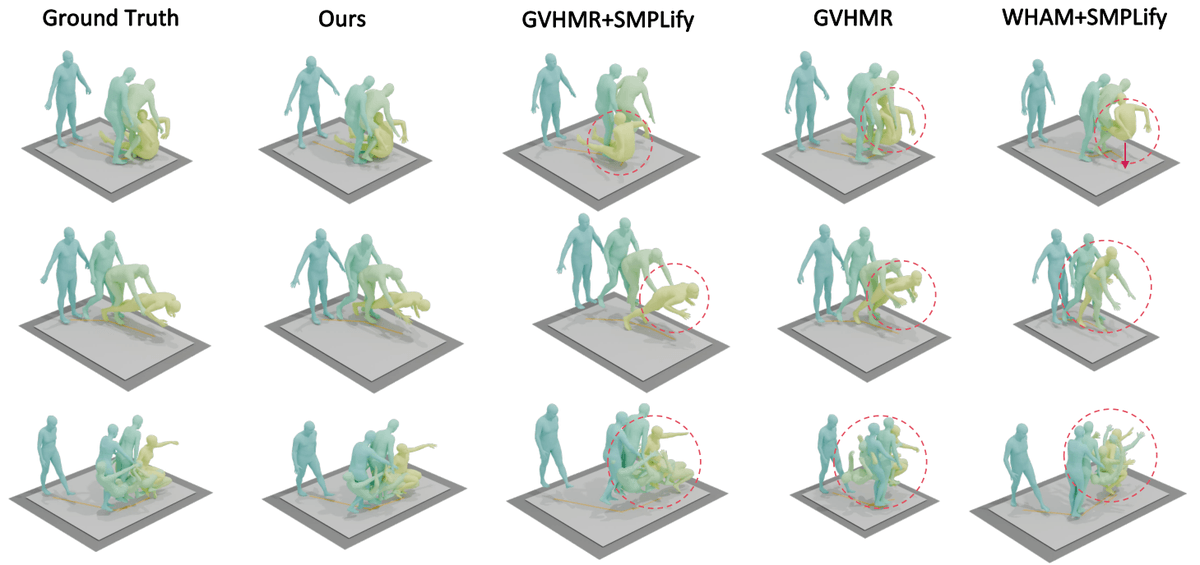
Evaluated on RICH (indoor and outdoor scenes with interactions) and AIST++ (dance), Mocap-2-to-3 posts consistent wins over image-based state of the art. On RICH with SMPL keypoints, it hits PA-MPJPE 26.2 mm and MPJPE 39.6 mm, against 30.7 and 58.7 for GVHMR combined with SMPLify. In absolute world coordinates without any alignment, the gap widens dramatically: Abs-MPJPE drops from 430.4 mm to 156.8 mm.
| Method | PA-MPJPE | MPJPE | Abs-MPJPE |
|---|---|---|---|
| WHAM+SMPLify | 37.5 | 68.9 | 456.3 |
| GVHMR+SMPLify | 30.7 | 58.7 | 430.4 |
| SA-HMR (uses scene scans) | 51.1 | 93.2 | 268.3 |
| Mocap-2-to-3 | 26.2 | 39.6 | 156.8 |
On AIST++ using COCO keypoints from a ViTPose detector, the method also beats MVLift and GVHMR+SMPLify on both pose accuracy and root translation error. Notably, this is achieved without scanned environments, which the previous best absolute-pose method, SA-HMR, requires.

What it is good for, and what it is not
The framework assumes calibrated camera intrinsics and extrinsics, so it is aimed at fixed-camera setups: sports analysis, esports capture, gaming rigs, embodied AI training scenes, retail or surveillance analytics. It is not a replacement for SLAM-based pipelines like TRAM when the camera is moving and calibration is unknown.
Two other honest limitations from the authors:
- Errors from bad 2D detectors on raw video propagate through. The method processes 2D keypoints, not pixels, so garbage in gives garbage out. It shines with reliable 2D input such as ViTPose on COCO or manually annotated SMPL keypoints.
- Foot-sliding is slightly higher than GVHMR because the authors did not add post-hoc foot-contact optimization, which they flag as future work.
The real result buried in the ablations is that adding just 175 in-domain 2D pose sequences during pretraining meaningfully improves PA-MPJPE and MPJPE on RICH. That suggests a practical workflow: for any new scene where 3D capture is impractical, you can shoot a handful of 2D annotated clips and quickly fine-tune the pretrained lifter, without buying a mocap suit or renting a scanned scene. As of publication, the authors have not released code or weights, but the paper is on arXiv along with detailed pseudocode in the supplementary.