
Beihang University's EAR Framework Pushes Satellite AI Grounding Past 46% Accuracy
A new benchmark and reward-driven training recipe push aerial imagery grounding from single-object matching toward relational, multi-entity reasoning with structured chain-of-thought.
 Pro
Takeaways
- ME-RSRG is the first aerial grounding benchmark with explicit subject-object entity roles, 7,162 images and 12,091 instances.
- EAR framework combines SFT cold start with entity-aware GRPO on top of Qwen-VL and InternVL backbones.
- Reward function bundles format checks, role-weighted IoU tiers, and a bonus for correctly matching multiple entities.
- Qwen2.5-VL-7B climbs from 10.35% to 46.72% mAcc@0.5; all tested VLMs show consistent gains.
- Ablations show GRPO without SFT initialization collapses; the relational bonus prevents single-box shortcuts.
- Dataset, code, and models released at github.com/CV-ShuchangLyu/ME-RSRG.
Aerial imagery is messy. A single satellite tile can contain dozens of tennis courts, a swarm of vehicles, and half a dozen roundabouts, all at wildly different scales. Ask a model to find the parking lot next to the lower-left building and most current remote sensing grounding systems either pick a plausible-looking object or hallucinate a box, because they were trained to match one phrase to one region. A team from Beihang University, the University of Liverpool, and the Chinese Academy of Sciences is trying to change that with a new dataset and training framework that force vision-language models to reason about multiple entities and their relationships before drawing any boxes.
Grounding was stuck on single objects
Remote Sensing Visual Grounding (RSVG) asks a model to localize an object in aerial imagery given a natural language expression. The paper argues that visual grounding was first explored in natural scene images to localize objects described by language expressions, with representative methods focusing on cross-modal representation learning and region-text matching through notable architectures and fusion mechanisms. Those ideas were then ported to aerial data, but the formulation stayed the same: one phrase, one box.
That is a problem in overhead scenes where identity is defined by context. Unlike existing datasets that annotate a single target region per referring description, each sample in ME-RSRG explicitly involves a subject entity together with one or more object entities, providing structured annotations for entity roles and language description. The authors also note that layering a <think> chain-of-thought on top of a single-entity task tends to produce shallow reasoning traces, because there is nothing relational to reason about.

Inside ME-RSRG
The new benchmark, ME-RSRG, is assembled from three existing aerial grounding corpora (RSVG-HR, DIOR-RSVG, and OPT-RSVG) using a five-stage pipeline. The construction pipeline follows a 5-step process: dataset collection, instance selection, manual annotation, expert assessment, and CoT generation. Gemini-2.5-Pro is used to filter expressions that actually describe subject-object relations, human annotators add the missing object boxes, and Gemini is called again to write chain-of-thought traces for a subset of samples.
The final counts:
- 7,162 images and 12,091 image-text instances, split into 10,305 training instances and 1,786 test instances
- 2,149 of the training instances carry explicit
<think>...</think>reasoning traces used for the SFT cold start - Image resolutions span roughly 152x152 up to 10569x10569 pixels, covering both dense and very-high-resolution scenes
- The protocol currently supports single-subject / single-object and single-subject / multiple-object configurations

The EAR framework
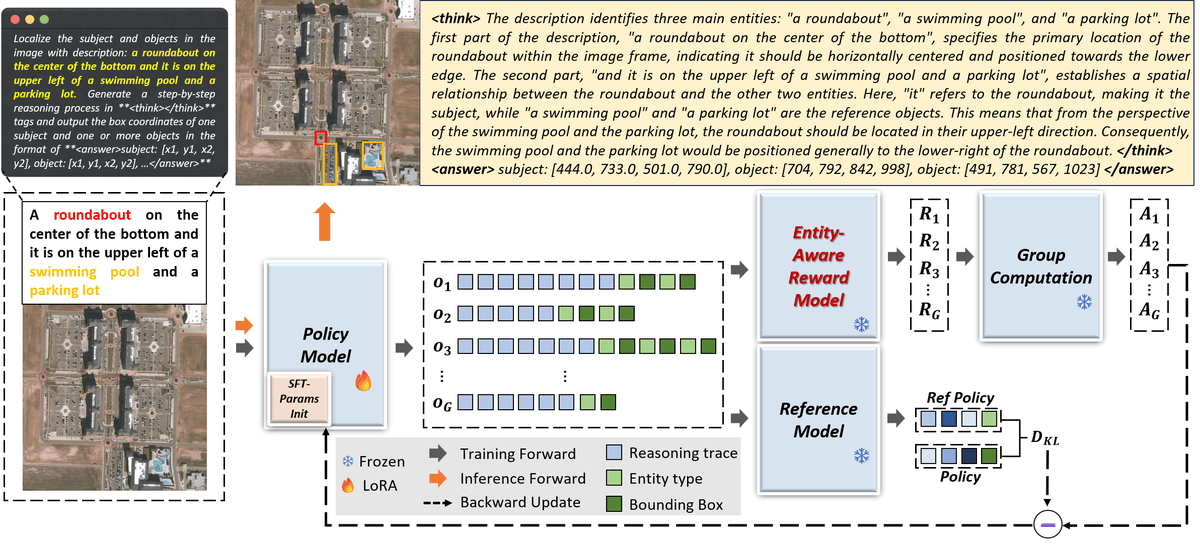
On top of the dataset, the authors propose Entity-Aware Reasoning (EAR), a two-stage recipe that sits on top of off-the-shelf vision-language models like Qwen2.5-VL, Qwen3-VL, and InternVL3.5. The model is asked to emit a strict structured output: a <think> block followed by an <answer> block containing subject: [(x1,y1),(x2,y2)], object: [(x1,y1),(x2,y2)],....
Stage one is standard supervised fine-tuning on the CoT-annotated subset to teach the output template and coarse localization. Stage two applies Group Relative Policy Optimization (GRPO), the same reinforcement-learning-with-verifiable-rewards trick behind DeepSeek-R1, but with a reward function designed specifically for multi-entity grounding. Three signals are combined:
- Two-level format reward. One indicator checks the
<think>/<answer>scaffold, another checks that at least one entity is emitted in the requiredrole: [box]syntax. Each is worth 0.3, so a fully-formatted response earns 0.6. - Entity-aware grounding reward. IoU is bucketed into discrete tiers (1.0 above 0.75, 0.8 above 0.5, 0.4 above 0.25, else 0), and the subject gets a 1.5x weight versus 1.25x for objects, biasing the model toward getting the primary referent right.
- Relational consistency bonus. A 0.3 bonus if both the subject and at least one object are matched, and another 0.3 if two or more objects are matched, discouraging the model from collapsing to a single-box answer.
GRPO then samples eight completions per prompt, normalizes the rewards within the group, and updates the policy with a KL penalty against a frozen reference. Training uses LoRA with rank 8 on a single 80GB A800.
What the numbers say
The zero-shot baselines are brutal. Extensive experiments verify the effectiveness of EAR in structured relational grounding. Qwen3-VL-8B, the strongest untuned baseline, only hits 21.72% mAcc@0.5, and InternVL3.5-4B scores 0.51%. Supervised fine-tuning alone pushes InternVL3.5-4B to 32.80% and Qwen2.5-VL-7B to 33.34%. Adding the entity-aware GRPO stage lifts Qwen2.5-VL-7B further to 46.72%, and with optimization under the EAR framework, the Qwen2.5-VL series achieves over 10% improvement in mAcc@0.5 value, and all evaluated visual-linguistic foundation models show consistent gains.
The ablations are worth reading. GRPO without an SFT cold start actively hurts, dropping Qwen2.5-VL-3B from 28.79% (SFT only) to 15.49%. Removing the relational consistency bonus causes the model to predict only a single object and ignore the rest of the scene, hitting both subject and object accuracy.
Where it still breaks
Two failure modes stand out in the qualitative analysis. First, compound spatial constraints like to the left of combined with long distances between entities still trip the model up when many similar objects (cars, tennis courts) are nearby. Second, the reasoning traces show a linguistic tic: the model tends to write The description mentioned two entities even when there are three or more, an artifact of the SFT set being dominated by single-subject / single-object examples.
Why it matters
The real contribution here is less about the raw numbers and more about the shape of the reward. Most GRPO-for-vision papers reward a single IoU. EAR shows that when a task involves multiple boxes with different roles, you need role-weighted IoU thresholds and an explicit relational bonus, or the policy will happily maximize reward by ignoring half the scene. That template is useful well beyond aerial imagery: any grounding task with subject-object structure (medical imaging, robotics, autonomous driving scene queries) faces the same reward-shaping problem.
The dataset, code, and trained models are being released on GitHub, and the framework is implemented on top of the ms-swift fine-tuning stack, so reproducing the Qwen2.5-VL and InternVL3.5 results should be tractable on a single high-memory GPU.