
Beihang's VTEdit-Bench Shows Universal Editors Beating Specialized Try-On Models
A new benchmark tests whether universal image editors like Flux.2 and Qwen-Image-Edit can replace specialized virtual try-on models across five realistic scenarios.
 Pro
Takeaways
- VTEdit-Bench introduces 24,220 test pairs across five try-on tasks of increasing complexity to evaluate universal editors.
- VTEdit-QA uses GPT-4o to score model consistency, cloth consistency, and image quality with 0.72 SRCC to humans.
- Flux.2-klein beats specialized IDM-VTON on overall quality across all three shop-based tasks.
- Universal editors match specialists on Shop2Model but generalize more stably to multi-view and multi-person cases.
- Multi-item composition and person-to-person transfer remain hard for universal models, with DreamO scoring 0.01.
- Code and dataset are available at github.com/Hiuyee124/VTEdit-Bench.
Virtual try-on used to be its own little pocket of computer vision, with bespoke models built on top of Stable Diffusion, custom masks, pose estimators, and human parsers glued together to swap a shirt onto a person. A new benchmark from Beihang University and Zhongguancun Academy argues that this whole stack may be on borrowed time. VTEdit-Bench systematically pits modern universal image editors, the same ones you use to change backgrounds or restyle photos, against seven purpose-built try-on models, and the results suggest the generalists are catching up fast.
Why specialized try-on hit a wall
Most specialized VTON models build on text-to-image backbones, treating the person and garment as conditioning signals, and follow pipelines that are either mask-based or mask-free. Mask-based methods estimate auxiliary conditions such as parsing and pose and perform region-aware inpainting, offering explicit correspondence but depending on the quality of those conditions. That works when the setup matches the training distribution, one product photo onto one frontal model, but retail scenarios have moved well beyond that.
The authors point out that existing try-on benchmarks tend to focus on that single canonical case, and standard scores like FID and KID can look great even when a model completely fails to transfer the garment. FID and KID measure distributional similarity, but they can be misleading for VTON when clothing transfer fails, for example by simply copying the input. You need something that actually checks whether the person is still the same person and whether the clothes actually made it across.
Five tasks, progressively meaner
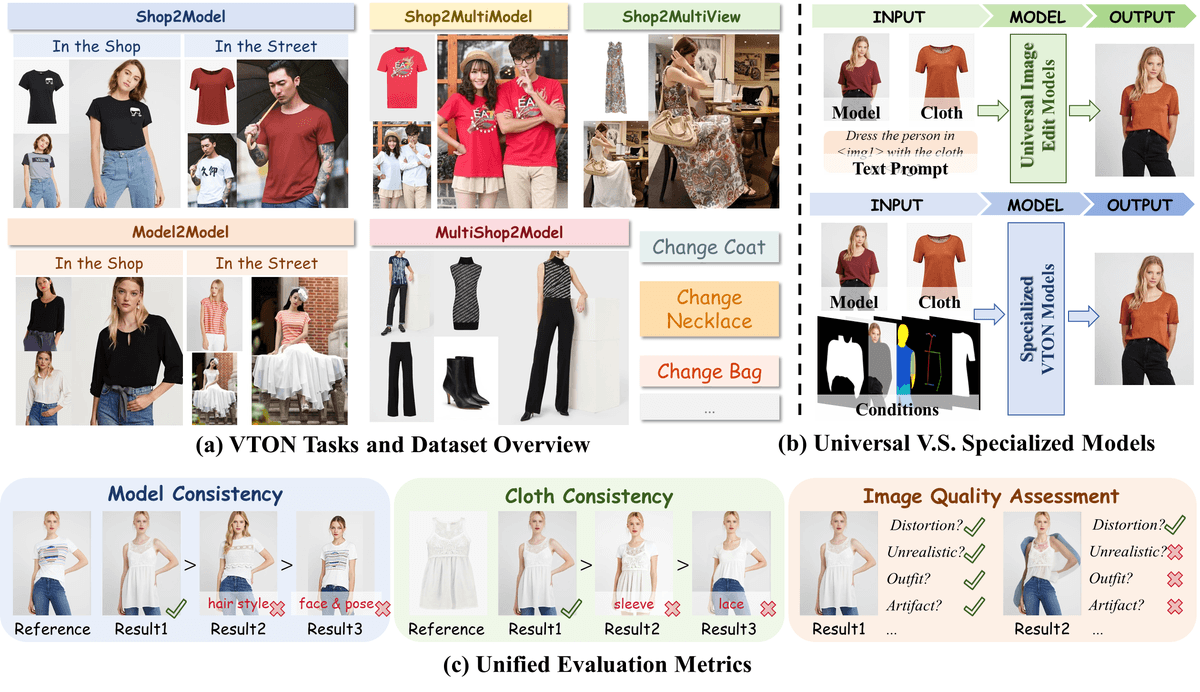
VTEdit-Bench contains 24,220 test image pairs spanning five representative VTON tasks with progressively increasing complexity. The tasks escalate from familiar territory into scenarios that break most existing pipelines:

- Shop2Model: the classic case, transfer a product image onto a frontal model. Uses DressCode and VITON-HD test sets for indoor models and StreetVTON for outdoor, yielding 9,521 test pairs.
- Shop2MultiView: non-frontal viewpoints where the model turns sideways or away.
- Shop2MultiModel: multiple people in the frame who all need consistent try-on.
- Model2Model: extract clothing from one person photo and re-render it on another, no clean product image available.
- MultiShop2Model: compose multiple items, tops, bottoms, shoes, bags, onto a single person at once.
Auxiliary conditions like OpenPose, human parsing, DensePose, agnostic masks, and cloth masks are provided for every sample. To ensure broad compatibility, the extractability of those signals was used as a filter during data curation. That last detail matters, it means specialized VTON pipelines can be evaluated on the benchmark without the excuse that their preprocessors would have failed.
An evaluator that actually looks at the references
The second contribution is VTEdit-QA, a scorer built on GPT-4o that grades outputs along three axes: model consistency (is it still the same person, same pose, same body), cloth consistency (are the textures, colors, and boundaries faithful), and image quality (are there artifacts or physics violations). Since a successful try-on requires simultaneously preserving model identity, transferring the garment, and maintaining image quality, a failure in any dimension can degrade the final result, so the authors take the minimum of the three scores as the overall score.
This conservative minimum-rule is the interesting part. A model that nails identity and quality but pastes the wrong shirt gets penalized as hard as one that ruins the face. Human annotators reached an average inter-annotator SRCC of 0.75, and VTEdit-QA reached 0.72 correlation with human rankings, close to the human agreement level. Close enough to use as a scalable proxy.
Universal editors are winning where it matters
The headline result is that on the standard Shop2Model task, universal editors are already competitive. On Shop2Model, IDM-VTON and OOTD-Diffusion lead with FID/KID of 7.40/2.61 and 7.49/2.36, while universal models like Flux.2 and Qwen-Image-Edit-2511 remain highly competitive. As things get harder, the picture flips.

On the fine-grained VTEdit-QA scores across shop-based tasks, Flux.2-klein posted the highest overall scores on all three shop-based tasks at 3.96, 3.99, and 3.56, outperforming the best specialized baseline IDM at 3.60, 2.73, and 1.65. That is a huge gap on the harder multi-view and multi-model settings, where the specialized model's image quality collapses even though it still nails the individual pieces.
The catch shows up in the extended tasks. On MultiShop2Model, FastFit performs best with an overall 2.90, while Flux.2-klein stays close at 2.68 and DreamO collapses to near-zero at 0.01, indicating failure to handle multi-item conditioning and composition. Universal editors struggle when they have to bind multiple garments to a single person, or preserve exact identity when transferring clothing from one person to another. On Model2Model, Qwen-Image-Edit-2511 scored only 1.17 overall due to low model-consistency of 1.60, suggesting frequent identity drift despite visually plausible outputs.
What this means in practice
For anyone building try-on into a product, the takeaway is that the specialized-versus-universal question depends heavily on which scenario you care about:
- Pure catalog-to-model on frontal images, specialized models still win on distributional metrics, but Flux.2 variants are close and don't need the auxiliary condition pipeline.
- Multi-view or multi-person shots, universal editors are more robust and don't need to be retrained per scenario.
- Full outfit composition or person-to-person transfer, this is still an open problem; specialized models like FastFit that handle multi-item are your best bet, or you accept the failure rate of universal models.
The authors are open about the remaining gaps. Two bottlenecks persist: model and cloth consistency degrade as reference complexity increases, and limited VTON-specific visual understanding weakens fine-grained compositional control like attribute binding, localization, and occlusion reasoning. They suggest fine-tuning universal editors on curated VTON data and adding spatially grounded reference binding as promising directions.
The benchmark and evaluator code are hosted on GitHub, and the paper details the exact prompts used for GPT-4o scoring and the auxiliary condition extraction pipeline. If you're evaluating a new try-on system, this is now the reference to beat, especially because it captures the failure modes that FID quietly hides.