
Beihang's IA-KRC Beats Rival AI Agents by 31x in Obstacle-Filled Battlefields
A new MARL framework picks communication partners by physical reachability and predicted enemy interference, delivering up to 31x higher win rates in complex maps.
 Pro
Takeaways
- IA-KRC picks MARL communication partners by K-step reachability plus predicted enemy interference, not raw distance. Paper
- A three-layer map (geometry, rules, interference) lets Dijkstra compute reachability on demand without global recomputation each step.
- An MLP predicts enemy attack intent, warping a directional potential field so forward-facing threats cost more.
- On custom SMACv2 obstacle and maze maps, win rate advantage ranges from 4.58x to 31.56x over seven baselines.
- Isolated-agent rate drops to 0.0058 vs 0.63 for CommFormer, preventing early losses from cascading into total defeat.
- K=9 is optimal; ablations show removing interference or reachability costs 9 and 18 points of win rate respectively.
Teaching a swarm of agents to cooperate is easy in an empty room. Add walls, doors, and hostile opponents, and the usual trick of broadcasting messages to whoever is nearby quickly breaks down. A team from Beihang University and Tsinghua University has proposed Interference-Aware K-Step Reachable Communication (IA-KRC), a framework that rethinks how agents in multi-agent reinforcement learning (MARL) decide who to talk to when bandwidth is tight and the environment is hostile.
Why picking a partner is harder than it looks
Effective communication protocols are pivotal for complex collaborative tasks in MARL, yet limited bandwidth and dynamic, intricate environmental topologies make it hard to identify high-value communication partners, forcing agents to select collaborators without knowing in advance which ones can deliver task-critical information. Most existing methods pick partners using one of two shortcuts, and both fail in messy environments.
- Euclidean distance: Two agents may look close on a map but be separated by a wall, so straight-line proximity overestimates how well they can actually cooperate.
- Line-of-sight visibility: More accurate for physical connectivity, but it misses reachable teammates hidden behind obstacles.
Even when agents can see each other, adversarial dynamics get in the way. An enemy firing across a corridor creates a high-risk zone that forces friendly agents to detour, making cooperation prohibitively expensive. Recent graph neural network approaches try to learn these structures end-to-end, but they tend to scale poorly and degrade in large teams.

Two modules, one idea
IA-KRC's core insight is that a good communication partner has to be both physically reachable in a bounded number of steps and subject to minimal interference from adversaries. The framework has two modules that work together.
The K-Step Reachability Module replaces Euclidean distance with what the authors call the shortest transition distance: the minimum expected number of steps to actually move from one agent's state to another. Because environments are not always reversible, this is a quasi-metric rather than a true distance. Communication is confined to agents inside a K-step reachable region, with K=9 turning out to be the sweet spot empirically.
The Interference Prediction Module adds a cost on top of that distance. Each enemy generates a directional interference potential field with exponential decay, but with a twist: a small neural network predicts the enemy's attack intent vector, and the field is stronger in the direction the enemy is likely to strike. The angle between the predicted attack direction and a candidate path modulates an effective distance d_eff = d_actual * (1 + alpha * (1 - cos(theta))), making forward-facing threats cost more than threats pointing away.
The multi-layer map trick
Recomputing all pairwise shortest paths every step would be prohibitively expensive. IA-KRC's answer is a three-layer map that separates information by how fast it changes:
- Geometric Layer: Static obstacles and terrain, updated slowly through visual observations and line-of-sight.
- Regulation Layer: Rule-based dynamics like doors opening or traffic changes, updated at moderate rate based on actual agent transitions.
- Interference Layer: Fast-changing adversarial potential fields, refreshed almost instantly.
The three layers are aggregated into a unified graph, and Dijkstra's algorithm computes reachability on demand. Only regions where something has actually changed are refreshed, so updates stay local. Once distances are known, leaders are elected by K-neighborhood centrality (agents with the most reachable teammates), and followers attach themselves to the smallest candidate group for load balancing. Training then uses QMIX value decomposition per group.

How it performs
The authors evaluated IA-KRC on custom SMACv2 maps designed to stress topology: a Dense-Obstacle layout and a Maze-Structure layout with narrow corridors. Because the built-in SMACv2 AI does not respect obstacles for vision or attacks, they built a self-play framework where two teams train adversarially. Baselines included DPP, Euclid, SOG(Vision), SOG(RL-Vision), CommFormer, MAPPO, and QMIX.
Under this setup, IA-KRC posted a win rate advantage ranging from 4.58x to 31.56x over the field. Final win rates on the Dense-Obstacle map ranged from 77.79% against MAPPO to 88.37% against DPP, with the Maze-Structure results holding a similar edge. Ablations tell a clean story:
- Dropping interference prediction (keeping K=9) cost roughly 9 points of final win rate.
- Dropping K-step reachability (falling back to Euclidean distance) cost about 18 points.
- K=9 was optimal; K=3 was too myopic, K=12 accumulated too much prediction noise.
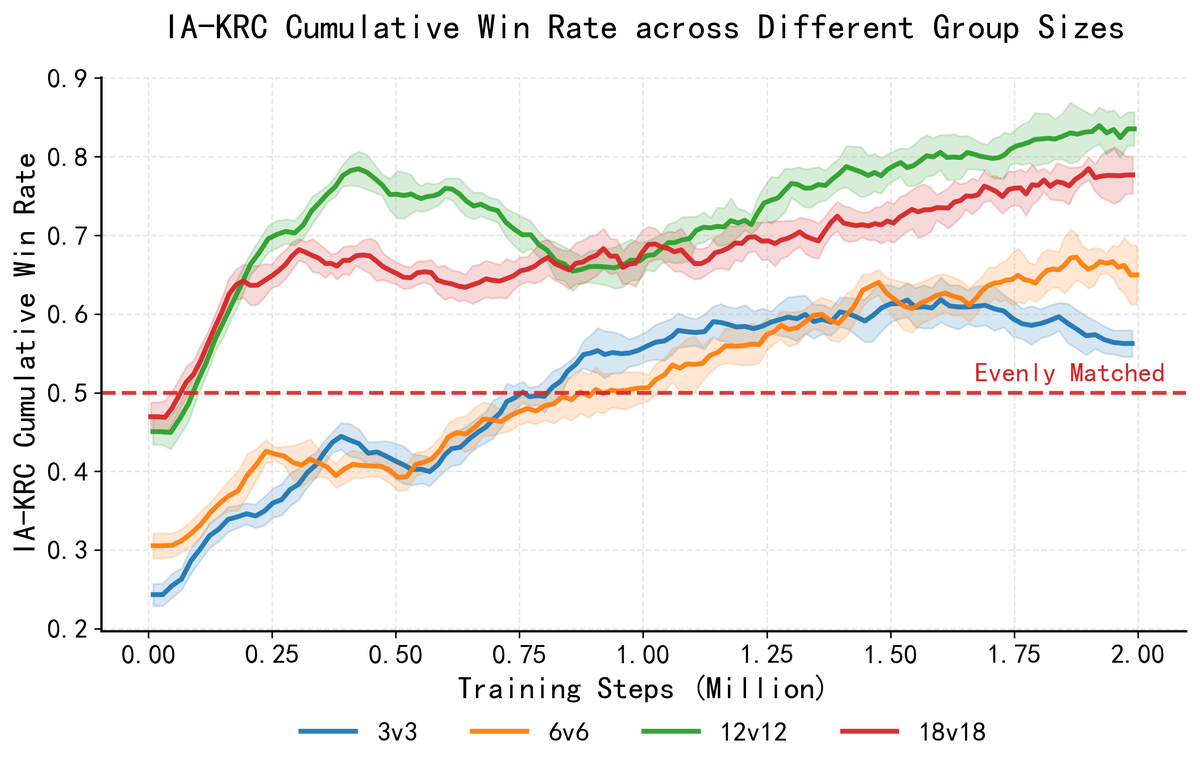
Structurally, IA-KRC had an isolated-agent rate of 0.0058 versus 0.63 for CommFormer, and a much higher algebraic connectivity, meaning its communication graphs stayed cohesive instead of fragmenting into stranded agents. The team also observed a scaling advantage: as team sizes grew from 3v3 up to 18v18, the combinatorial group space explodes, and IA-KRC's reachability filtering kept per-agent computation nearly constant while baselines struggled to find good subgroups.
Where it fits and where it does not
The biggest win is what the authors call preventing an avalanche effect: baselines like Vision-based grouping tend to leave a few agents isolated early in an episode, those agents get picked off, and the numerical disadvantage cascades into total defeat. By explicitly modeling reachability plus dynamic interference, IA-KRC keeps groups connected and coherent throughout an episode.
Even in the obstacle-free 8m scenario, where K-step reachability collapses into something close to Euclidean distance, IA-KRC still outperformed baselines and finished second only to CommFormer, but at roughly a quarter of CommFormer's training time. The framework added about 19% overhead relative to lighter baselines, a reasonable price for its gains.
The limits are worth noting. IA-KRC targets grid-based or discretizable environments where a multi-layer map makes sense; continuous, high-dimensional state spaces would need adaptation. It also assumes you can extract enemy state and trajectories to train the intent prediction MLP, which fits combat and pursuit tasks better than, say, purely cooperative negotiation games. As for code, the paper does not link a public repository yet, though the full algorithms and hyperparameters are laid out in the appendix.
The real breakthrough is conceptual: by treating communication as a hierarchical mechanism that decouples slow-changing environmental topology from rapidly evolving adversarial dynamics, IA-KRC makes it possible to compute interference-aware reachable distances in real time. That gives MARL a physically grounded prior for partner selection that neither pure geometry nor pure end-to-end GNN learning has delivered on its own.