
BCR Cuts AI Vision Hallucinations 3x by Hiding Objects in Plain Sight
A new adversarial method hides objects from vision-language models without making them invent fake objects to fill the gap
 Pro
Takeaways
- New adversarial attack BCR hides objects in VLMs without triggering the usual hallucinations that suppression attacks cause.
- Core idea: re-encode ROI tokens to match background feature statistics instead of masking or zeroing them out.
- Uses four losses (statistical alignment, dictionary projection, background preservation, total variation) across late ViT layers.
- Cuts grounded hallucination up to 3x versus VIP and preserves up to 86% of non-target objects on ImageNet and COCO.
- Tested on LLaVA-1.5, BLIP-2 (Flan-T5-XL), and InstructBLIP with GLIP-based grounded hallucination verification.
- Full paper: arxiv.org/abs/2603.15940. No public code release mentioned.
A new arXiv paper from researchers Amira Guesmi and Muhammad Shafique tackles a stubborn side effect in adversarial attacks on vision-language models: when you try to hide an object from a model like LLaVA or BLIP-2, the model often invents a different, plausible-looking object to replace it. Their paper argues this hallucination is a symptom of how prior attacks work, rather than an unavoidable price of concealment.
The proposed method, called Background-Consistent Re-encoding (BCR), hides target objects by making their internal features look like the surrounding background instead of blanking them out. Across three popular VLMs, it cuts grounded hallucinations by up to 3x while keeping concealment success in the 89-98% range.
Why suppression backfires
Existing object-hiding attacks on VLMs typically suppress or block region-specific representations by masking pixels, erasing patches, or reducing attention weights on region-of-interest tokens. This works for hiding the object itself, but it leaves a hole in the visual feature map.
That hole is the problem. Because VLMs assume visual tokens form a smooth, coherent manifold, the language decoder treats the sudden discontinuity as missing evidence and falls back on strong language priors to fill it in. The paper frames this concisely: hallucination arises from semantic discontinuity introduced by suppression-based attacks, rather than from the absence of the object itself. In one of the paper's examples, a masked person becomes a fire hydrant; in another, a masked region triggers a description of a fireworks scene that bears no relation to the actual image.
The re-encoding trick
Instead of removing the target tokens, BCR blends them into the background feature distribution so the encoder still sees a full, coherent scene. The attack is a white-box, pixel-space perturbation bounded by an L-infinity budget of 0.2, and it optimizes four losses computed at multiple vision transformer layers:

- Statistical alignment: matches the mean and standard deviation of ROI token features to those of background tokens, so the region no longer looks like a distributional outlier.
- Dictionary projection: forces each ROI token to be reconstructable as a soft-weighted combination of background tokens, anchoring it inside the background feature manifold.
- Background preservation: penalizes any drift in the non-ROI features between the clean and adversarial images, keeping the rest of the scene semantically intact.
- Total variation: keeps the pixel perturbation spatially smooth so it stays visually unobtrusive.
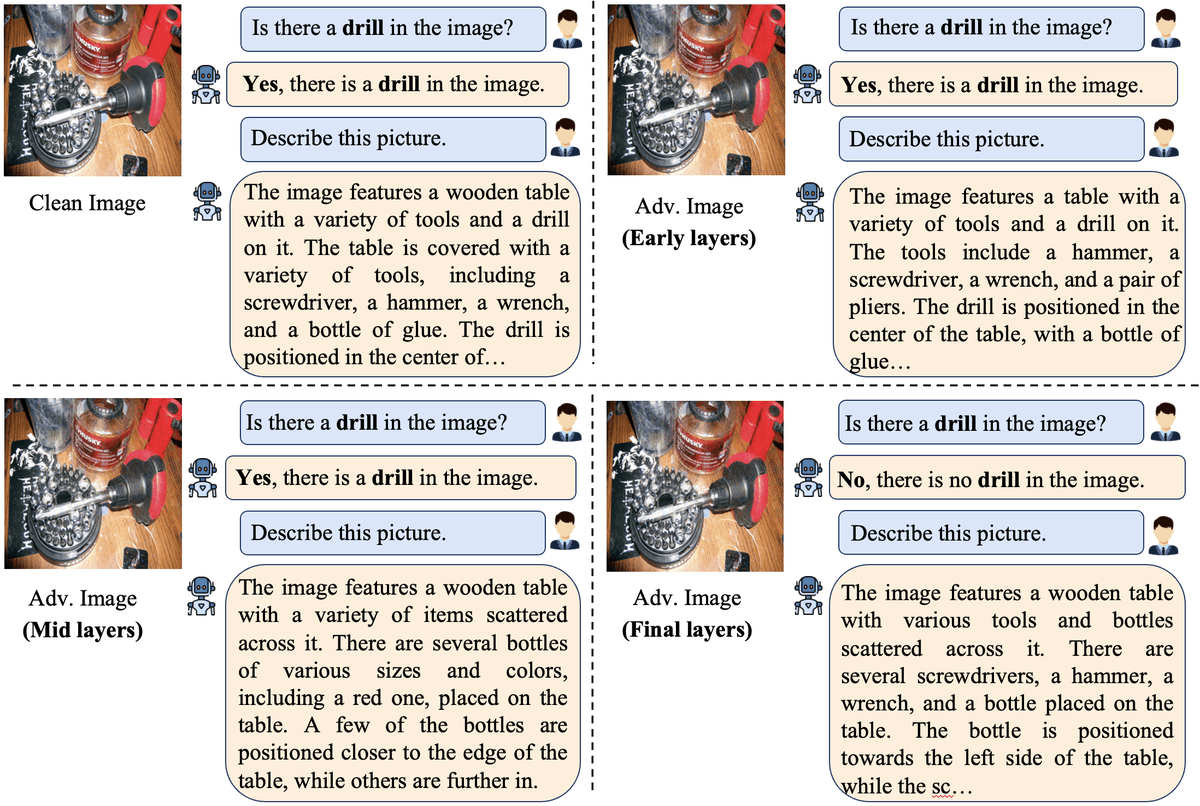
A sensitivity study in the paper shows that applying these losses to late transformer layers (around blocks 21-25) is what makes it work. Optimizing early layers touches low-level texture but leaves object semantics intact, so the model still recognizes the target.
Numbers that back it up
The experiments cover three widely used vision-language models: LLaVA-1.5 (Vicuna-7B), BLIP-2 with Flan-T5-XL, and InstructBLIP. Evaluation uses 1,000 images sampled from ImageNet plus COCO scenes, with ground-truth bounding boxes as the ROIs. Concealment is checked with a caption parser, and hallucinations are verified by asking GLIP whether newly mentioned objects can actually be localized in the adversarial image.

The headline comparison is against VIP, a recent attention-suppression attack. On ImageNet with InstructBLIP, BCR matches VIP on concealment (0.92 vs 0.93) while dropping the grounded hallucination rate from 0.43 to 0.19 and raising global preservation from 0.57 to 0.81. Across all three models the pattern holds:
| Model | Metric | VIP | BCR |
|---|---|---|---|
| InstructBLIP | Grounded hallucination | 0.43 | 0.19 |
| BLIP2-T5 | Grounded hallucination | 0.41 | 0.17 |
| LLaVA | Grounded hallucination | 0.48 | 0.14 |
| LLaVA | Global preservation | 0.62 | 0.86 |
Perceptual fidelity also improves: BCR reaches SSIM around 0.94-0.96 and LPIPS 0.02-0.04, versus 0.65-0.80 SSIM for VIP. Ablations confirm every loss contributes, with the statistical alignment and dictionary projection terms being the most important for keeping hallucinations down.
Where this fits and where it does not
The attack is white-box and image-level. It needs gradients through the vision encoder and a specified ROI, which typically comes from an object detector or a user-drawn box. The authors frame it as a privacy-preservation tool: think redacting a face or license plate in an image before it is captioned or answered by a multimodal system, without the model then inventing something in that spot.
The paper is upfront about limits. Small or ambiguous objects sometimes get replaced by semantically adjacent items (a tie becomes generic clothing), which avoids hallucination but leaks category-level information through context. Different VLMs also tokenize images differently, and Q-Former-style architectures require applying the losses before the bottleneck, since Q-Former tokens discard spatial correspondence. Adversarial prompts that explicitly interrogate the concealed region (repeated yes/no probing) can still surface residual information.
No code repository is linked in the paper. For teams working on VLM robustness, visual privacy, or hallucination auditing, the more durable takeaway may be the framing itself: hallucination benchmarks that only compare captions can miss whether the mentioned objects are actually present. BCR's grounded hallucination metric, which uses GLIP to verify new objects against the image, is a cleaner probe of what the model is really doing.