
BASF's Claude Opus 4.6 Agents Autonomously Design Chemical Plants in Industrial Simulations
Researchers show a two-agent LLM system can design and simulate chemical processes end-to-end using Claude Opus 4.6 inside GitHub Copilot.
 Pro
Takeaways
- BASF and RWTH Aachen researchers built a two-agent LLM system for chemical process design (paper).
- One agent handles engineering reasoning; another writes valid syntax for BASF's Chemasim simulator.
- Runs on Claude Opus 4.6 inside GitHub Copilot with no fine-tuning, only in-context docs and examples.
- Successfully designed reaction-separation, pressure-swing, and heteroazeotropic distillation processes end-to-end.
- Unit-by-unit implementation with re-run initialization is the key trick for solver convergence.
- Fails on complex ternary thermodynamics and entrainer selection beyond textbook complexity.
A team of process engineers has published a study showing that a pair of coordinated LLM agents, running inside GitHub Copilot with Claude Opus 4.6, can autonomously design chemical processes and implement them in a real industrial flowsheet simulator. The paper, titled Context is all you need: Towards autonomous model-based process design using agentic AI in flowsheet simulations, comes out of BASF and RWTH Aachen and tackles a domain that has largely resisted the LLM wave: equation-based chemical process modelling.
The pitch is straightforward. Chemical engineers still design reaction and separation trains the way they did in the 1980s, sketching a flowsheet from heuristics, simulating it, and iterating. The authors argue that if LLMs can now write code from natural-language specs, they should be able to write flowsheet models too, given the right context and the right tools.
Why flowsheet simulators broke previous attempts
Two things make this domain hard for language models. The syntax of industrial simulators is niche and mostly absent from public training data. And running a simulation is not like running Python: the numerical solver can silently fail to converge, and closing recycle loops between units routinely blows up if the initial guesses are bad.
The team targets Chemasim, BASF's in-house steady-state and dynamic process simulator. Unlike most commercial tools that are driven by a GUI, Chemasim uses a plain-text input file as its source of truth. That property is central to the whole approach: an agent can edit the flowsheet the same way a human does, without needing a vendor-maintained API.
The syntax itself is German-flavored and idiosyncratic. A mixer looks like this:
MISCHER: MX_01 < 25. GRAD, REIN aus BASIS, REAL aus BASIS >
ZULAUF: STROM Water < 100 KG/H ( 1 H2O ), FLUSS 25 GRAD >
ZULAUF: STROM Ethanol < 100 KG/H ( 1 EtOH ), FLUSS 25 GRAD >
FLUSS: STROM Out
Nothing in a base LLM's training set looks like that. The authors report that older models produced pseudocode or broken syntax. Only the current generation, specifically Claude Sonnet and Opus from version 4.5 and GPT from version 5.2, reliably emit valid Chemasim in one shot, and only when given the tool's technical documentation, a set of annotated how-tos, and full-flowsheet reference implementations in the prompt. No fine-tuning is used.
Two agents, split by responsibility
The system splits the job across two agents that both run on Claude Opus 4.6:

- Process development agent: solves the abstract engineering problem. It has thermodynamic tools for computing azeotropes and miscibility gaps, can parse reaction networks, and can write free Python to do mass-balance arithmetic. It outputs a unit-by-unit process plan with estimated flow rates and compositions.
- Chemasim modelling agent: takes that plan and implements it. It edits input files, triggers simulations through a custom VS Code extension, reads solver output and SQLite result databases, and reacts to error messages.
Crucially, the second agent is forced to build the flowsheet one unit at a time. It generates a to-do list, adds one unit, runs the simulation, stores the converged result as the initial guess, then moves on. This mirrors how a human engineer would coax a stiff numerical solver through a large model, and it is the main reason the framework actually converges on non-trivial cases.
What actually worked
Three case studies form the core of the paper. Components are masked as A, B, C, D so the process agent cannot cheat by recognizing a textbook problem:
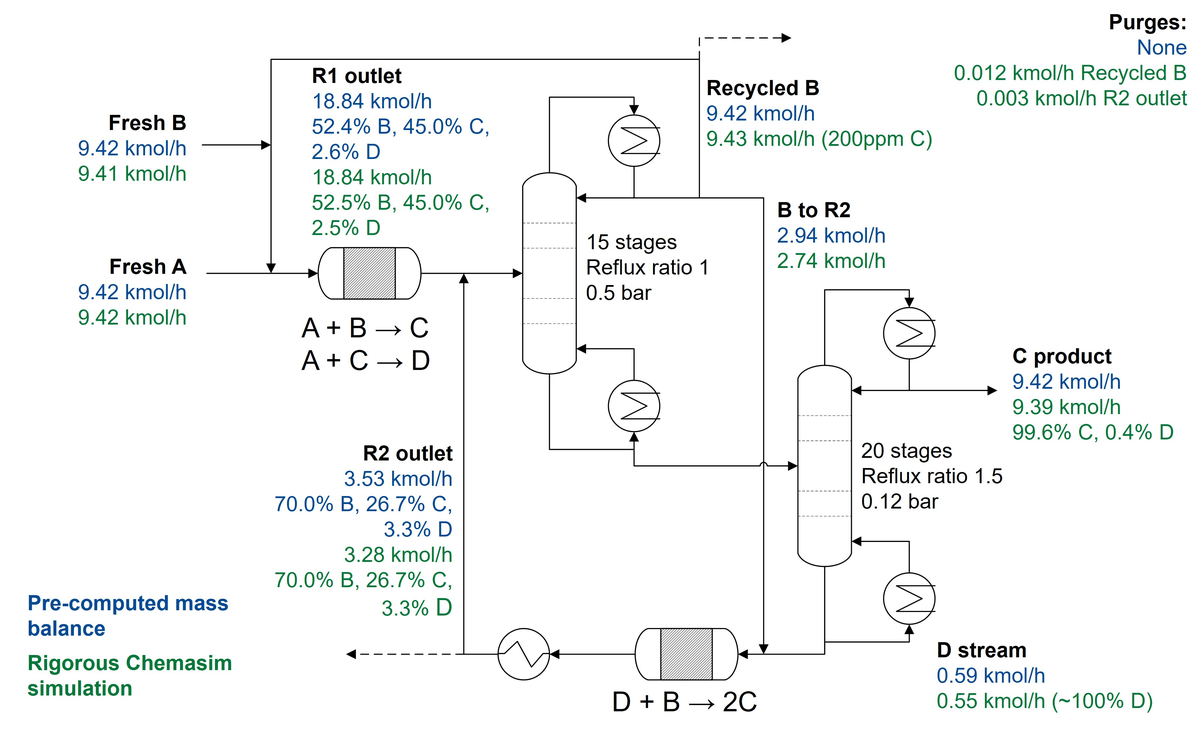
- Reaction plus separation inspired by ethyl benzene production, with a main reaction, a side reaction, and a transalkylation step. The agent designed a two-reactor, two-column flowsheet with a benzene recycle and purge streams, and the rigorous simulation matched the pre-computed mass balance closely.
- Pressure-swing distillation for two azeotropic binaries (n-propanol/benzene, acetone/chloroform). The agent correctly identified which column should sit at the higher pressure and sized recycle flows appropriately for both minimum- and maximum-boiling azeotropes.
- Heteroazeotropic distillation with entrainer selection for water and 1,4-dioxane, choosing between two candidate entrainers. Given only a nudge toward lower operating cost, the agent switched from a single-column-plus-decanter design to a two-column layout with a pre-separation step, an alternative that would cut energy demand by more than 60%.
Where it falls apart
The authors are refreshingly explicit about failure modes. On a five-component water/pyridine/entrainer system, the agent fixates on a chemically plausible but numerically ugly entrainer and refuses to consider the design that the literature actually endorses. When forbidden from picking its favorite candidate, it drifts into designing an extractive distillation column with an unsuitable solvent, contradicting standard entrainer-selection guidelines.

A ternary pressure-swing problem breaks it too. Crossing a distillation boundary requires adding an excess of one component already present in the feed, and the agent proposes adding the wrong one, a plan that is geometrically impossible in the mixture's phase diagram. The paper concludes that abstract thermodynamic reasoning is currently the ceiling. Convergence handling and syntax generation are essentially solved for the tested cases; interpreting complex phase behavior is not.
A template for proprietary DSLs
A few things are worth flagging. The whole system leans on in-context learning against an in-house tool, with no fine-tuning and no custom model. Other domains with proprietary DSLs can copy the template: dump the docs, add commented examples, wire up an execution loop, split reasoning from implementation. Agent-driven text editing of simulator input files also works as an interface pattern, sidestepping the API surface most commercial tools would otherwise force on you.
The supplementary material contains the context files, the system prompts for both agents, and the resulting Chemasim models with stream tables. The framework itself is not released as an open-source repo, and Chemasim is not publicly available, so anyone wanting to reproduce this will need either BASF's simulator or a text-based equivalent as a substrate. The authors argue this previews where flowsheet simulation is going: less graphical UI, more text-driven interaction with expert tools mediated by an LLM.