
Barcelona Supercomputing Center Finds Efficient Attention Cuts Memory 37x in Speech Emotion AI
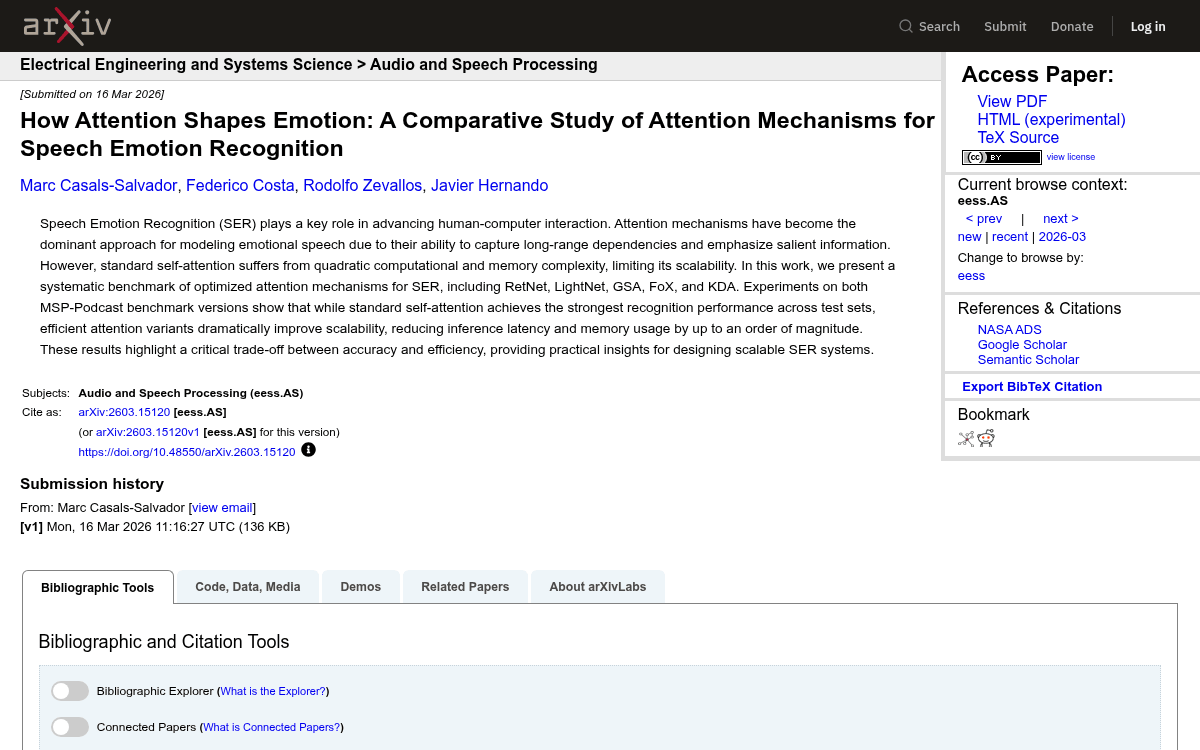
A benchmark of five efficient attention variants against standard self-attention on speech emotion recognition reveals a clear accuracy versus scalability trade-off.
 Pro
Takeaways
- First systematic benchmark of five efficient attention variants for speech emotion recognition on MSP-Podcast.
- Softmax attention wins recognition on Test1 (36.42) and Test2 (27.19) means across four SSL backbones.
- KDA delivers an 8.15x latency reduction over softmax attention at 400-second inputs.
- FoX uses 37.6x less peak memory than softmax attention, thanks to fused kernel implementations.
- All models degrade sharply on Test2, exposing robustness gaps under realistic audio conditions.
- Implementation uses Flash Linear Attention; code release promised post-review.
Speech emotion recognition sits at an awkward crossroads. The field has largely converged on transformer-based encoders, but audio sequences are long, and the quadratic cost of softmax attention makes scaling painful. A new benchmark from the Barcelona Supercomputing Center and Universitat Politècnica de Catalunya asks a practical question: can any of the recent efficient attention architectures replace vanilla self-attention without wrecking accuracy?
The study finds a clean trade-off. Standard softmax attention still wins on recognition quality across evaluation splits, while efficient variants cut inference latency and memory by up to an order of magnitude, making them the obvious pick for long-form audio.
Why quadratic attention hurts here
Softmax attention has quadratic computational and memory complexity with respect to sequence length, which is particularly problematic in speech emotion recognition where signals may span long durations and exhibit high temporal redundancy. Podcast clips, call-center recordings, and meeting audio routinely run for minutes, so the cost of pairwise token interactions balloons fast. Most prior SER work has sidestepped this issue, optimizing only for F-score on short utterances.
The authors line up five alternatives against standard self-attention, each replacing pairwise similarity with a cheaper aggregation scheme:
- RetNet swaps softmax attention for a retention mechanism that accumulates past information using exponential decay, balancing long-term memory with recency bias.
- LightNet aggregates context through a single-pass scan with an additive decay parameter, avoiding attention entirely.
- Gated Slot Attention maintains a fixed number of latent slots and selectively updates them, constraining memory growth.
- The Forgetting Transformer (FoX) adds a learnable temporal decay that biases the model toward more recent tokens.
- Kimi Delta Attention (KDA) introduces fine-grained, dimension-wise decay so different feature channels can retain information at different rates.
Holding everything else constant
To isolate the attention module, the pipeline fuses speech and text embeddings, then runs them through the seq2seq block under test. Speech is encoded with frozen SSL backbones (WavLM, Wav2Vec2, HuBERT, and Wav2Vec2XLSR), while text uses BERT large uncased, which performed best in preliminary experiments. Only the seq2seq module, attention pooling, and classifier are trainable, all configured to roughly 20M parameters for a fair comparison, though the full stack sits around 655M due to frozen encoders.
Evaluation uses MSP-Podcast versions 1 and 2, an eight-class corpus covering anger, happiness, sadness, fear, surprise, contempt, disgust, and neutral, drawn from spontaneous podcast speech. Test1 follows the retrieval-based protocol reflecting natural emotion distribution, while Test2 is a control split without emotion-based retrieval, designed to expose selection bias. Implementations rely on PyTorch plus the Flash Linear Attention library, trained on four H100 GPUs.
The accuracy scoreboard
Recognition performance is measured by Macro F-score, averaged across the four SSL backbones:
| Mechanism | Dev | Test1 | Test2 |
|---|---|---|---|
| Softmax Attention | 36.39 | 36.42 | 27.19 |
| LightNet | 36.62 | 33.93 | 25.19 |
| FoX | 35.88 | 34.95 | 25.31 |
| RetNet | 34.92 | 34.30 | 24.59 |
| KDA | 33.50 | 32.97 | 24.46 |
| GSA | 32.73 | 30.24 | 21.73 |
LightNet edges out the softmax baseline on the development set (36.62 versus 36.39), but softmax generalizes best, taking both Test1 and Test2 and leading across all backbones on Test1. FoX is consistently second, while GSA shows the weakest robustness with a 21.73 mean on Test2.
Where efficient attention actually pays off
The efficiency numbers are where the story flips. Measurements were done on the seq2seq module alone, batch size one, varying the input length:
- Softmax attention takes 0.55 ms at a 10-second input but jumps to 48.59 ms at 400 seconds.
- KDA processes 400 seconds in 5.96 ms, an 8.15x latency reduction over the softmax baseline.
- Peak memory for softmax attention climbs from 0.02 GB to 12.35 GB, while every efficient variant stays under 1.5 GB.
- FoX is the most memory-efficient, using 0.328 GB at 400 seconds, 37.6x less than softmax.
Efficient alternatives exhibit approximately linear scaling in both compute and memory, whereas softmax attention grows quadratically. That matches the theory but is worth confirming empirically on a realistic SER pipeline.
Bounded memory, unbounded surprises
The paper draws a useful architectural distinction: unbounded-memory models like softmax attention and FoX materialize an explicit representation of past tokens, while bounded-memory models like RetNet and KDA compress history into a fixed recurrent state. Counterintuitively, bounded models such as KDA and RetNet showed higher peak memory usage than FoX in the full-sequence evaluation, because FoX benefits from fused kernel implementations that reduce peak activation memory to O(LD). Efficient attention on paper does not always mean efficient attention in practice, and kernel engineering matters.
Every method drops substantially from Test1 to Test2, which better reflects realistic audio conditions and class imbalance, indicating room for architectural improvements. The efficient variants are not the bottleneck for real-world robustness, the whole field is.
When to reach for which
Based on the numbers, a rough decision guide:
- Short clips, accuracy matters most: stick with softmax attention.
- Long-form audio (podcasts, meetings, calls), latency-critical: KDA gives the best speed at the cost of a few F-score points.
- Memory-constrained deployment on long sequences: FoX offers the smallest footprint with the second-best accuracy.
- Fixed-state streaming inference: RetNet's recurrent formulation is the natural fit.
The authors state that code will be released to ensure reproducibility, with the repository link to be added post-review. For anyone building SER systems on realistic audio lengths, this benchmark is one of the first head-to-head comparisons that treats efficiency as a first-class metric rather than a footnote.