
Barcelona's Med-DualLoRA Closes the Gap to Centralized Hospital AI by 7.5%
A dual-adapter LoRA scheme keeps site-specific weights private, cuts network traffic, and beats standard federated fine-tuning on multi-vendor cardiac MRI.
 Pro
Takeaways
- Med-DualLoRA splits each LoRA adapter into a shared global module and a private per-client module for federated fine-tuning.
- Only the global adapter is aggregated via FedAvg, keeping site-specific weights on-premise.
- Reaches 0.768 balanced accuracy on cardiac MRI disease detection, beating federated LoRA by 7.5% (p=0.037).
- Applying the method to just two transformer blocks cuts communication to about 28 MB per round with near-peak accuracy.
- Evaluated on ACDC and combined M&Ms datasets with each MRI vendor treated as a separate client.
- Code is available on GitHub under MIT license with a MICCAI 2026 reproducibility tag.
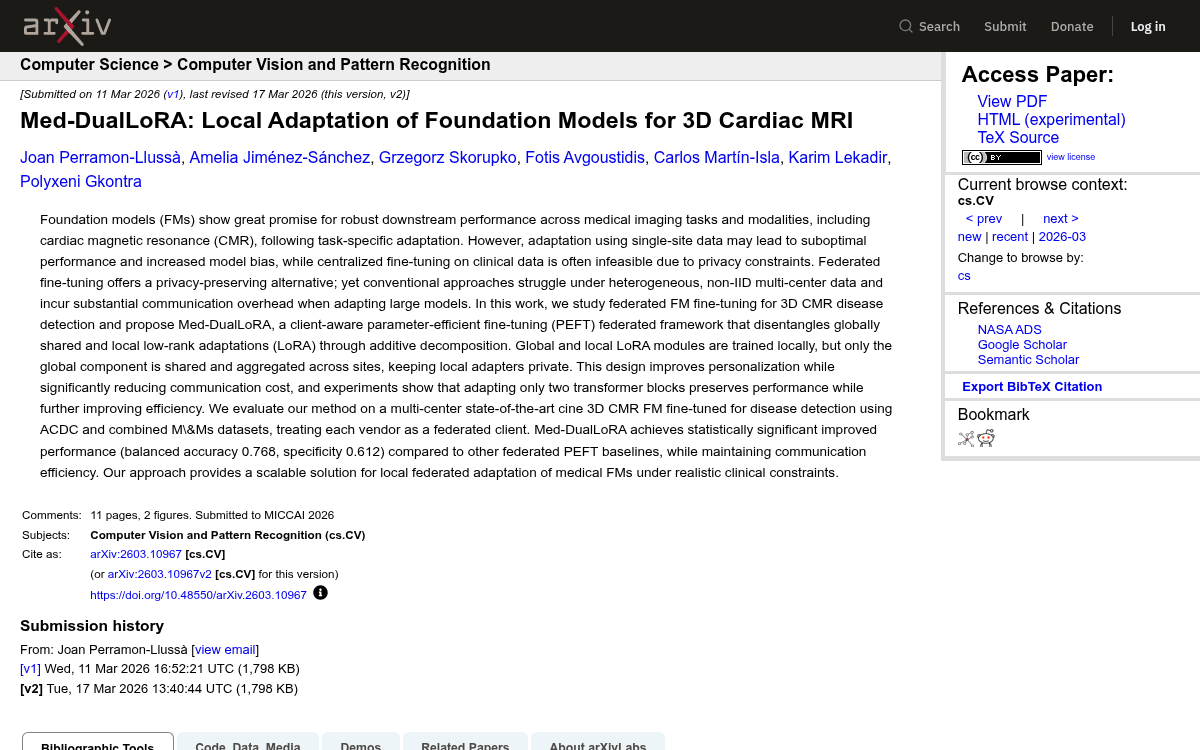
Training a single medical imaging model that works well across hospitals is hard for one boring reason: the data can't leave the building. Federated learning is the standard workaround, but when you try to fine-tune a large foundation model across sites, two problems collide. Every round ships gigabytes of gradients over the wire, and averaging updates from clinics with very different scanners tends to bias the model toward whoever has the most patients. A new paper from the BCN-AIM lab at the University of Barcelona, Med-DualLoRA, proposes a compact fix built around two low-rank adapters per layer, one shared and one kept private.
The setting is 3D cine cardiac MRI disease detection, and the backbone is CineMA, a recently released foundation model for cardiac MR analysis. The authors treat each scanner vendor (Siemens, GE, Philips, Canon) plus the ACDC dataset as a separate federated client, which is a realistic stand-in for a multi-hospital deployment where each site has its own acquisition quirks.
Why standard federated PEFT falls apart here
Parameter-efficient fine-tuning methods like LoRA inject small low-rank matrices into a frozen backbone, which is normally great for federated learning because you only sync a tiny fraction of parameters. LoRA works by learning two small matrices A and B such that the update to a weight W is B times A, with a rank r much smaller than the layer dimensions. But under non-IID clinical data, aggregating these adapters into a single global model biases it toward the dominant clients.
The paper shows this concretely. Federated head-only tuning collapsed to a balanced accuracy of 0.514, with sensitivity near 1.0 and specificity of 0.03, meaning the model was essentially predicting "diseased" for everyone. Federated standard LoRA did better at 0.693 balanced accuracy but still lagged its centralized version. Local-only models on small vendor cohorts like Canon dropped to 0.611 balanced accuracy with 0.222 specificity, another symptom of majority-class collapse when data is scarce.
The dual-adapter trick
Med-DualLoRA replaces each targeted linear projection with two additive LoRA modules instead of one. For client i, the forward pass becomes:
f_i(x) = W x + (alpha/r) * B_g A_g x + (alpha/r) * B_li A_li xHere A_g, B_g are the global adapters and A_li, B_li are client-specific. Both are trained locally each round, but only the global pair is sent to the server for FedAvg aggregation. The local pair stays on-site permanently and captures whatever is idiosyncratic about that vendor's scanner. At inference, each client combines its private local adapter with the shared global one.

Two properties fall out of this design. First, communication cost is unchanged versus vanilla federated LoRA because only the global adapter is transmitted. Second, the local adapter absorbs distribution shift that would otherwise pollute the shared model, so the global component can focus on transferable representations.
Numbers that matter
Evaluated on ACDC plus the combined M&Ms-1/M&Ms-2 datasets with vendors as clients, Med-DualLoRA hit 0.768 balanced accuracy and 0.612 specificity in the federated setting. That's a 7.5% improvement over federated LoRA (p=0.037) and 25.4% over federated head-only tuning (p<0.001). It also effectively closed the gap to centralized fine-tuning, whose 0.780 balanced accuracy was not statistically distinguishable from the federated dual-adapter result.
The communication analysis is where the design gets more interesting. Applying dual adapters to all 12 transformer blocks costs about 154 MB per round. Restricting them to just two blocks drops that to roughly 28 MB per round while still reaching 0.7465 balanced accuracy, which lands on the Pareto frontier of accuracy versus bandwidth. Intermediate configurations of 4 to 10 blocks were dominated by the two-block variant, suggesting most of the useful adaptation happens in a small subset of layers.

Where this fits and where it doesn't
The obvious use case is any multi-hospital deployment of a medical foundation model where patient data can't be pooled and each site has meaningful distribution drift. Because each client keeps a private adapter, the method is a form of personalized federated learning, not a route to a single portable model. If you need one artifact that runs anywhere, you're better off with a plain federated LoRA and accepting the accuracy hit.
Some honest limitations from the paper itself:
- The datasets are small and imbalanced, with some vendors having fewer than 10 non-diseased test samples, so variance estimates should be read carefully.
- Aggregation still uses FedAvg, which favors dominant distributions. Pairing the dual adapter with FedProx or Scaffold is left as future work.
- Only binary disease detection was evaluated; the extension to segmentation or multi-task cardiac assessment is untested.
- The comparison is against LoRA variants, not against newer PEFT methods like AdapterFusion or visual prompt tuning.
Code and reproducibility
The authors released the implementation on GitHub under an MIT license, with a miccai2026 tag pinning the exact version used in the paper. Training used PyTorch, LoRA rank r=4 with scaling alpha=8, and one local epoch per communication round on a dual NVIDIA L40S setup. That's small enough to reproduce on a modest cluster, which for a medical imaging benchmark is a welcome change.