
Barcelona Robotics Lab's COTONET Beats YOLO11 at Spotting Cotton Bolls
A modified YOLO11 with stacked attention modules hits 81.1% mAP50 on cotton boll detection across six growth stages while staying under 8M parameters.
 Pro
Takeaways
- COTONET modifies YOLO11 to detect cotton bolls across six growth stages, hitting 81.1% mAP50.
- Uses SimAM plus PHAM attention, Squeeze-and-Excitation backbone, and CARAFE upsampling in place of nearest-neighbour.
- Stays at 7.6M parameters and 27.8 GFLOPs, targeting mobile harvesting robots at the edge.
- Introduces CONDIS++ dataset with six phenological classes including fertilised vs unfertilised flowers.
- Beats every YOLOv8 through YOLO12 variant tested from nano to medium sizes on the same data.
- Code and weights not released publicly; dataset available on request from the authors.
Robotic cotton harvesting sits in an awkward spot: mechanical pickers are cheap but bruise the fibres, while manual picking preserves quality at costs that rarely pencil out. A team from the Institut de Robòtica i Informàtica Industrial in Barcelona has released COTONET, a custom YOLO11 variant designed to sit on a mobile robot and recognise cotton bolls across every phenological stage, from unfertilised flower to ripe capsule.
The core problem is visual variance. Cotton bolls do not look like tomatoes or apples. A ready-to-harvest boll can be elongated or round, split into three to five sections, with fibres partially yanked out by neighbouring plants. Immature open bolls look like closed bolls if they just cracked, or like ripe bolls if their bracts have not yet browned. Add greenhouse light shifts, occlusions from leaves, and the fact that fertilised and unfertilised flowers differ only by a pinkish tint, and you have a detection task where off-the-shelf YOLO models struggle.
A new dataset with six growth stages
The authors first built CONDIS++ (Cotton Growth-Stage Discerning Image Set), photographed inside a 500 m² polycarbonate greenhouse with a 15 MP smartphone camera between 50 cm and 1 m from the plants. Six classes cover the full lifecycle:
- Bracts - the first leaflets where the flower emerges
- Early Flower - unfertilised, off-white to yellow
- Fertilised Flower - pink to violet after pollination
- Square - green capsule after the flower falls
- Open Boll - immature, partially open
- Ripe Boll - fully developed, ready to harvest
The distinction between early and fertilised flowers is the interesting one. Prior work like Verma et al. and Gong et al. lumped flowers into a single class, losing the moment of pollination that predicts when a boll will be ready.
What actually changed in the architecture
COTONET keeps the YOLO11 skeleton but swaps out several blocks. The changes are targeted at feature refinement and gradient flow rather than raw capacity:
- SEConvBlock in the backbone - every convolutional block gets a Squeeze-and-Excitation module tacked onto the end, recalibrating channel-wise responses through a small bottleneck MLP.
- SimAM after each C3k2 bottleneck - a parameter-free 3D attention module that scores each neuron via an energy function based on how distinguishable it is from its neighbours. Zero added parameters.
- PHAM in the neck - the Parallel Hybrid Attention Module stacks CBAM (channel plus spatial gates) with a coordinate gate that encodes long-range positional relationships along width and height axes separately.
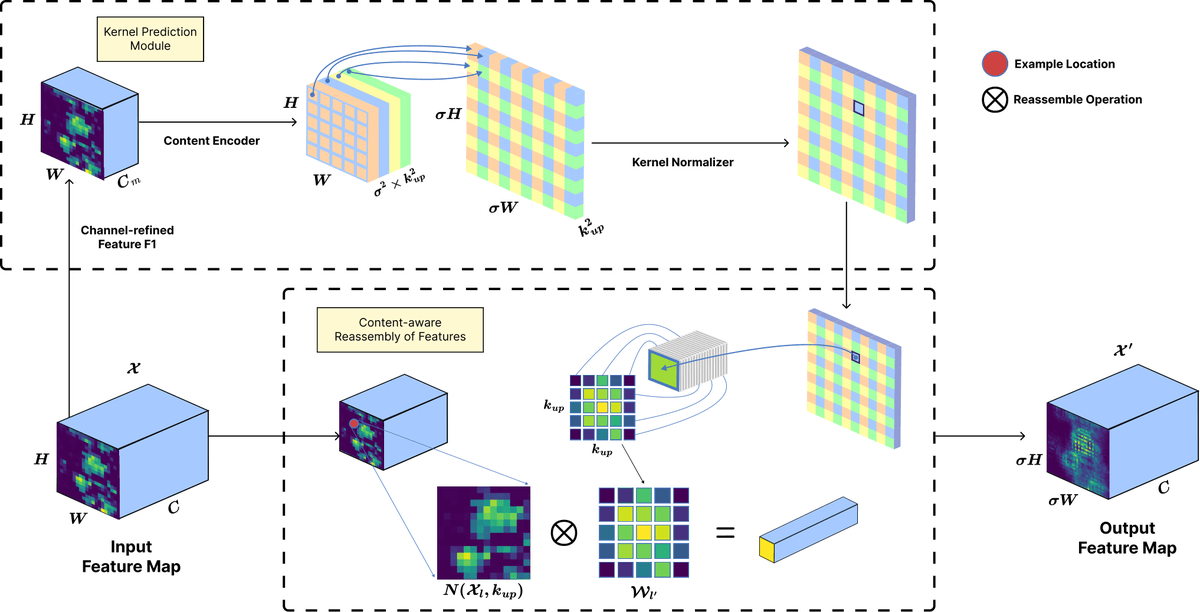
- CARAFE instead of nearest-neighbour upsampling - Content-Aware Reassembly of Features predicts location-specific reassembly kernels, giving the upsample step actual learnable gradients.
- SCDown from YOLOv10 replaces standard downsampling convolutions with a point-wise plus depth-wise separable pair.
- SIoU loss swaps the default CIoU. Scylla IoU adds an angle cost telling the model which direction the ground truth box sits relative to the prediction.
The numbers
COTONET lands at 7.6M parameters and 27.8 GFLOPs, roughly the size of YOLOv9s or YOLO11s. On CONDIS++ with rotation plus flipping augmentation, it hits 81.1% mAP50 and 60.6% mAP50-95, beating every standard YOLO variant tested from nano to medium sizes. For context, YOLO11m at 20.1M parameters and 68.5 GFLOPs managed 79.7% and 59.6% respectively.
The ablations are worth reading. Dropping both attention modules costs about 3.2 points of mAP50-95. SimAM alone lifts precision by nearly 7 points over no attention, while PHAM contributes more to mAP50. Together they hit the ceiling. Among alternative attention mechanisms tested (CBAM, EMA, MAA, MCA, Triplet Attention), only EMA came close on mAP50 but lost on mAP50-95.
What it is good for, and what it is not
COTONET is aimed at a narrow slice of agricultural robotics: greenhouse cotton monitoring and selective harvesting from a mobile platform with a specialised gripper. The parameter budget was chosen for edge deployment, and the class taxonomy is tied to the Intercott-211 variety grown at CEBAS-CSIC.
Two caveats matter for anyone thinking of applying this elsewhere:
- The dataset is greenhouse-only, imaged between 10 am and noon in June and July. Open-field cotton with dust, wind blur, and stronger sun is not tested.
- Recall lags precision across the board, meaning the model misses more bolls than it hallucinates. For a harvesting robot that is arguably the right trade-off, but it caps throughput.
Code is not publicly released. The paper states that data will be made available on request, and the trained weights and modified YOLO11 configuration files are not linked in the manuscript. Anyone wanting to reproduce the work will need to reimplement the SEConvBlock, PHAM stack, and SCDown insertions on top of an Ultralytics YOLO11 base themselves.