
Barcelona Robotics Lab Builds a Gripper That Opens 240 Sterile Pouches per Shift
Barcelona researchers unveil a robotic gripper that separates and grasps thin plastic flaps to automate a repetitive, injury-prone task nurses perform hundreds of times per shift.
 Pro
Takeaways
- New robotic gripper automates opening of sterile hospital pouches, a task nurses do up to 240 times per shift.
- Design combines an active dented-roller with compliant twin fingers, mounted on a RobotiQ Hand-E on UR5E arms.
- Uses Euler buckling theory: clamping both layers at distance forces the top sheet to buckle under roller drag.
- Grip withstands 55+ N pulling force, enough to peel sealed seams; silicone tips add 15-20 N.
- Tested on paper, plastic, and fabric layers; normal force is the most sensitive parameter.
- Patent-pending under EU project SoftEnable; no open-source release.
Opening a sterile pouch sounds trivial until you realize a circulating nurse does it up to 240 times in a single shift. Peeling apart two thin, statically clinging layers of plastic and paper is one of those manipulation problems that off-the-shelf grippers just cannot handle. A team at the Institut de Robòtica i Informàtica Industrial in Barcelona has now published a design that solves this specific hospital chore, and along the way tackles a broader open problem in robotic manipulation: separating a single thin flexible layer from a stack.
The 240-bags-a-shift problem
The task addresses a high-volume repetitive hospital procedure in which nurses manually open up to 240 bags per shift, a physically demanding task linked to musculoskeletal injuries. Bag contents can weigh anywhere from 20 grams to nearly a kilo, and hospital protocol requires that the interior never be touched and that sterility is preserved when the pouch is offered to the instrument nurse. Industry has started to notice: Siemens Healthineers' Project AURORA targets similar operating-room assistance, but assumes the flaps are already separated, which is precisely the hard part.
Existing thin-layer separation solutions come from garment manufacturing, using Velcro-covered rollers, electro-adhesive fingers, or microneedles. None of them work on the plastic-paper composite of a medical pouch, and most produce a grip too weak to peel a sealed seam.
A finger built around a buckling column
The core insight is mechanical, not algorithmic. If you press a roller on the top layer and try to drag it, the top will move only if the friction between layers is higher than between the bottom layer and the table. Tables are slippery, so this usually fails. The workaround is to clamp both layers at a distance l from the roller, which turns the layer into a slender column under an axial load. Once the roller's drag exceeds Euler's critical buckling force, the top layer bows upward while the bottom stays put.

The critical load scales with Ewh^3 / l^2, so a shorter l and a stiffer material buckle more easily. This is the same trick humans intuitively use when we pin a page down with one finger and drag the top sheet with the other.
Dented rollers and compliant fingers
The gripper mounts on a stock RobotiQ Hand-E parallel gripper. One factory finger is removed and replaced with a fixed three-roller assembly driven by a Dynamixel XM430 motor through a timing belt. The remaining finger is swapped for two silicone-tipped compliant fingers that act both as the table clamp and as the final grasp surface.

Three design choices matter:
- A central dented roller flanked by two smooth silicone rollers. The dents add passive compliance that helps the top layer snap around the roller into a clamping grasp instead of a fragile pinch.
- Twin compliant fingers with internal springs that press against the table and provide a linear grip, avoiding the rotation that broke bags during single-point grasps.
- Fixed roller, moving fingers, so the Hand-E's own actuator closes the compliant fingers against the roller to lock the flap.
The manipulation sequence has six phases: approach, hold, drag, snap, grasp, and lift. A bi-manual setup with two UR5E arms then pulls the two flaps apart to peel the seal.
What the numbers show
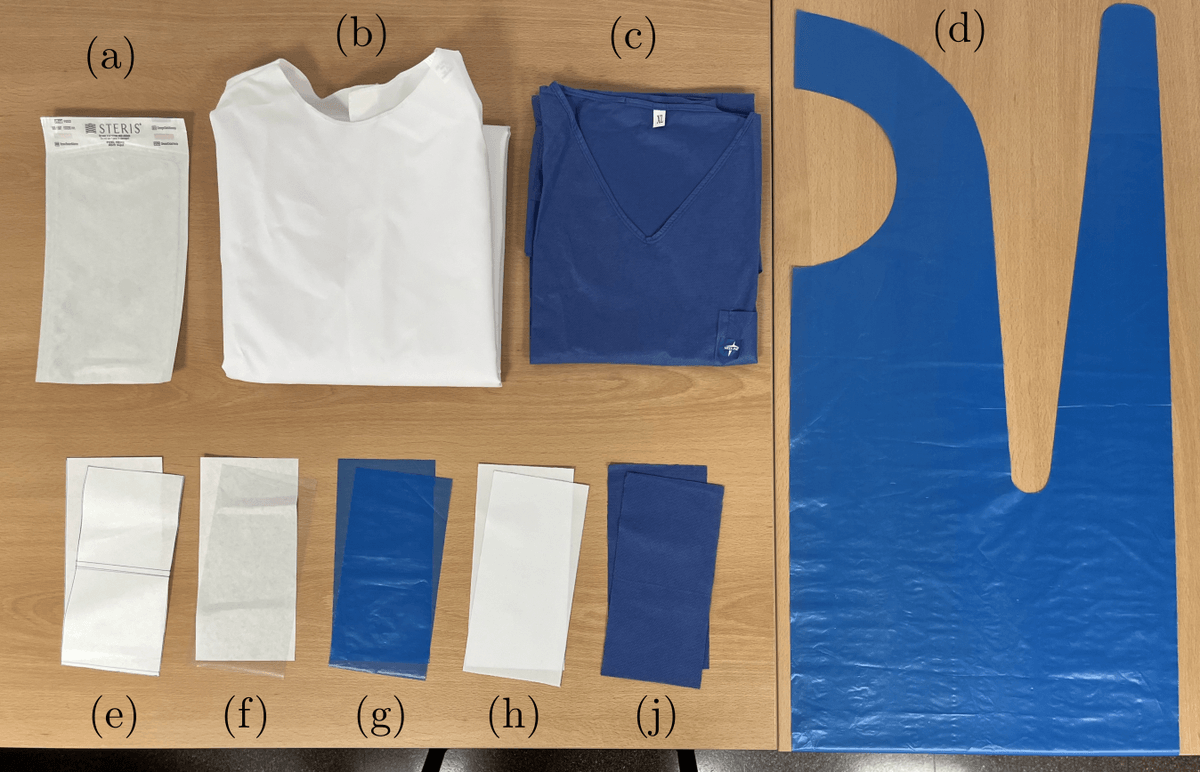
The authors ran a matrix of materials (paper-paper, plastic-paper, plastic apron, two medical coat fabrics) at penetration depths from 0 to -4 mm and roller speeds from 1 to 45 rev/min, 40 repetitions per cell. Without clamping, only paper-paper and thin plastic succeeded. Adding the compliant-finger clamp enabled reliable separation across every tested material. The most sensitive variable affecting performance is the normal force applied.
For grip strength, the gripper held pulling forces above 55 N before the flap slipped, with silicone-coated finger tips adding another 15 to 20 N. In full end-to-end trials with two arms, 30 fully sealed pouches and 30 with pre-opened side seams were tested; the dominant failure mode was paper tearing on fully sealed bags because the lateral seams force the flap into a sharp bend.

Availability and what it is not
The gripper design is in the patent process under an European Union patent, filed as EP24382974.4, so this is not an open-source hardware release. A supplementary video and additional details live on the project website, and the work is funded by the EU Horizon SoftEnable project on soft-object manipulation.
Two limitations are worth flagging. The system currently runs open-loop, without sensor feedback for path planning, and the authors have not benchmarked cycle time against a human nurse. For thin plastic aprons, the window of successful normal forces was very narrow, meaning autonomous deployment will require accurate force sensing. Beyond pouches, the same finger has already been repurposed to grasp the necks of folded medical gowns in related work on robotic dressing assistance, and pinch grasps of single sheets fall out for free.