
Baidu's GlobalRAG Beats Search-R1 Using 97% Less Training Data
A new RL framework from Baidu and Tsinghua fixes the two failure modes that break RAG on multi-hop questions, gaining 14.2% EM and F1 with 42% less data.
 Pro
Takeaways
- GlobalRAG is a new RL framework for multi-hop RAG from Baidu and Tsinghua, posting 14.2% EM/F1 gains.
- Identifies two root causes of RAG failure: absence of global planning and unfaithful execution, together over 94% of errors.
- Introduces Planning Quality Reward and Subgoal Completion Reward that score decomposition as a DAG against golden plans.
- Uses progressive weight annealing to shift from structure-first to accuracy-first rewards during training.
- Trains on just 8k trajectories versus 19k for StepSearch and 170k for Search-R1.
- Beats baselines on HotpotQA, 2Wiki, MuSiQue, Bamboogle, and WikiHop across Qwen2.5 and LLaMA-3.1 backbones.
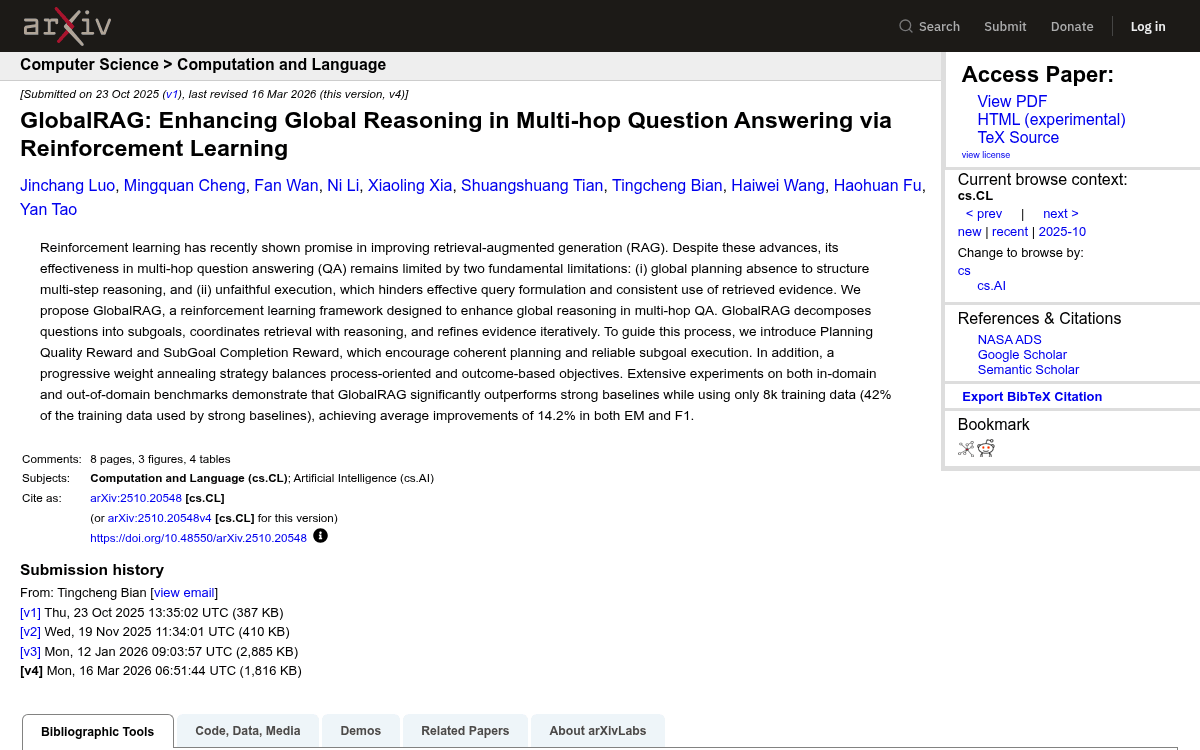
Reinforcement learning has become the go-to trick for teaching retrieval-augmented generation systems to actually reason before they search. Methods like Search-R1 and StepSearch train language models to interleave retrieval with thinking, but they still fall apart when questions require chaining together several pieces of evidence. A new framework called GlobalRAG, from researchers at Baidu and Tsinghua, argues the problem is not more retrieval steps but a missing global plan, and it posts 14.2% average gains in Exact Match and F1 across five multi-hop benchmarks while training on less than half the data of prior work.
Where existing RAG agents lose the plot
The team ran a diagnostic on Search-R1 across HotpotQA, 2WikiMultiHopQA, MuSiQue, Bamboogle, and WikiHop. On the subset of failures where the answer was never retrieved, two error modes dominated: absence of global planning (the model never lays out a coherent decomposition of the question) and unfaithful execution (retrieval and reasoning drift away from the intended subgoals). Together these accounted for over 94% of failures.

The intuition is simple. If you ask a model who Mary, Crown Princess of Denmark's mother is, a step-wise RL agent that only gets rewarded for the final answer may search for "Mary Crown Princess Denmark mother" once, get noisy results, and hallucinate. It never commits to the two-step structure (identify Mary's identity, then look up her mother) that the question demands.
Rewarding the plan, not just the answer
GlobalRAG treats each question as a directed acyclic graph of subgoals, where nodes are sub-questions and edges are dependencies. A teacher model builds a "golden" plan offline in three stages: global planning to decompose the question, subgoal execution using the same dense retriever as training, and final answer generation. Trajectories that violate topological constraints, exceed 15 retrieval attempts per subgoal, or produce wrong final answers are discarded.
During RL training with GRPO, the model gets rewarded on four axes beyond the usual final-answer signal:
- Structural Consistency Reward compares the graph edit distance between the rollout's plan DAG and the golden plan DAG, mapped to a similarity score in [0,1].
- Semantic Consistency Reward finds the maximum common subgraph via depth-first search, then measures cosine similarity between E5 embeddings of matched sub-questions.
- Subgoal Completion Reward uses token-level F1 to check whether the model's answer to each intermediate subgoal matches the golden answer.
- Outcome Reward is a binary exact-match check on the final answer.
The clever bit is the schedule. Early training emphasizes format, planning structure, semantics, and step execution, guiding the policy to construct and follow a coherent graph. Later training shifts weight toward the outcome signal to refine exactness without losing this discipline. A sigmoid-based weight w_t = 1 / (1 + exp((t - 0.9T)/10)) handles the crossover, with the transition point tuned to step 50.
Fewer tokens, more right answers
On Qwen2.5-7B-Instruct, GlobalRAG hits 38.2 EM on HotpotQA, 47.8 on 2Wiki, 14.9 on MuSiQue, 48.8 on Bamboogle, and 19.0 on WikiHop, beating StepSearch on every benchmark and posting the largest absolute gains on 2Wiki (+23.5% F1) and Bamboogle (+17.9%). The efficiency story is where things get interesting for anyone budgeting compute.

Using only 8k examples (42% of StepSearch's 19k, 4.7% of Search-R1's 170k), GlobalRAG achieves both 14.2% EM/F1 gains over StepSearch and 28.2% EM, 29.4% F1 gains over Search-R1. Ablations show that removing the subgoal completion reward causes the biggest drop (roughly 17.7% EM and 12.5% F1 on average), confirming that intermediate verification is doing most of the heavy lifting.
What it is good for, and where it breaks
The framework generalizes across backbones. Consistent gains are observed on Qwen2.5-3B/7B and LLaMA-3.1-8B, and improvements hold on both in-domain (HotpotQA, 2Wiki, MuSiQue) and out-of-domain (Bamboogle, WikiHop) benchmarks. If you are building an agent that has to chain evidence across documents, whether for enterprise search, literature review, or compliance workflows, this is the recipe worth copying.
The limitations are honest. The authors did not test on 14B or 32B models due to compute constraints, and they focus exclusively on multi-hop QA rather than single-hop or other reasoning tasks. The training still optimizes toward a single reference trajectory, even though the similarity-based reward permits partial credit for alternative valid plans. Most critically, the framework has no mechanism for real-time error correction: if the model produces a bad initial decomposition, it cannot revise the plan based on retrieval failures downstream.
The paper does not link a public code repository, so practitioners will need to reimplement the reward stack on top of a GRPO trainer like verl or trl. Given how much of the win comes from the DAG-based planning rewards rather than exotic model changes, that reimplementation looks tractable, and the ablation numbers give a clear order of priority: start with subgoal completion, then add structural and semantic plan rewards, then layer the annealing schedule on top.