
Avignon Université's SBARThez Cuts AI Hallucinations in Half While Summarizing 200 Languages
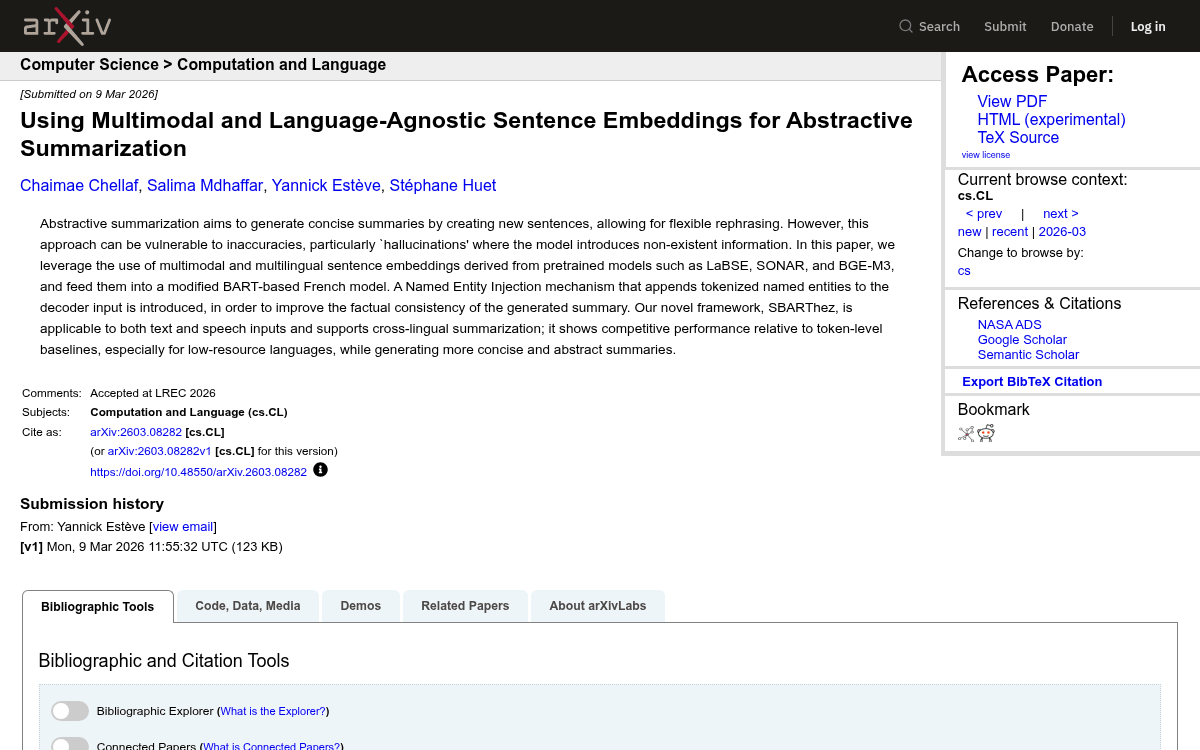
SBARThez replaces token-level encoding with sentence embeddings and a Named Entity Injection trick to cut hallucinations and unlock cross-lingual, speech-to-text summarization in one compact model.
 Pro
Takeaways
- SBARThez replaces token-level encoding with whole-sentence embeddings (BGE-M3, SONAR, LaBSE) fed into a modified 165M-parameter French BART model.
- A Named Entity Injection (NEI) mechanism prepends extracted entities to the decoder, cutting named-entity hallucination from 58% to 34% — matching human-written summaries.
- SBARThez generates more abstractive summaries than token-level models like BARThez, flanT5, and mBART-50, matching human abstractiveness scores.
- On low-resource cross-lingual summarization (CrossSum), it outperforms both translate-then-summarize pipelines and zero-shot LLaMA-8B across most languages, including Igbo, Kirundi, and Pidgin.
- The same model handles text and speech inputs natively, achieving near-identical BertScores on both modalities (35.07 text vs 35.05 speech).
- Training code is open-source at github.com/cchellaf/SBARThez; the paper is on arXiv.
Abstractive summarization , the kind where a model actually rewrites content rather than just copying sentences , has a persistent enemy: hallucination. Models that predict one token at a time tend to drift, quietly inventing names, places, and facts that never appeared in the source. A new paper from Avignon Université introduces SBARThez, a framework that attacks this problem from an architectural angle, swapping out the standard token-by-token encoder for whole-sentence semantic embeddings and adding a targeted mechanism to keep named entities grounded.
The token-level trap
Most summarization models , BART, T5, mBART , work at the token level. They read a document as a stream of subword pieces and predict the next piece, conditioned on everything before it. This works well for fluency, but it has two structural weaknesses for summarization specifically:
- Hallucination: the approach can be vulnerable to inaccuracies, particularly hallucinations where the model introduces non-existent information.
- Language lock-in: a model trained on French tokens cannot natively read Spanish or Japanese input. Cross-lingual summarization requires either a separate translation step or a massively multilingual model.
- Modality lock-in: text and speech live in completely different token spaces, so a text summarizer cannot directly consume audio.
The alternative, inspired by Meta's Large Concept Models work, is to encode entire sentences into dense vectors before any summarization happens. Large Concept Models operate in conceptual embedding spaces, moving away from traditional token-by-token processing and instead focusing on understanding and generating language at the conceptual level. SBARThez borrows this intuition but applies it at a fraction of the scale and compute, targeting the summarization task specifically rather than general-purpose language modeling.
Three embedding models, one decoder
The core idea is straightforward: split the input document into sentences, encode each sentence into a fixed-size vector using a pretrained multilingual embedding model, then feed that sequence of vectors into a modified BART decoder that generates the summary token by token as usual. The encoder never sees raw tokens , only dense sentence vectors.
The team evaluated three embedding backbones:
- BGE-M3: distinguished for its versatility in Multi-Functionality, Multi-Linguality, and Multi-Granularity , it can simultaneously perform dense retrieval, multi-vector retrieval, and sparse retrieval, and supports more than 100 working languages. It produces 1024-dimensional embeddings.
- SONAR: a new multilingual and multimodal fixed-size sentence embedding space whose single text encoder covers 200 languages. Crucially, speech segments can be embedded in the same SONAR embedding space using language-specific speech encoders trained in a teacher-student setting.
- LaBSE: a multilingual text-only model covering 109 languages, built on a dual-encoder BERT architecture, trained on massive datasets using masked language modeling and translation ranking tasks, producing 768-dimensional embeddings.
The seq2seq backbone is BARThez, a French-specific BART model. BARThez is a large-scale pretrained seq2seq model specifically tailored for French. With its BART-based architecture and a low computational footprint of 165M parameters, it has demonstrated strong performance in various generative tasks. To bridge the dimensional mismatch between embedding models and BARThez's expected input size, a linear projection layer followed by a GeLU activation function was introduced to normalize the inputs.
How it works, step by step
- The input document (text or audio) is split into sentences or speech utterances.
- Each sentence is encoded into a dense vector by one of the frozen embedding models (BGE-M3, SONAR, or LaBSE).
- If the embedding dimension does not match BARThez's expected 768-dim input, a learned linear projection layer rescales it.
- The sequence of sentence vectors is fed into the modified BARThez encoder (with the token embedding layer removed).
- The decoder generates the summary token by token, attending to the sentence-level encoder states.
- A Named Entity Injection (NEI) module prepends extracted named entities to the decoder's start tokens, steering generation toward factually grounded output.
The training is two-stage: first on the large French MLSUM dataset (392,876 document-summary pairs) to adapt the model to sentence embedding inputs, then fine-tuned on a task-specific dataset (OrangeSum for monolingual, WikiLingua or CrossSum for cross-lingual, DECODA for speech).
The hallucination fix
Before NEI, the results were sobering. SBARThez-BGE reaches a Named Entity Hallucination Risk (NEHR) of 58.52%, indicating that more than half of its named entities are hallucinated. This is the direct cost of operating purely in semantic space , the model understands the meaning but loses track of specific proper nouns.
Named Entity Hallucination Risk (NEHR) is a metric that measures what fraction of named entities in the generated summary do not appear in the source document. The fix is elegant: run a French NER model (camembert-ner) over the input, extract entities with confidence above 0.9, format them as (Entity, Type) pairs, tokenize them, and prepend them to the decoder's input sequence at both training and inference time. The decoder then has explicit access to the names it should be using before it generates a single word of the summary.
The results after NEI are striking. SBARThez-BGE originally hallucinated over half of the named entities, but with the addition of the NE injection module, the NEHR decreased to 34%, comparable to the ground truth. For reference, human-written summaries themselves have a 34.01% NEHR , because humans paraphrase entities too (writing "France" instead of "French Republic").
More abstract, not just more accurate
The deeper story in the results is about abstractiveness. Token-level models are, by design, copy machines. One notable aspect of token-level encoding models is their extremely high P-R1, EFC, and EFD values, indicating an over-reliance on copying from the source document. For example, BARThez uses over 90% of the words in its generated summaries that are present in the source document.
SBARThez-BGE, by contrast, matches human-level abstractiveness scores (P-R1: 78.54 vs ground truth 78.36; EFC: 72.30 vs 72.84) while staying competitive on ROUGE-L and BertScore. The model generates shorter, more condensed summaries , it compresses rather than selects.
Cross-lingual and speech: where it shines
The real payoff of the sentence-embedding approach is cross-lingual generalization. Because the embedding models map semantically equivalent sentences from different languages to nearby vectors, SBARThez can summarize documents in languages it was never explicitly trained on , without any translation step.
On the CrossSum benchmark (cross-lingual summarization across 24 languages, all summarized into French), SBARThez-BGE outperforms both a translate-then-summarize pipeline and a zero-shot LLaMA-8B across all low-resource languages tested. Languages such as Igbo, Kirundi, and Pidgin were not seen in the training of the BGE embedding model. Despite this limitation, SBARThez-BGE still achieves strong results and outperforms all other methods on these languages. For Kirundi and Pidgin, the translate-then-summarize baseline could not even run because no suitable MT systems exist for those languages.
For speech, the model integrates with SONAR's speech encoders and SAMU-XLSR to directly consume audio utterances. SBARThez-BGE achieves a BertScore of 35.07 on the text test-set and 35.05 on the speech test-set, demonstrating consistent performance across modalities. The model also proves robust to automatic audio segmentation: simple 5-second fixed-length chunks perform nearly as well as ground-truth speaker-turn boundaries.
Limitations to know
SBARThez is not a drop-in replacement for token-level models on standard benchmarks. On OrangeSum, BARThez still leads on ROUGE-L (22.57 vs 20.22) and NEHR. The paper also has a few structural constraints worth noting:
- The entire framework is built around French output. Extending to other target languages requires retraining on new data.
- The NER system used (camembert-ner) only recognizes PER, ORG, and LOC entities , it misses domain-specific entities like phone numbers or prices, which hurt performance on the DECODA call-center speech dataset.
- Factual consistency metrics for French are immature; the team had to rely on NEHR as a proxy rather than more sophisticated consistency evaluators.
- The approach has only been validated on summarization; its usefulness for other generation tasks remains untested.
What is now possible
The practical unlock here is a single compact model (165M parameters) that can ingest French text, multilingual text from dozens of languages, or raw audio , and produce a French abstractive summary, without a translation step, without an ASR transcription step, and without the hallucination rates that plague purely semantic approaches. SBARThez is applicable to both text and speech inputs and supports cross-lingual summarization, showing competitive performance relative to token-level baselines, especially for low-resource languages, while generating more concise and abstract summaries.
The training code is publicly available at github.com/cchellaf/SBARThez, making it straightforward to adapt the framework to other target languages or embedding backbones. For teams building multilingual document intelligence pipelines , especially for languages where large supervised datasets do not exist , this architecture offers a practical and resource-efficient path forward.