
AVFakeBench Exposes How Badly AI Fails at Explaining Modern Deepfakes
A new benchmark tests whether audio-video language models can spot forgeries beyond faces, and finds them strong at yes/no but weak at explaining why.
 Pro
Takeaways
- AVFakeBench introduces the first audio-video forgery benchmark covering non-human scenes and mixed edit-synthesis manipulations.
- 3,000 clips and 12,000 QA pairs span 11 scenarios, 7 forgery type combinations, and 4 annotation levels.
- A multi-stage pipeline uses proprietary LMMs to plan forgeries and expert generators like KLING to execute them.
- AV-LMMs beat specialized deepfake detectors on binary real-or-fake judgment across both human and general scenes.
- Performance collapses on fine-grained classification: Gemini 2.5 Pro drops to 7.5% F1 on edited forgeries.
- Models are vision-dominant and biased toward predicting real, with near-zero performance on audio-only forgeries.
Deepfake detection research has spent years staring at faces. But the newest wave of generative models can fabricate anything from a disaster scene to a bird taking flight, complete with matching audio, and the benchmarks used to measure detection have not kept up. A team from Beijing University of Posts and Telecommunications and UC Santa Barbara just released AVFakeBench, a benchmark built to test whether audio-video large multimodal models (AV-LMMs) can actually catch modern forgeries and, more importantly, explain them.
Why current benchmarks fall short
Early datasets focus almost exclusively on human-face manipulations, restricting their applicability to broader scenes or subjects, and treat forgery as a binary classification task without modeling hybrid manipulations that combine editing and synthesis. That leaves a large blind spot. A model tuned to catch lip-sync artifacts on a talking head has no idea what to do with a synthesized wave crashing on a shoreline or an edited scene where only a boat in the background has been erased.
AVFakeBench extends beyond human-centric deepfake manipulations to cover both human and general subjects across 11 diverse real-world scenarios, containing 3,000 paired audio-video clips. It interleaves three data types (real, edited, and synthesized) across audio and video modalities to form seven distinct multimodal forgery combinations. Scenarios include natural landscapes, animals, transportation, industrial operations, alarm signals, and science, in addition to human speech.

The forgery factory
Building 1,500 general-subject fakes by hand would be impossibly tedious, so the authors built a pipeline that separates planning from execution. The framework separates forgery intent planning from modality-specific manipulation, enabling precise control over both editing and synthesis processes. Concretely, a proprietary LMM proposes what to change and where. Then specialist generative models actually do the work.
For synthesis, an image-to-video model like KLING takes a first frame plus a motion description and generates video, and the generated video is subsequently passed to a Video-to-Audio generator to produce temporally aligned audio that reflects the scene dynamics. For editing, the LMM writes an instruction such as removing a small boat, and either a closed-source video editor or a mask-based pipeline using SAM2 does the surgical work. Human reviewers check every stage.

Four tasks, one uncomfortable finding
The benchmark grades models on four escalating tasks:
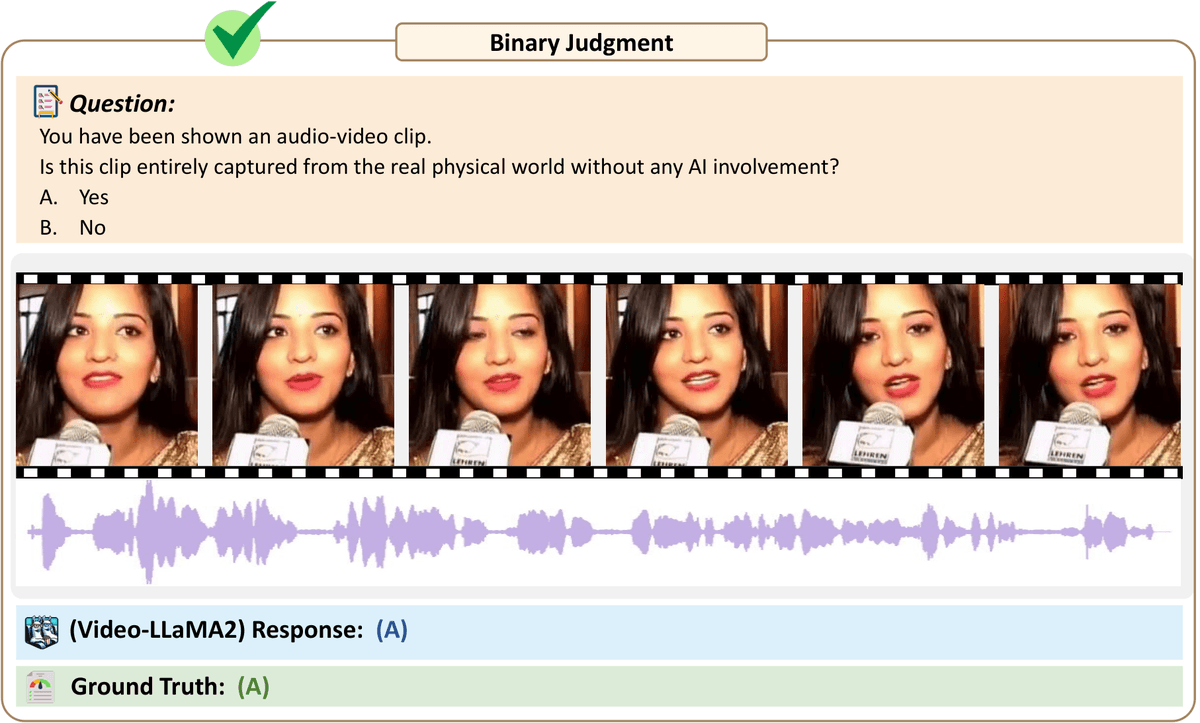
- L1 Binary Judgment: is this real or fake?
- L2 Forgery Classification: which of the seven audio-video combinations is it?
- L3 Detail Selection: pick the most salient forgery artifact from five options.
- L4 Explanatory Reasoning: describe what was manipulated, where, and how.
The team ran 5 open-source AV-LMMs and 6 proprietary AV-LMMs, covering different model types and scales, alongside two expert deepfake detectors. On binary judgment, the AV-LMMs actually beat the specialized detectors. Expert detection models perform poorly even on the human subject with F1-Scores of 45.0% and 51.7%, and further degrade substantially on general subject (18.9-34.3% F1). This indicates that these models rely heavily on face-centric deepfake artifacts and fail to detect forgeries outside their narrow training domain. Gemini 2.5 Pro reached around 60% overall F1.
Then the ceiling collapses. Compared with T1, all AV-LMMs show a substantial performance drop on T2, with even the best-performing Gemini-2.5-Pro reaching only 19.2% F1. Edited forgeries, the localized, low-visibility manipulations that most resemble real-world tampering, are hardest. Even the strongest model, Gemini-2.5-Pro, achieves only 7.5% F1, far below its performance on real or synthetic samples.
Vision-heavy, audio-blind
A clean cross-modal split exposes an uncomfortable pattern. Most AV-LMMs perform noticeably better on video forgeries while collapsing almost entirely on audio forgeries. For example, OneLLM and Video-LLaMA2 achieve 18.8% and 14.7% F1 on video-only forgeries but fall to 0.0 on audio-only forgeries, and even advanced closed-source AV-LMMs such as GPT-4o show a sizable gap (8.0 vs. 21.7). These are supposedly audio-visual systems, yet they mostly ignore the audio channel when hunting for fakes.
There is also a bias problem. A large subset of models including OneLLM, Video-LLaMA2, and closed-source AV-LMMs show a strong bias toward the Real Audio and Real Video category. These patterns indicate that most AV-LMMs do not learn reliable multimodal manipulation cues. When uncertain, they guess real.

What this is good for, and what it is not
AVFakeBench is a diagnostic. It is useful if you are training or evaluating a multimodal forgery detector and want to know how it handles non-face content, mixed edit-and-synthesis pipelines, or explanation quality. The benchmark's fine-grained annotations let you distinguish a model that guesses correctly from one that can actually point to the artifact.
It is less useful as a training set on its own. At 3,000 clips it is sized for evaluation, not for fitting large detectors. And because forgery quality depends on the specific generators used to build it, models tuned aggressively against these particular artifacts risk overfitting to KLING-style synthesis or SAM2-mask editing rather than learning general forgery cues.
The paper does not currently announce a public code or dataset release URL in its abstract or main text, so practitioners interested in using it will likely need to watch the authors' follow-up releases. The real takeaway is sobering: the current generation of AV-LMMs can tell you something is off, but ask them to explain why and they mostly hallucinate confident, wrong rationales. Closing that gap between detection and explanation is the next research frontier this benchmark makes measurable.