
AutoEP Lets Open-Source Qwen3-30B Match GPT-4 at Tuning Optimization Algorithms
A new framework uses large language models as zero-shot reasoning engines to tune metaheuristic algorithm hyperparameters on the fly, no training required.
 Pro
Takeaways
- AutoEP tunes metaheuristic hyperparameters online using LLMs as zero-shot reasoners, no training required. Paper
- Combines Exploratory Landscape Analysis features with a three-agent Chain of Reasoning pipeline (Strategist, Analyst, Actuator).
- Qwen3-30B with the CoR pipeline matches GPT-4 and GPT-o1 at roughly one-tenth the runtime.
- Beats RL tuner GLEET and LLM-based EoH/ReEvo across TSP, CVRP, FSSP, and UAV trajectory optimization benchmarks.
- Plug-and-play across GA, PSO, and ACO; average decision latency is around 30 milliseconds per call.
- Open-source code at github.com/YiZheZhang12/AutoEP, designed for local deployment.
Tuning hyperparameters for optimization algorithms has always been a frustrating dark art. You either hard-code human intuition into brittle rules, or you burn millions of algorithm runs training a reinforcement learning policy that overfits to your training distribution. A new framework called AutoEP proposes a third path: skip training entirely and let a large language model reason about the search dynamics in real time.
AutoEP is a framework that bypasses training entirely by leveraging Large Language Models as zero-shot reasoning engines for algorithm control. The interesting twist is that it enables open-source models like Qwen3-30B to match the performance of GPT-4 on this task, which makes the approach genuinely deployable rather than API-dependent.
The exploration-exploitation headache
Metaheuristics like genetic algorithms, particle swarm optimization, and ant colony optimization are workhorses for combinatorial problems, but they hinge on a delicate balance between exploration (searching broadly) and exploitation (drilling into promising regions). That balance is governed by hyperparameters like mutation rate and crossover probability, and the optimal setting shifts as the search progresses.
Existing approaches have real limitations. Manual rule-based strategies embed expert knowledge into predefined rules but are problem-dependent and require extensive manual calibration. Deep reinforcement learning tuners like GLEET can learn adaptive policies, but they face prohibitive sample complexity, requiring millions of algorithm executions to train a single policy, and poor generalization, where policies often overfit to the training distribution.
Sense, reason, act
AutoEP operates as a closed-loop control system with three stages running throughout the optimization. First, it senses the state of the search using Exploratory Landscape Analysis (ELA), a set of quantitative metrics that summarize what's happening in the population. Second, a chain of LLMs reasons about that state. Third, it applies new hyperparameters and observes the outcome.

The ELA module extracts a small but expressive set of features from the current population:
- Skewness and kurtosis of the fitness distribution, which flag whether the population is balanced, converging prematurely, or lacking diversity
- Coefficient of determination (R squared) from fitting a simple quadratic model to solutions, which estimates how structured or rugged the fitness landscape is
- Dispersion ratio, comparing the spatial spread of the best 10% of solutions against the worst 10%, to detect single-funnel versus multi-modal structures
- Variability, a rate-of-change indicator comparing recent mean fitness to older generations, to catch stagnation
These features turn the black-box state into a machine-readable summary that grounds the LLM's reasoning in empirical data rather than vibes.
A chain of specialized LLMs
Rather than dump everything into one monolithic prompt, AutoEP decomposes reasoning across three roles. The Strategist LLM runs once at the start, receiving the problem and chosen metaheuristic, and generates a static control mapping that defines the qualitative effect of each hyperparameter on the search process. For example, it maps mutation rate to the concept of boosting exploration.
At each decision point, the Analyst LLM digests the current ELA features plus recent history and issues a strategic directive like "Increase Exploration." The Actuator LLM then translates that directive into concrete numerical hyperparameter values, using in-context examples from an experience pool of past states and outcomes to calibrate how aggressive the adjustment should be.
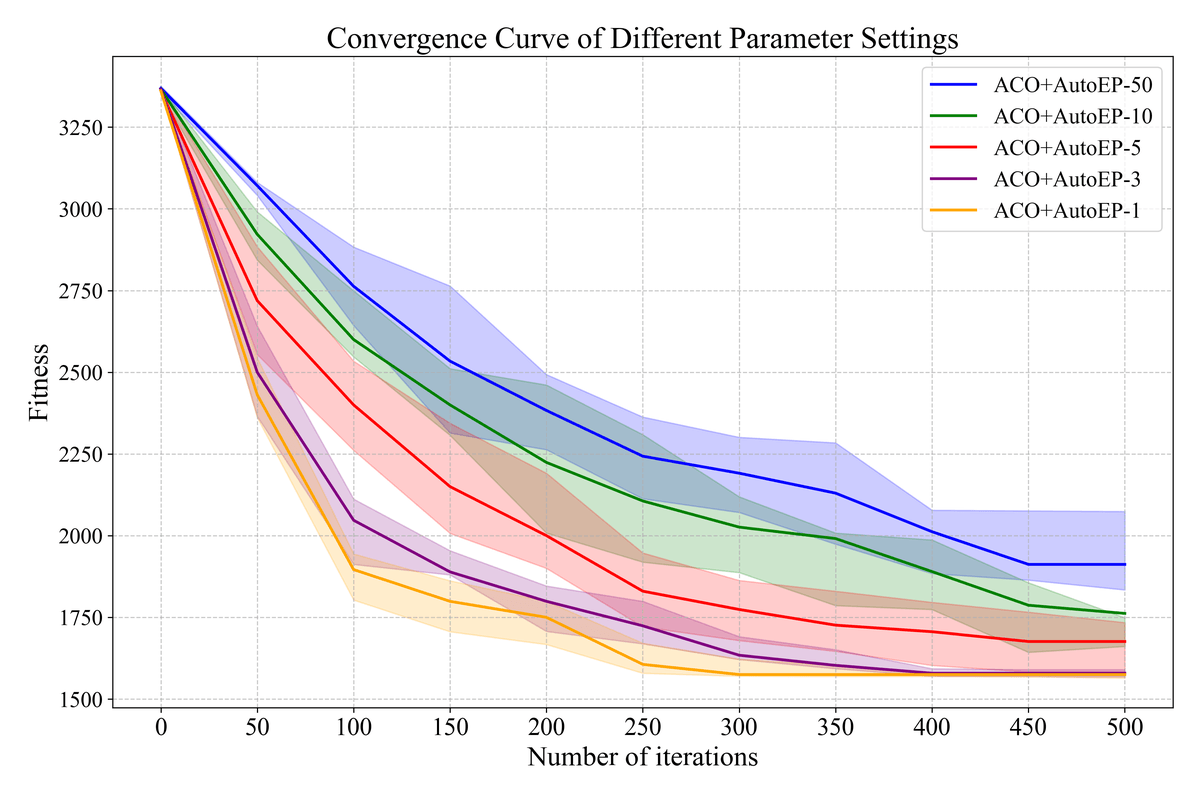
To keep prompts manageable, AutoEP uses a sliding window over its experience pool. The default setting of L=20 strikes the optimal balance, providing sufficient history for trend analysis while maintaining low inference latency and filtering out obsolete data. Feeding full history actually degraded performance because early-stage metrics became noise later on.
Results across four benchmarks
The team tested AutoEP with GA, PSO, and ACO across TSP, CVRP, FSSP, and a UAV trajectory optimization task, comparing against manual tuning (PT), Bayesian optimization (BEA), the RL-based GLEET, and LLM-based operator generators like ReEvo and EoH.
On TSP, GA-2opt with AutoEP hit optimality gaps of 0.00% on eil51 and 0.01% on rd100 and kroa150, beating specialized neural combinatorial optimizers like DACT and LEHD. On the UAV task with 300 sensor nodes, AutoEP improved ACO's baseline performance by roughly 17%. On flow shop scheduling with 500 jobs, it cut the optimality gap from GA-2opt's 7.83% down to 2.83%.

Perhaps the most practical finding: swapping the multi-LLM Chain of Reasoning for a single call to GPT-o1, Claude 3.7, Gemini 2.5 Pro, or DeepSeek-R1 produced similar solution quality but took roughly an order of magnitude longer. On the eil51 benchmark, CoR with Qwen3-30B ran in 5.8 minutes versus 44 to 54 minutes for the proprietary reasoning models. Ablations also confirmed both ELA and CoR are essential: removing ELA leaves the LLM reasoning blind, and removing CoR collapses performance to near-baseline.
When it fits and when it doesn't
This is a plug-and-play controller for population-based metaheuristics, so it's a natural fit for classical combinatorial problems: routing, scheduling, trajectory planning, and similar domains where you already have a working GA, PSO, or ACO but want better solution quality without retraining anything. The inference overhead is small: the average inference latency per decision is negligible (30 ms), and over an entire optimization run the total added time is minimal.
The framework has real limits, though. It doesn't touch the operators themselves, only the hyperparameters, so it can't rescue a fundamentally weak algorithm. It's built for combinatorial optimization with discrete metaheuristics, not continuous black-box optimization or ML hyperparameter tuning in the Optuna sense. And on very short runs the LLM overhead may not pay for itself. For long runs, users can reduce adjustment frequency to every 3 to 5 iterations and keep most of the gains.
Code is available on GitHub, and the design deliberately targets local deployment with 30B-class open-source models, which matters for factory scheduling, logistics, and other settings where sending problem data to a proprietary API is a non-starter.