
Athens Team Wins SemEval RAG Challenge by Rewriting Queries 5 Ways
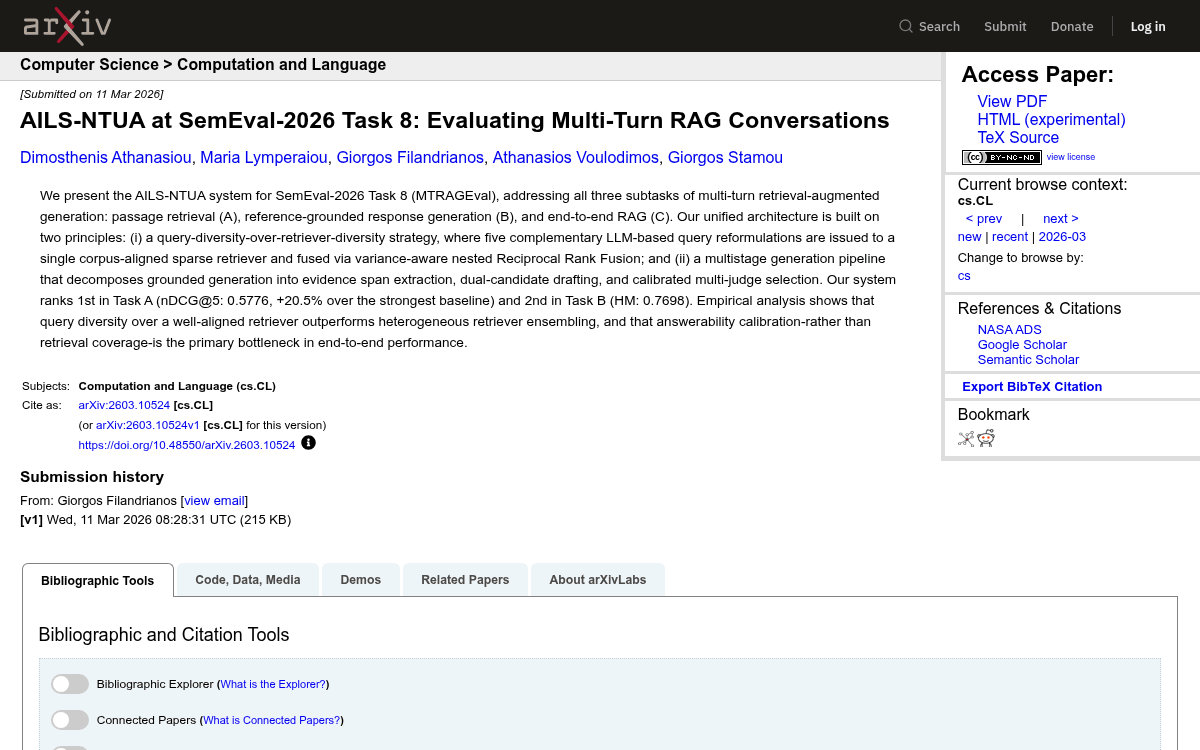
A Greek research team topped SemEval-2026 Task 8 by ditching the standard retriever ensemble in favor of five LLM-rewritten queries hitting a single sparse index.
 Pro
Takeaways
- AILS-NTUA won Task A (nDCG@5: 0.5776, +20.5% over baseline) and placed 2nd in Task B at SemEval-2026 Task 8.
- Their key insight: five complementary LLM query rewrites into one aligned sparse retriever beats ensembling multiple retrievers.
- Nested Reciprocal Rank Fusion separates high-precision rewrites (Minimal, Corpus-Specific) from high-variance ones (HyDE, CoT, Anchor-Keyword).
- Generation pipeline extracts verbatim spans, generates dual candidates, then uses multi-judge selection with an extractiveness shaping term.
- Model routing across DeepSeek-V3.2, GPT-4o, and GPT-4o-mini matches uniform GPT-4o quality at one-third the cost.
- Answerability calibration, not retrieval coverage, is the primary bottleneck in end-to-end multi-turn RAG performance.
Everyone building retrieval-augmented generation systems eventually hits the same wall: single-turn benchmarks look great, but the moment you drop the pipeline into a real conversation, small errors compound turn after turn and the system starts hallucinating with confidence. A team from the National Technical University of Athens has just published the winning entry to SemEval-2026 Task 8 (MTRAGEval), and their headline result is a design choice that inverts conventional RAG wisdom.
Instead of ensembling multiple retrievers, they use one retriever and rewrite the query five different ways. Their system ranks 1st in Task A (nDCG@5: 0.5776, +20.5% over the strongest baseline) and 2nd in Task B (HM: 0.7698). Along the way they surface a finding that reframes what actually breaks in end-to-end multi-turn RAG.
The benchmark that punishes shortcuts
MTRAGEval is built on IBM's MTRAG benchmark and is deliberately harder than the RAG evals most teams tune against. It consists of 110 human-authored multi-turn conversations comprising 842 annotated turns, and conversations average 7.7 turns and exhibit high passage diversity (16.9 unique relevant passages per conversation), making retrieval and generation performance strongly turn-dependent. The task splits into three subtasks:
- Task A: retrieve the top 10 passages given the conversation history and current query
- Task B: generate a grounded response when reference passages are provided
- Task C: the full end-to-end RAG pipeline, retrieval plus generation plus knowing when to refuse
The corpora span four wildly different domains, from Wikipedia (ClapNQ) to StackExchange finance (FiQA) to government policy and cloud technical documentation. Approximately 87% of turns are non-standalone, and conversations contain on average 1.3 co-references, meaning almost every query depends on something said earlier.
Why multi-turn kills naive RAG
The paper reframes multi-turn RAG as a retrieval stability problem. Without rewriting, ELSER R@5 drops from 0.89 (first turn) to 0.47 (later turns), a 51% relative decrease. Every turn where the retriever misses the right passage poisons the context available to future turns, and generation quality collapses in step.
The authors' framing is that a good architecture has to explicitly separate context preservation, evidence discovery, and answer commitment, and stabilize each stage independently rather than piling on bigger models.
Five rewrites, one index
For Task A, the team generates five complementary reformulations of the current query using DeepSeek-V3.2, each targeting a different failure mode:
- Minimal: resolves pronouns and conversational omissions without adding new terminology
- Corpus-Specific: adapts phrasing to domain vocabulary (Wikipedia style, finance tickers, CLI flags, and so on)
- HyDE: generates a hypothetical answer passage, bridging the vocabulary gap between question and document
- Chain-of-Thought: expands the information need through step-by-step reasoning
- Anchor-Keyword: extracts entities and salient keywords for sparse lexical matching
All five queries hit a single sparse index, Elasticsearch Learned Sparse Encoder (ELSER v1), which the MTRAG creators used during annotation and therefore aligns naturally with the ground truth. The five ranked lists are then merged via a two-level Reciprocal Rank Fusion scheme.
The nested structure matters. Minimal and Corpus-Specific produce stable, high-precision rankings, while HyDE, CoT, and Anchor-Keyword are higher variance. The pipeline pre-aggregates the noisy three into a Weak Consensus ranking, then fuses that with the two stable strategies using corpus-specific weights. This prevents any single bad rewrite from injecting noise into the top ranks.
The ensemble paradox
The paper's most counterintuitive finding is what they call the multi-retriever ensemble paradox. Standard practice for hybrid retrieval is to stack retrievers of different types. The team tried it, and found that once the base retriever is well-tuned, adding more retrievers actively hurts. As rewriting improves ELSER (R@5: 0.483 to 0.607), ensemble gains reverse: unique documents from other retrievers appear at ranks 37 to 54 on average and introduce fusion noise. Thus R@100 improves but R@5/10 degrades, favoring single-retriever, multi-query architecture.
In other words, if your retriever already covers the gold documents, alternative retrievers mostly surface those same documents at worse ranks, and the fusion math pushes borderline good hits out of the top-k. Query diversity over one aligned retriever beats retriever diversity.
An agentic pipeline for generation
For Task B, the team decomposes grounded generation into five stages:
- Answerability check: unanswerable turns trigger a calibrated refusal
- Evidence span extraction: DeepSeek-V3.2 pulls up to 8 verbatim sentences from the top 5 passages, which then replace full passages as input to the generator
- Dual candidate generation: GPT-4o produces two candidates, one greedy and one with slight temperature variation
- Multi-judge selection: a technical judge scores faithfulness, a user-satisfaction judge (invoked on 60% of turns) scores naturalness, combined with an extractiveness shaping term
- Micro-adjustments: light editing to fix length or hedging violations
The extractiveness shaping function is a nice touch. It rewards responses that fall in a 4-gram overlap band of 28 to 38% with the extracted spans, penalizes under-extractive answers (hallucination-prone) harder than over-extractive ones, and matches the empirical band where dev-set references cluster (mean 36.2%).
Model routing keeps costs down. DeepSeek-V3.2 handles structured tasks like extraction and technical judging, GPT-4o generates the actual response, and GPT-4o-mini handles lightweight steps. Model routing achieves comparable results to uniform GPT-4o usage at one-third the cost.
What the ablations reveal
The paper is unusually candid about what did not work:
- LLM-based reranking: no gains over weighted RRF, at 20 to 200x the cost
- Passage-Informed Rewriting (feeding first-stage results back to the rewriter): tracks the seed signal but never exceeds it, because once R@100 saturates the bottleneck is ranking precision, not coverage
- Naive query rewriting with smaller models: FlanT5 rewrites actually degrade retrieval below the unaugmented baseline
The recurring theme: once R@100 exceeds ~0.95, the retrieval bottleneck shifts from coverage to top-k ranking precision, where additional signals add more noise than information.
The real bottleneck nobody solved
The most sobering result comes from Task C, the end-to-end setting. The system's HM score drops from 0.7698 on Task B to 0.5409 on Task C, and the culprit is not retrieval or generation, it is knowing when to refuse. Our system achieves 83.9% accuracy but only 21.8% unanswerable recall, revealing a strong acceptance bias. The pattern remains stable across prompt variants and voting rules, suggesting a structural bias toward semantic plausibility over abstention.
The team ran three specialized judges in parallel, a document judge, a span judge, and an answer judge, with an arbiter combining them via confidence-weighted voting. Error analysis shows document- and span-grounded judges often correctly reject insufficient evidence, while the answer-grounded judge accepts plausible responses. LLM judges prioritize semantic plausibility over evidence availability.
This matters practically because the test set was much harsher on refusals than the dev set. The unanswerable rate nearly triples (19.1% vs. 6.5%), substantially amplifying the answerability bottleneck. Systems tuned on dev were structurally unprepared.
When to reach for this
If you are building a conversational RAG system over a defined corpus, the practical takeaways are concrete:
- Invest in a single retriever that aligns well with your data before ensembling
- Push complexity into query rewriting, using multiple diverse LLM reformulations with rank fusion
- Extract verbatim evidence spans before generation, do not feed the LLM full passages
- Use judge-based selection between multiple candidates rather than trusting one greedy decode
- Do not underinvest in the abstention path, it is likely your dominant failure mode in production
The paper is a useful blueprint for teams shipping multi-turn RAG in high-stakes domains where confidently wrong answers are worse than a refusal. And it is a reminder that the frontier is not always about bigger models; sometimes it is about routing capability to the right stage and admitting when the evidence is not there.