
Athens Researchers' Federated GNN Hits 96% Accuracy Steering Satellite Beams
A hierarchical federated learning setup with graph neural networks predicts optimal satellite beams at 96% accuracy without shipping raw channel data to the ground.
 Pro
Takeaways
- Athens NTUA researchers propose federated beam selection for LEO satellites using orbital planes as clients.
- GNN hits 96.14% Top-1 beam prediction accuracy versus 88.41% for an MLP baseline.
- HAPS act as edge aggregators; FedAvg runs at a ground-based network control center.
- Both models stay small (38-71 KB) and train in seconds, feasible for satellite payloads.
- GNN tracks the oracle beam-switching rate closely, giving more stable links at low elevation.
- Evaluation is simulation-only with static users; interference and mobility left for future work.
Beam management in Low Earth Orbit satellite networks is a moving target, quite literally. Satellites race across the sky at kilometers per second, propagation conditions shift by the second, and picking the right beam to point at a user on the ground has traditionally meant either exhaustive searches or heavy channel state feedback. A new study from a team at the National Technical University of Athens tackles this with a federated learning framework that turns entire orbital planes into distributed learners, and shows that a graph neural network can predict the best beam with 96% accuracy while keeping raw data off the wire.
Why beam selection is hard above the clouds
Sixth-generation systems lean heavily on large-scale MIMO and beamforming to compensate for the brutal path loss of satellite links. In a non-terrestrial network (NTN), each satellite carries an antenna array that can steer energy in fixed azimuth and elevation directions defined by a beam codebook. Choosing the right entry in that codebook is what keeps the signal-to-noise ratio high enough to be useful.
The conventional approach is to estimate channel state information (CSI) and pick the beam that maximizes SNR. Conventional beam selection approaches such as CSI-based estimation suffer from computational complexity, signaling overhead, and limited adaptability, making them sub-optimal for dynamic NTN deployments. Centralizing the learning by shipping every satellite's channel measurements to a ground station only makes the overhead worse.
Orbital planes as federated clients
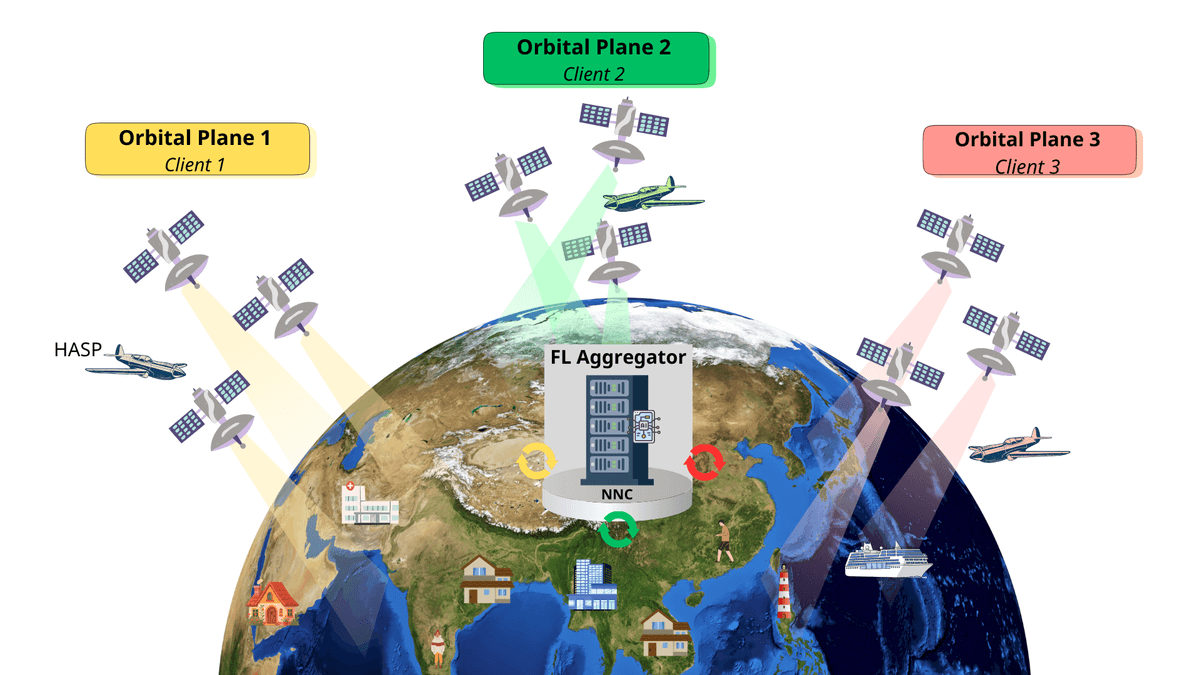
The authors treat each orbital plane as a single logical federated learning client, with satellites in that plane coordinating through a High-Altitude Platform Station (HAPS) that sits in the stratosphere and acts as an edge aggregator. Local training happens on the plane's data, and only model weights move around.
The scheme works in three tiers:
- Satellites in an orbital plane feed channel and geometry data to their HAPS aggregator.
- The HAPS trains a plane-level model for a fixed number of local epochs (200 in the experiments) and forwards weights, not raw data, downward.
- A ground-based Network Control Center runs FedAvg across all planes and broadcasts the aggregated global model back for the next round.
This preserves data locality, reduces communication overhead, and captures the non-IID data distributions induced by distinct orbital geometries. Different planes see different portions of the sky, so their local datasets are genuinely different distributions rather than random shards of a common one.
The simulation setup
The scenario uses an S-band LEO constellation with a 2 GHz downlink and altitudes between 1015 and 1325 km, built on top of MathWorks' LEO mega-constellation reference model. Each satellite carries a 4x4 uniform planar array with a fixed beam codebook, and ground UEs are filtered in only when their elevation angle to the satellite exceeds a minimum threshold. The system runs for two hours across 1,000 snapshots, and for each visible link the satellite evaluates every candidate beam to build the training set. The supervised target is the beam index that maximizes SNR under a channel model that includes path loss, elevation-dependent Rician fading, temporally correlated shadowing, and receiver noise.
MLP versus GNN
Two architectures are trained under the same federated setup. The MLP uses fully connected layers with non-linear activations and evaluates each candidate beam independently, making it a lightweight geometry-driven predictor. The GNN, by contrast, treats each beam as a node in a graph connected to its neighbors and uses graph convolutions so that beams can share information about local signal quality with their spatial neighbors, an inductive bias that matches how real beam patterns behave.
The results show a clear but not free win for the graph model:
| Metric | MLP | GNN |
|---|---|---|
| Top-1 accuracy | 88.41% | 96.14% |
| Top-3 accuracy | 98.03% | 99.52% |
| Mean per-client Top-1 | 89.15% | 95.97% |
| Training time | 6.27 s | 19.23 s |
| Model size | 38.4 KB | 71.4 KB |
The GNN buys roughly 8 percentage points of Top-1 accuracy for about 3x the training time and 2x the parameters. Both models are tiny, which matters when the inference has to run on a satellite payload or HAPS with a strict energy budget.
Elevation angle changes everything
The headline number hides an important detail: performance depends heavily on how high the satellite sits in the sky relative to the user. Both models get more accurate as elevation angles increase and propagation conditions become friendlier, but the gap between them widens at low elevations where fading and shadowing hit hardest.

Beam switching rate tells a similar story. All approaches switch beams more often at low elevations due to increased channel dynamics, fading, and shadowing, but the GNN closely follows the oracle switching trend derived from the maximum-SNR beam, while the MLP exhibits slightly higher switching at low elevation. In practical terms, that means fewer unnecessary handovers and more stable links when conditions are worst.
What this is and isn't useful for
The framework is aimed squarely at LEO mega-constellations doing codebook-based beam selection, where the geometry between satellite and user changes fast but is knowable in advance from ephemeris data. It should slot in cleanly for operators who already have HAPS or similar aerial nodes in their architecture and want to avoid piping raw CSI to the ground.
A few caveats are worth flagging:
- The evaluation is simulation-only, using MATLAB's LEO mega-constellation reference scenario and a Fontan-Espineira propagation model rather than measured channel traces.
- Users are static, so mobility-driven Doppler and rapid pointing changes are not stressed.
- Interference between satellites and between users is not modeled; the authors flag interference-aware beam management as future work.
- No code or trained model has been released alongside the paper.
The broader takeaway is that the geometry of a satellite constellation is itself a strong inductive bias, and graph neural networks that respect the spatial relationships between beams can extract most of the accuracy an oracle would deliver, while federated aggregation across orbital planes keeps the training loop compatible with the bandwidth and privacy realities of space-to-ground links.