
Athens Lab's RViT Drops 75% of Satellite Pixels and Keeps 98.5% Accuracy
A systematic study finds Earth observation imagery is so spatially redundant that vision transformers can drop 75% of input patches and lose almost nothing.
 Pro
Takeaways
- New study shows Earth observation vision transformers keep ~98.5% accuracy while using ~4x fewer GFLOPs.
- RViT and RViT-UPerNet drop 50-75% of image patches during training and inference.
- Uniform random masking matches or beats similarity-based strategies, suggesting redundancy is diffuse.
- Results hold across 7 datasets, sensors from Sentinel to UAV, and resolutions from 20cm to 10m.
- BigEarthNet keeps 99.4% baseline accuracy with just 15% of patches retained.
- Cross-channel and temporal redundancy remain unexplored; no public code released yet.
Satellite and aerial imagery has a dirty secret: most of the pixels do not matter. A new investigation into how vision transformers process Earth Observation (EO) data shows that models can throw away three quarters of every image and still hit roughly 98.5% of the accuracy of a model that sees the whole picture, while cutting compute by around 4x. The finding holds across tasks, sensors, resolutions, geographies, and model sizes, which is unusual enough to be worth taking seriously.
The paper, Hide and Seek: Investigating Redundancy in Earth Observation Imagery, comes out of the Orion Lab at the National Observatory of Athens. The authors argue that EO data has a structural property that natural-image research has quietly benefited from but never really measured in the satellite domain: a pile of overlapping information across spectral bands, time steps, adjacent pixels, and repeating semantic concepts.
Why satellite pixels repeat themselves
EO imagery does not look like ImageNet. It is multispectral, with up to dozens of channels beyond the visible RGB spectrum, and multi-temporal, with images captured at regular intervals from nearly constant viewpoints. As a result, EO scenes contain strong spatial and spectral redundancy, while temporal evolution arises from recurring seasonal patterns rather than object motion. A forest tile looks like the forest tile next to it. A wheat field in July looks like the same field a week later. Ocean pixels are, overwhelmingly, ocean.
This is why masked autoencoders for satellites have worked so well: Earth observation images contain vast regions that are irrelevant to the given task, whose exclusion has minimal impact on inference results. But existing work treated masking as a pretraining trick. The Orion Lab team asks the sharper question: is redundancy a first-class property of the domain that we should exploit at training and inference time, on any architecture, for any downstream task?
RViT: a vision transformer that drops patches on purpose
The tool for the investigation is a Redundancy-aware Vision Transformer (RViT), plus a segmentation variant RViT-UPerNet. The pipeline is straightforward:

- Split the image into non-overlapping patches like a standard ViT.
- Apply a masking strategy that keeps only a subset of patches.
- Feed just those tokens through the transformer, discarding the rest entirely so self-attention runs on a much shorter sequence.
- For segmentation, scatter the retained tokens back to their original grid positions, zero-fill the holes, and hand the reshaped feature maps to an UPerNet decoder.
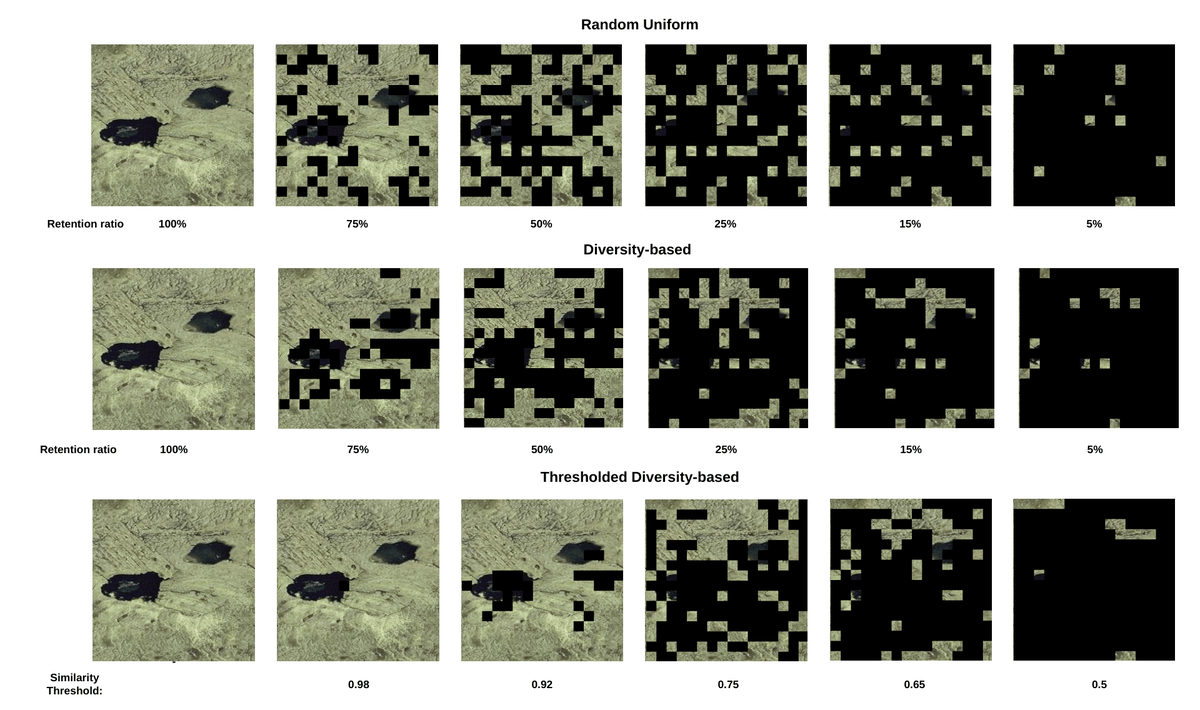
Because self-attention is quadratic in sequence length, dropping patches compounds savings quickly. The team tests three masking strategies with deliberately different assumptions:
- MS1 (uniform random): pick patches at random with a fixed retention ratio. Zero prior knowledge.
- MS2 (diversity-based): compute pixel-space cosine similarity and greedily keep the most dissimilar patches, maximizing coverage of visual variety.
- MS3 (thresholded diversity): keep any patch whose maximum similarity to every other patch falls below a threshold, letting the retention ratio adapt per scene.
The punchline is that MS1, the dumbest of the three, matches or beats the informed strategies at equivalent retention ratios. Random selection turns out to be a strong baseline because the redundancy is diffuse rather than concentrated in specific regions.
What holds up across seven datasets
The team ran the experiments across a deliberately varied benchmark: BigEarthNet and its coarser 5-class variant for Sentinel-1/2 land cover classification, MLRSNet for multi-sensor scene understanding, MARIDA for Sentinel-2 marine debris detection, and three high-resolution aerial datasets (Woody, Waititu, and FLAIR) for tree species and land cover segmentation. Resolutions span 20 cm to 10 m per pixel, coverage spans Europe, France, Chile, New Zealand, and global.
The numbers are consistent enough to matter:
- On BigEarthNet, retaining just 15% of patches (roughly 9 tokens) preserves about 99.4% of baseline performance.
- On MLRSNet, retaining 25% of patches yields about 98.9% of baseline with a ~4x reduction in GFLOPs and memory.
- On FLAIR (512x512 high-resolution segmentation), 50% retention recovers about 97% of baseline at ~2x fewer GFLOPs, cutting a 1024-patch sequence in half.
- Under extreme masking of 5%, MLRSNet still keeps within ~6% of baseline, at 20x fewer GFLOPs during training and 10x at inference.
Segmentation is more sensitive than classification, as you would expect when boundaries matter, but the trend holds. On MARIDA, where tiny debris targets sit inside huge sea regions, aggressive masking can obliterate whole objects, so 75% retention is the safe zone. On tasks with big, spatially spread targets like tree canopies in UAV imagery, you can drop far more.
The findings that generalize
Four results stand out beyond the raw benchmark numbers:
- Redundancy is not a resolution artifact. Downscaling MLRSNet from 224x224 to 32x32, or FLAIR from 512x512 to 64x64, preserves the same relative impact of masking. Ground sampling distance is not the driver.
- Redundancy is not a granularity artifact. Coarse 5-class BigEarthNet and fine-grained 19-class BigEarthNet show the same tolerance curves.
- Redundancy-aware training does not hurt transfer. Linear probing shows that features learned under aggressive masking transfer as well as or slightly better than features from full-input baselines, likely because the model is forced to lean on the most discriminative signals.
- Patch size is orthogonal. The trends survive across ViT patch sizes, so you can use finer patches for accuracy without paying the usual compute tax.
What this is good for, and what it is not
The practical implication is that EO pipelines have been leaving a lot of compute on the table. For pretraining large satellite foundation models, for onboard inference where power and bandwidth are tight, and for edge deployment on drones or ground stations, dropping 50 to 75% of patches is a nearly free lunch. The pattern of aggressive spatial redundancy also matches results from independent lines of work on the domain: experiments randomly masking data at inference show that masking an average 40% of satellite data results in only 6.92% accuracy degradation.
The current study limits itself to spatial redundancy. Cross-channel and temporal redundancy, which are arguably where the biggest wins live given the tens of spectral bands and years of history in modern archives, are called out as future work. RViT-UPerNet also still runs its decoder on the full spatial grid via zero-token scattering, so segmentation gains are capped at around 2x until someone designs a decoder that truly skips masked positions. And on tasks like marine debris detection, where the target class occupies a tiny fraction of the image, uniform random masking is risky.
The paper does not currently ship code or pretrained weights alongside the arXiv release, which is a real gap for a study whose value is largely methodological. The good news is that RViT is a thin wrapper over any ViT-Small, Base, or Large initialized from ImageNet weights, and the three masking strategies are simple enough to reimplement in a weekend. For anyone training or serving EO models today, running MS1 at 25 to 50% retention is the kind of ablation worth doing before the next compute purchase order goes out.