
ASU's GlucoNet Beats Transformers by 36% While Running on a Raspberry Pi
A hybrid LSTM plus Transformer model splits glucose signals by frequency, then distills the Transformer down to about 10,900 parameters for edge deployment.
Takeaways
- GlucoNet forecasts blood glucose by decomposing the CGM signal into low and high frequency bands with Variational Mode Decomposition.
- An LSTM handles slow trends while a Transformer handles rapid fluctuations, running in parallel.
- Knowledge distillation shrinks the Transformer to roughly 10,900 total parameters for edge deployment.
- Achieves 10.03 mg/dL RMSE at 30 minutes and 16.13 mg/dL at 60 minutes on OhioT1DM, beating PatchTST by 33-36%.
- Generalizes to the larger AZT1D cohort of 25 patients with 14.12 mg/dL RMSE at 60 minutes.
- Code available on GitHub, runs at 26 ms inference on Raspberry Pi 5.
Forecasting blood glucose is one of those problems where accuracy and efficiency pull in opposite directions. Transformers capture the messy, non-stationary patterns in continuous glucose monitor (CGM) traces well, but they are too heavy to sit inside a wearable that has to react within seconds. A team from Arizona State University has proposed GlucoNet, a hybrid architecture that decomposes the glucose signal by frequency, routes each band to a specialized model, and then distills the Transformer branch down to something that fits on a Raspberry Pi.
Why glucose is a nasty time series
Continuous glucose monitors are now available as over-the-counter commodities, yet forecasting the values they produce remains hard. Levels shift constantly in response to food, medication, physical activity, sleep, and stress, and predicting them from multimodal, irregularly sampled inputs over long horizons compounds the difficulty. The models also need to run in real time on edge hardware to enable in-the-moment interventions.
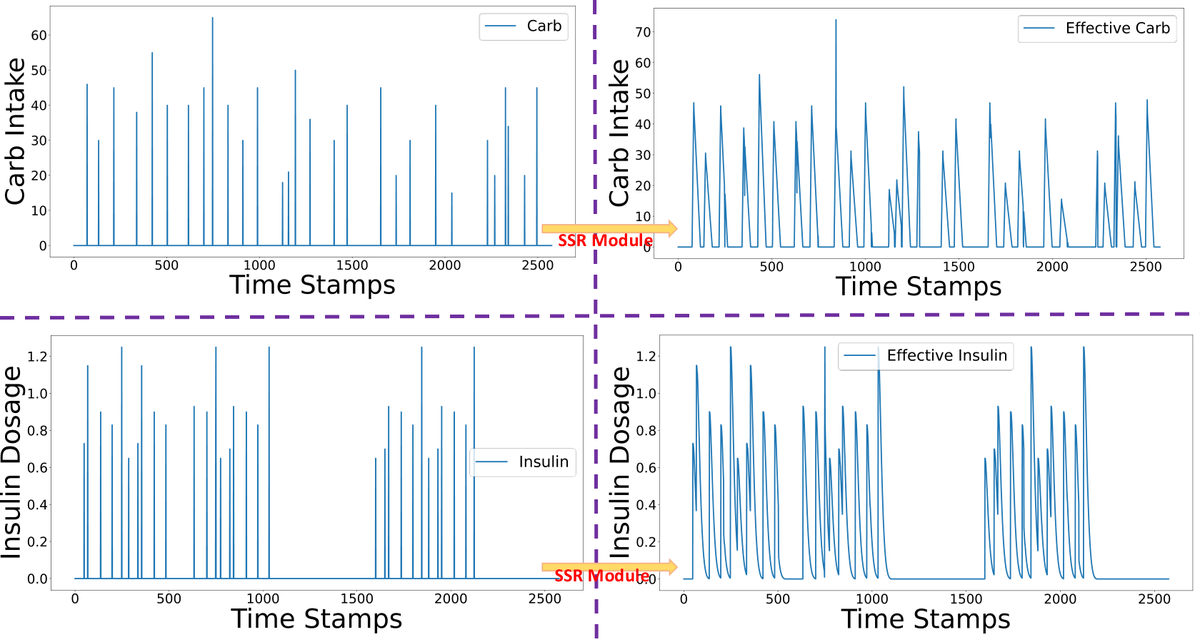
Two things push this beyond a typical time-series problem. Meal logs and insulin doses arrive as sparse discrete events, while CGM readings arrive every five minutes as a continuous signal. And CGM sensors measure interstitial fluid, not blood, so readings lag actual glucose by roughly 5-10 minutes and drift 9-12% away from ground truth on commercial systems. A forecaster fed only raw CGM has to implicitly reconstruct everything else going on physiologically.