
ASU's Flare Finds Hidden Bias in AI Without Peeking at Demographics
Flare uses Fisher Information geometry to find hidden underperforming subgroups in health sensing models without ever touching demographic labels.
 Pro
Takeaways
- Flare finds and repairs hidden underperforming subgroups without any demographic labels, using Fisher Information curvature.
- Three-stage pipeline: autoencoder pretraining, GMM+UMAP latent clustering, and do-no-harm cluster adaptation.
- Introduces BHE metric suite: Beneficence, Harm Avoidance, Equity, going beyond statistical parity.
- On OhioT1DM: +4.28% Beneficence, +4.72% Harm Avoidance, +0.92% Equity over baselines.
- Demographic-based fairness baselines produced negative Beneficence, meaning they harmed users on average.
- Validated on EDA, IHS, OhioT1DM, and Percept-R mobile health sensing datasets.
A team from Arizona State University has proposed a fairness framework that does something most fairness methods explicitly need to do: peek at demographic labels. Flare (Fisher-guided LAtent-subgroup learning with do-no-harm REgularization) instead reads the geometry of the model's own loss landscape to find populations it is quietly failing, and then repairs them without dragging down anyone else.
The setup is aimed at ubiquitous health sensing, where wearables and phones make decisions about people from noisy physiological and behavioral signals. In such contexts, achieving high accuracy alone is insufficient; models must also act ethically and equitably across diverse populations, but fair AI approaches that rely on demographic attributes are impractical, as such information is often unavailable, privacy-sensitive, or restricted by regulatory frameworks. That is a real constraint for anyone shipping clinical or workplace ML today.
The problem with parity
Standard fairness methods try to equalize error rates across protected groups. That works only if you know the groups, and it can misfire even then. Conventional parity-based fairness approaches, while aiming for equity, can inadvertently violate core ethical principles by trading off subgroup performance or stability. Pulling one group up by pushing another down technically closes the gap but harms real users.
The other complication is that harm is often hidden. Hidden heterogeneity in physiology, behavior, context, and device usage often yields uneven performance across subgroups, many of which are latent. Consequently, models that perform well on average can still systematically underserve specific groups, embedding inequities into decision pipelines. A stress detector trained on wrist sensors might quietly collapse on people with darker skin tones, thicker wrists, or certain arrhythmias, without any label telling you so.
Curvature as a fairness signal
Flare's core idea is to look for those hidden groups in the shape of the loss surface. When a model is confident and generalizes well, the loss around its parameters is flat. When it is barely holding on, the loss is sharply curved and a small perturbation would flip predictions. Measuring that curvature exactly requires the Hessian, which is far too expensive for real networks, so the authors use a standard trick. Because computing full Hessians is prohibitive at scale, following the literature, we adopt Fisher Information as a tractable surrogate that preserves key curvature properties.
Flare leverages optimization geometry, particularly the Fisher Information, to regularize curvature, uncovering latent disparities in model behavior without access to demographic or heterogeneous attributes. By integrating representation, loss, and curvature signals, it identifies hidden performance strata and adaptively refines them through collaborative but do-no-harm optimization. In plain terms, samples that sit in sharp, unstable regions of the loss surface are treated as evidence of an underserved subgroup even if no label ever says so.

How the pipeline works
Flare runs in three stages on top of a fairly standard backbone. Each dataset uses an autoencoder-classifier backbone tailored to its modality, with dataset-specific architectures for OhioT1DM, IHS, EDA, and Percept-R. These pretrained autoencoder-classifier networks serve as the initialization stage for Flare, on which it performs cluster-specific adaptation and cross-cluster aggregation.
- Base pre-training. An encoder learns latent representations, a classifier head predicts, and a symmetric decoder reconstructs, giving the model both discriminative and representational signal.
- Latent clustering. UMAP compresses the embeddings and a Gaussian Mixture Model groups samples using representation similarity, prediction loss, and Fisher-derived curvature response jointly. Each cluster is a candidate latent subgroup.
- Cluster adaptation and aggregation. Per-cluster fine-tuning is combined with a Fisher-based classification loss and a do-no-harm constraint, so improving a struggling cluster is not allowed to degrade another one.
The stability part matters ethically as well as numerically. Through Fisher-informed curvature regularization, Flare learns smoother loss landscapes and more stable decision boundaries, reducing sensitivity to perturbations and enhancing generalizability, thus reinforcing the ethical principle of autonomy through stability and reliability.
A new scorecard: BHE
Because standard fairness metrics let you "win" by hurting people, the authors introduce their own suite. BHE (Beneficence-Harm Avoidance-Equity) is a metric suite that operationalizes ethical fairness beyond statistical parity. Beneficence tracks whether performance actually went up on average, Harm Avoidance flags whether any subgroup got worse, and Equity measures how tight the spread across subgroups became. A method that closes the gap by degrading a group registers negative Harm Avoidance and fails the test.
Results across four health sensing datasets
Flare was benchmarked on mobile physiological, behavioral, and clinical sensing datasets, including EDA, OhioT1DM, IHS, and Percept-R. OhioT1DM is the well-known type-1 diabetes glucose management dataset, EDA covers electrodermal activity for stress, and IHS captures behavioral signals.

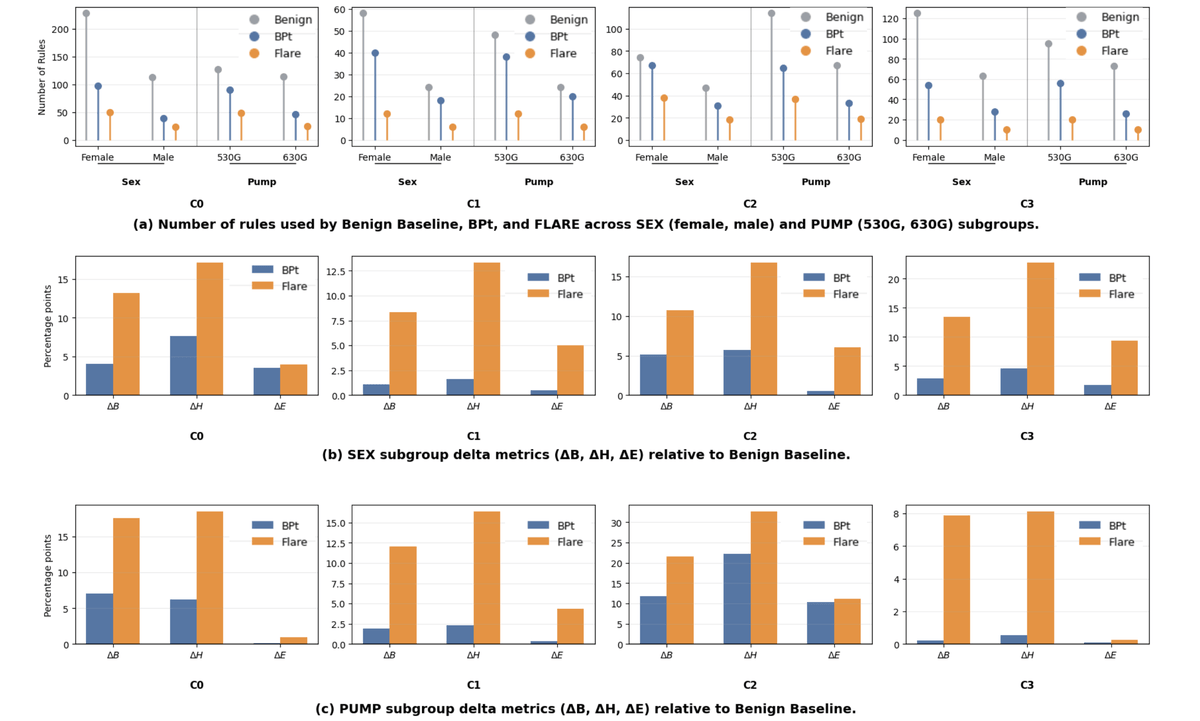
The pattern is consistent. On OhioT1DM, Flare achieves mean improvements of +4.28%, +4.72%, and +0.92% across Beneficence, Harm Avoidance and Equity, while both fairness-with-demographics baselines still produce negative mean Beneficence. On Percept-R, Flare reaches +4.15%, +7.34%, and +3.32%. The negative numbers from parity-based baselines are the telling part: those methods statistically look fairer while actually making the average patient worse off.
The authors argue the improvements are structural rather than incidental. Ablation study, rule-based interpretability, and loss-landscape analyses show that these gains arise from flatter optimization geometry, simpler and more consistent model decision rules.
Where it fits, and where it does not
Flare is designed for a very specific regime. It is most useful when you cannot legally or practically collect demographic labels, when the population is heterogeneous in ways you cannot enumerate ahead of time, and when the cost of silently harming a subgroup is high, think clinical monitoring, mental health prediction, or workforce analytics. It is also relevant in privacy-sensitive settings that align with recent regulatory shifts. Recent U.S. policy developments, such as updates to the Health and Human Services nondiscrimination rule and new federal AI governance frameworks, emphasize equitable and privacy-oriented ML in healthcare.
Some honest caveats. Flare inherits the assumption that the clusters GMM finds in latent space actually correspond to meaningful subgroups, which is not guaranteed if the encoder itself is biased. Fisher approximations to curvature are cheaper than Hessians but still add non-trivial compute, and the pipeline is heavier than a single-shot classifier because of the per-cluster adaptation stage. It is validated on physiological, behavioral, and clinical sensing tasks with modest-sized cohorts, so the story for large-scale vision or language fairness is still open. And a public code release is not advertised in the current preprint from the latest arXiv version, so practitioners will likely have to reimplement the three stages from the paper's description of the autoencoder-classifier backbone and Fisher-regularized clustering loss.
The larger contribution is conceptual: rewriting the fairness problem as one of loss-landscape geometry instead of protected-attribute bookkeeping. That reframing is what lets Flare deliver improvements to underserved subgroups without ever asking who they are, and it is what makes BHE a stricter test than parity, because a method that harms anyone to look fair simply fails.